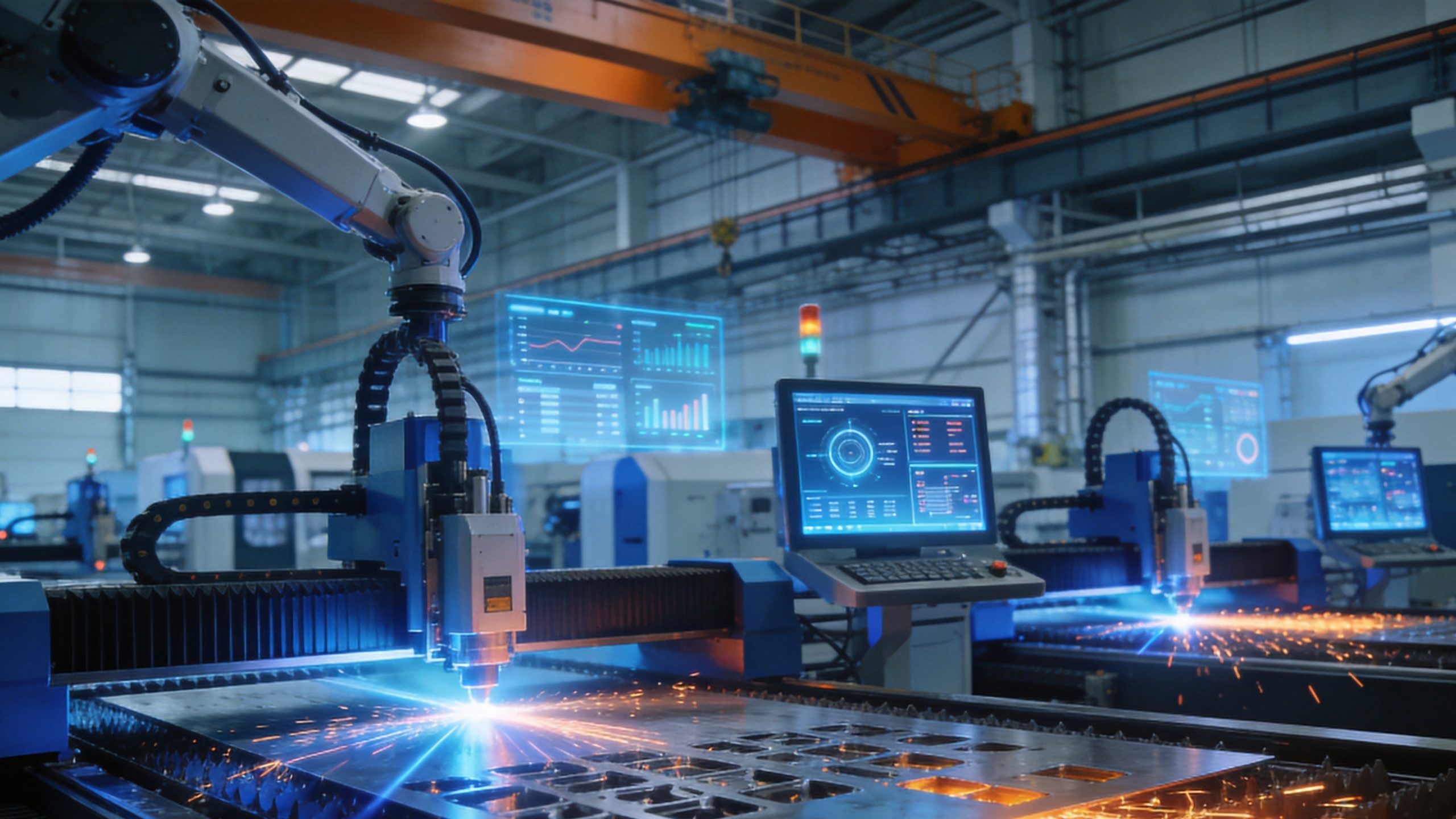
The laser manufacturing industry is moving faster than ever. Every year, fiber lasers get more powerful, more affordable, and more capable — and the pace of change shows no signs of slowing down. For metal fabricators, keeping up with these trends isn’t just about staying competitive — it’s about understanding where the industry is headed so you can make smart investment decisions.
2026 has already been a landmark year for laser technology. Power levels that were cutting-edge just two years ago are now standard. Prices have dropped dramatically. And new technologies like AI-assisted cutting, automated material handling, and multi-process machines are changing what’s possible on the shop floor.
In this article, we’ll break down the most important laser industry trends for 2026 and 2027 — what’s happening, why it matters, and what it means for your fabrication business.
1. Higher Power, Lower Cost: The Fiber Laser Price Revolution Continues
The biggest story in laser cutting continues to be the steady increase in power and the steady decrease in price.
Power Levels Keep Climbing
But here’s the thing: for most sheet metal shops, the practical benefit of going from 6000W to 12000W is real but diminishing. The biggest speed gains happen when going from 1500W to 3000W, and then 3000W to 6000W. Beyond 6000W, the speed gains on thin and medium material are smaller — though the ability to cut thicker material is a real benefit.
Prices Keep Falling
Perhaps even more important than rising power is falling price:
This price collapse has put fiber laser technology within reach of small and medium-sized shops that couldn’t afford it just a few years ago. And the trend shows no sign of stopping — as production volumes increase and laser source costs continue to fall, prices will keep coming down.
What this means for you: If you’ve been waiting for the right time to invest in a fiber laser, there’s never been a better time. The technology is mature, the prices are low, and the ROI calculations are more compelling than ever. That said, don’t buy more power than you need — 3000W or 6000W is plenty for most sheet metal shops.
2. Automation and Lights-Out Manufacturing
Labor costs keep rising, and skilled machine operators are harder to find than ever. The answer for more and more fabricators: automation.
Automated Loading and Unloading
Automatic material loading and unloading systems used to be a luxury reserved for high-volume production shops. Now they’re becoming standard equipment for mid-sized fabricators too.
- Auto-loaders automatically feed raw sheets into the machine
- Auto-unloaders remove finished parts and skeletons
- Tower storage systems hold multiple sheets of different materials and thicknesses
- Part sorting systems automatically separate and organize cut parts
The benefit? One operator can manage multiple machines, and many shops run their lasers unattended for 4–8 hours after the day shift ends — essentially doubling production capacity without adding labor.
Robotic Integration
Robots are increasingly paired with laser machines for:
Lights-Out Production
The ultimate goal of automation is lights-out manufacturing — running the machine completely unattended overnight or on weekends. While not every shop can achieve full lights-out operation, many are getting close:
What this means for you: Even if you’re not ready for full automation, consider machines that are automation-ready. A machine with a standard automation interface can be upgraded later as your business grows. And even simple auto-loading can dramatically increase your effective production capacity.
3. Multi-Process Machines: Cut, Weld, Clean, Mark — One Machine
One of the most interesting trends in recent years is the rise of multi-process laser machines that can do more than one job.
3-in-1 Handheld Machines (Weld + Clean + Cut)
Handheld laser machines that can weld, clean, and cut with a simple head change have exploded in popularity. These machines — typically 1000W, 1500W, or 2000W — are incredibly versatile for job shops, repair operations, and small fabrication businesses.
- Welding: The primary function for most users
- Cleaning: Remove rust, paint, oil, and weld discoloration
- Cutting: Cut thin sheet metal (up to ~3mm with 1500W)
The ability to switch between processes in seconds makes these machines extremely useful for shops that handle a variety of work.
Combined Cutting and Welding Systems
Larger integrated systems that combine laser cutting with robotic laser welding are also emerging. These systems can cut blanks and then weld them into finished assemblies — all in one cell.
Why This Matters
What this means for you: If you’re a small shop or job shop with diverse work, a multi-process machine might be the most cost-effective way to get into laser technology. For larger shops with high volume in a single process, dedicated machines are usually still the better choice.
4. AI and Smart Software Are Making Lasers Easier to Use
Artificial intelligence and advanced software are quietly transforming laser machines — making them easier to set up, more consistent, and less dependent on skilled operators.
AI-Assisted Parameter Setting
Getting the right cutting parameters used to require an experienced operator who knew the machine inside and out. Now, many machines include AI-assisted parameter databases that automatically suggest optimal settings based on:
Just select the material and thickness, and the machine sets everything else automatically.
Automatic Fault Detection and Diagnosis
Modern laser machines can detect problems and suggest solutions:
Some systems can even automatically compensate for minor issues, reducing downtime and scrap.
Smart Nesting and Production Planning
Advanced nesting software uses AI to:
Remote Monitoring and Predictive Maintenance
IoT connectivity allows manufacturers and machine owners to:
What this means for you: Look for machines with modern, user-friendly software and AI-assisted features. These features don’t just make the machine easier to use — they directly reduce scrap, reduce downtime, and improve productivity. The gap between a good operator and a great operator narrows significantly with smart software.
5. The Rise of Laser Welding in Sheet Metal Fabrication
While laser cutting has been mainstream for years, laser welding is the fastest-growing laser application in sheet metal fabrication.
Why Laser Welding Is Booming
Handheld Laser Welders: The Game-Changer
The biggest driver of laser welding’s growth is the handheld laser welder. These portable machines — essentially a laser source on wheels with a handheld gun — have made laser welding accessible to every size of shop.
- Price point: $3,000–$8,000 puts it within reach of almost any shop
- Ease of use: Much easier to learn than TIG welding
- Versatility: Weld steel, stainless steel, aluminum, brass, and more
- ROI: Often pays for itself in weeks or months through labor savings and increased production
What’s Coming in Laser Welding
What this means for you: If you do any welding in your shop and haven’t looked at laser welding recently, it’s time to take another look. The technology has improved dramatically and the prices have dropped significantly. For sheet metal fabrication especially, laser welding is rapidly becoming the new standard.
6. Laser Cleaning Moves from Niche to Mainstream
Laser cleaning — using laser light to remove rust, paint, oil, and contaminants from metal surfaces — is another fast-growing application.
Why Laser Cleaning Is Taking Off
Price Drops Drive Adoption
Just like with other laser technologies, falling prices are driving adoption:
Key Applications
What this means for you: If you’re still using sandblasting, chemical stripping, or manual grinding for surface cleaning and rust removal, a laser cleaner could save you time and money. The ROI is especially strong for shops that currently spend a lot of labor on manual cleaning or sandblasting.
7. UV and Green Lasers: Expanding the Range of Markable Materials
Fiber (infrared) lasers dominate metal marking, but UV and green laser markers are gaining ground for applications where fiber lasers struggle.
What UV and Green Lasers Do Better
Prices Are Coming Down
UV and green lasers used to be very expensive — $50,000+ was common. Now, entry-level UV laser markers are available for $10,000–$20,000, making them accessible to more shops.
What this means for you: If you’re only marking standard metals like steel and aluminum, a fiber laser marker is still the best choice. But if you need to mark copper, gold, glass, plastics, or ultra-fine features, it’s worth looking at UV and green laser options.
8. Chinese Manufacturers Continue to Disrupt the Market
Chinese laser machine manufacturers have transformed the global laser industry — and their influence continues to grow.
How China Changed the Market
What’s Driving This
Quality and Support: The Real Concerns
It’s not all upside, of course:
What this means for you: Buying from a Chinese manufacturer can be a great decision — if you choose the right one. Look for companies with: a proven track record, English-speaking technical support, clear warranty terms, and references from customers in your country. The lowest price isn’t always the best deal — support and reliability matter more.
9. Sustainability and Energy Efficiency Become More Important
As energy costs rise and environmental regulations get stricter, energy efficiency and sustainability are becoming more important factors in laser machine purchasing decisions.
Fiber Lasers Are Already Efficient
Compared to CO2 lasers, fiber lasers are much more energy efficient:
The Green Manufacturing Trend
What this means for you: Energy efficiency might not be your top concern when buying a laser machine, but it adds up over time. A more efficient machine saves money on electricity every single day. And as environmental regulations tighten, having cleaner production methods can become a competitive advantage.
10. The Growing Importance of Service and Support
As laser machines become more powerful and more complex, the quality of after-sales service becomes increasingly important.
Why Support Matters More Than Ever
What to Look for in a Supplier
Transon Laser invests heavily in customer support, with 24/7 English-speaking technical support, comprehensive training, and fast spare parts shipping worldwide. For fabricators investing in laser equipment, good support isn’t a nice-to-have — it’s essential for protecting your investment.
What This Means for Your Business: Key Takeaways
So what do all these trends mean for metal fabricators? Here are the key takeaways:
1. There’s Never Been a Better Time to Invest
Laser technology is better and more affordable than ever. If you’ve been on the fence about adding laser cutting, welding, cleaning, or marking to your capabilities, now is the time to act.
2. Don’t Buy More Than You Need
With all the talk of high-power machines, it’s easy to overbuy. For most sheet metal shops:
3. Automation Is Worth Considering
Even if you’re not ready for full lights-out production, features like auto-loading and smart software can significantly boost productivity.
4. Choose Your Supplier Carefully
The machine is only as good as the support behind it. Price matters, but reliability, support, and spare parts availability matter more in the long run.
5. The Industry Will Keep Changing Fast
The laser industry isn’t slowing down. New technologies, lower prices, and better capabilities will keep coming. The best strategy is to invest in machines that meet your current needs with some room to grow — and to work with suppliers that keep their machines updated.
Final Thoughts
The laser manufacturing industry is in a period of rapid transformation. Power is going up, prices are going down, and new technologies like AI, automation, and multi-process machines are expanding what’s possible.
For metal fabricators, this is both an exciting time and a challenging one. The opportunities are enormous — but so is the risk of falling behind if you don’t keep up.
The good news is that you don’t need to adopt every new technology at once. Start with the one that makes the most sense for your business — whether that’s a fiber laser cutter, a handheld laser welder, a laser cleaning machine, or a laser marker. Master it, get a return on your investment, and then expand from there.
And remember: the best time to invest in laser technology was five years ago. The second-best time is today.
Further Reading: