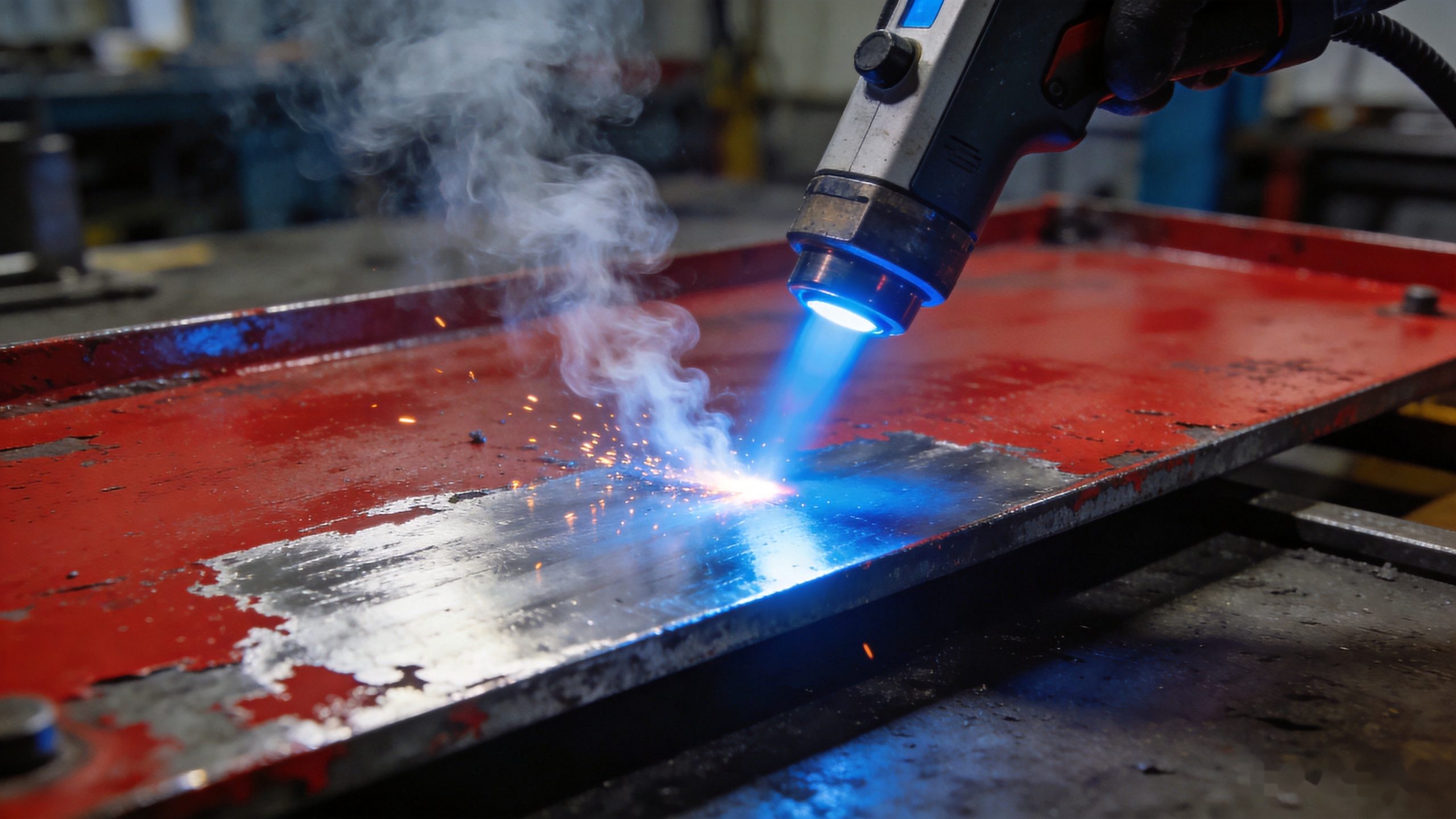
Paint removal is one of the most common — and most frustrating — tasks in metalworking, manufacturing, and restoration. Traditional methods like sandblasting, chemical stripping, and grinding are messy, slow, harmful to workers, and bad for the environment. They also often damage the base material underneath.
Laser paint removal changes all that. It’s fast, precise, non-abrasive, and completely dry — no chemicals, no blasting media, no messy waste disposal. And as fiber laser technology has become more affordable, laser paint removal has gone from a niche industrial process to a practical solution for shops of all sizes.
In this complete guide, we’ll cover everything you need to know about laser paint removal: how it works, what it can (and can’t) remove, real-world speeds and costs, how it compares to other paint removal methods, and how to choose the right machine.
How Laser Paint Removal Works
Laser paint removal — also called laser coating removal or laser ablation — uses a focused laser beam to vaporize or ablate paint, powder coating, and other surface coatings from metal and other materials. Here’s the basic process:
- Laser emission: A fiber laser generates pulses of infrared light (1064nm wavelength)
- Beam delivery: The laser travels through an optical fiber to a handheld cleaning head or automated scanner
- Focusing: Optics focus the laser onto the coated surface
- Absorption: The paint or coating absorbs the laser energy much more strongly than the underlying metal
- Vaporization / ablation: The absorbed energy heats the coating almost instantly, causing it to vaporize or sublimate
- Extraction: A dust extraction system captures the vaporized paint particles and fumes
The key principle is selective absorption: paint and coatings absorb laser energy readily, while clean, bare metal reflects most of it. This means the laser removes the coating without damaging the base metal — a huge advantage over abrasive methods.
Why It Works Better on Paint Than on Rust
Interestingly, laser cleaning is often even more effective for paint removal than for rust removal. Here’s why:
What Can You Remove with a Laser Paint Stripper?
Laser paint removal machines handle many types of coatings and surface treatments:
Paints and Coatings
Other Surface Treatments
What It Can’t Remove (or Doesn’t Do Well)
Pro tip from Transon Laser’s technical team: For most industrial paint and powder coating removal on metal, a 200W or 300W laser cleaning machine is the sweet spot. It handles most coating thicknesses at practical speeds while keeping the machine cost reasonable. For very thick coatings or high-volume production, step up to 500W or 1000W.
How Fast Is Laser Paint Removal?
Cleaning speed depends on several factors: laser power, coating type and thickness, required cleanliness level, and base material.
Typical Speeds by Power (Standard Paint / Powder Coating)
| Laser Power | Thin Coating (<50μm) | Medium Coating (50–150μm) | Thick Coating (150–500μm) | Very Thick (>500μm) |
|---|---|---|---|---|
| 100W | 3–8 m²/hour | 1–3 m²/hour | 0.2–1 m²/hour | Not recommended |
| 200W | 6–15 m²/hour | 2–6 m²/hour | 0.5–2 m²/hour | 0.1–0.5 m²/hour |
| 300W | 10–20 m²/hour | 4–10 m²/hour | 1–4 m²/hour | 0.3–1.5 m²/hour |
| 500W | 15–30 m²/hour | 8–15 m²/hour | 3–7 m²/hour | 1–3 m²/hour |
| 1000W | 25–50 m²/hour | 15–25 m²/hour | 6–12 m²/hour | 2–6 m²/hour |
These are rough estimates — actual speeds vary based on:
Real-world example: A 200W handheld laser cleaner removing standard powder coating from steel parts typically achieves about 3–6 m²/hour at production quality. For thin spray paint, speeds of 8–12 m²/hour are possible.
Laser Paint Removal vs. Traditional Methods
Let’s compare laser paint removal with the three most common traditional methods:
| Factor | Laser Cleaning | Sandblasting | Chemical Stripping | Grinding / Sanding |
|---|---|---|---|---|
| Speed (thin paint) | Fast | Very fast | Very slow | Slow |
| Speed (thick paint) | Medium | Very fast | Very slow | Slow |
| Surface damage risk | Very low | High | Medium–High | High |
| Precision | Excellent | Poor | Poor | Poor |
| Consumables | Very few | High (media) | High (chemicals) | Medium (discs) |
| Waste generated | Minimal (dust) | High (spent media + paint) | High (toxic waste) | Medium (dust + debris) |
| Environmental impact | Very low | High | Very high | Medium |
| Operator skill required | Low | Medium | High | Medium |
| Safety hazards | Laser radiation, fumes | Silicosis, noise, dust | Chemical burns, fumes | Eye injury, dust, noise |
| Equipment cost | High ($3k–$15k) | Low–Medium ($500–$3k) | Low–Medium | Low |
| Cost per m² (thin paint) | Low | Medium | High | Medium–High |
Laser vs. Sandblasting for Paint Removal
Sandblasting is fast and cheap for heavy paint removal, but it’s abrasive, messy, and damages the base metal. It also creates massive amounts of waste and requires full PPE plus containment. Laser paint removal is slower on very thick coatings but produces far better surface quality, no media waste, and is much safer and cleaner. For precision work, restoration, or surfaces where you can’t afford to damage the base metal, laser wins.
Laser vs. Chemical Stripping
Chemical paint strippers are slow, messy, and toxic. They require careful handling, proper ventilation, personal protective equipment, and hazardous waste disposal. Laser paint removal is faster, cleaner, and safer — and it works without any chemicals at all. The only advantage of chemical stripping is very low equipment cost for small, occasional jobs.
Laser vs. Grinding / Sanding
Angle grinders and sanders are cheap and widely available, but they’re slow, labor-intensive, and remove base material along with the paint. They also produce lots of sparks and dust. Laser paint removal is faster, cleaner, and non-abrasive — though the upfront cost is much higher.
Cost Analysis: How Much Does Laser Paint Removal Cost?
Equipment Cost
| Power Level | Typical Price Range | Best For |
|---|---|---|
| 100W | $2,000 – $4,000 | Light duty, thin coatings, small parts |
| 200W | $3,500 – $6,000 | Most popular — general paint and rust removal |
| 300W | $5,000 – $8,000 | Medium-heavy coatings, higher production |
| 500W | $7,000 – $12,000 | Thick coatings, high-volume production |
| 1000W | $10,000 – $18,000 | Very thick coatings, maximum speed |
Operating Cost
Laser paint removal has very low operating costs:
- Electricity: ~$0.50–$2.00 per hour
- Consumables: Protective lenses ($10–$30 each, replace every 1–4 weeks with daily use)
- No media cost: No sand, no chemicals, no grinding wheels
- No waste disposal cost: Only paint dust, which is captured by the extraction system
Cost per Square Meter Comparison
| Method | Cost per m² (thin paint) | Cost per m² (thick paint) |
|---|---|---|
| Laser cleaning (200W) | $0.50 – $1.50 | $2.00 – $6.00 |
| Sandblasting | $1.00 – $3.00 | $1.50 – $4.00 |
| Chemical stripping | $3.00 – $10.00 | $5.00 – $20.00 |
| Manual grinding | $2.00 – $6.00 | $5.00 – $15.00 |
Laser paint removal is competitive on cost — especially when you factor in eliminated waste disposal, lower labor requirements, and no damage to base material.
ROI Example
Let’s say you currently use sandblasting for paint removal:
If you’re currently using chemical stripping or manual grinding, the savings are even larger and the payback period is shorter.
Real-World Applications of Laser Paint Removal
Laser paint removal is used across many industries. Here are the most common applications:
1. Automotive and Transportation
2. Manufacturing and Metal Fabrication
3. Aerospace and Defense
4. Historical Restoration and Cultural Heritage
5. Food and Pharmaceutical
6. Marine and Shipbuilding
7. Rail and Infrastructure
8. Graffiti Removal
Tips for Getting the Best Results with Laser Paint Removal
1. Start with the Right Power
2. Use the Right Scan Speed
3. Overlap Passes
For complete, uniform paint removal, overlap each pass by about 30–50%. This ensures full coverage and avoids stripes or missed areas.
4. Keep the Lens Clean
Paint and coating residue can contaminate the protective lens, reducing cleaning power and potentially damaging the optics. Check the lens regularly and replace it when it shows signs of contamination.
5. Use Proper Fume Extraction
Paint fumes can be toxic — always use a fume extractor at the source. This isn’t just a safety issue; it also keeps the laser path clear of smoke, which improves cleaning quality.
6. Test on Scrap First
Always test your parameters on a scrap piece first. Different paints and coatings behave very differently with laser removal. The color, type, thickness, and age of the paint all affect the result.
7. Consider the Base Material
8. Work in a Well-Ventilated Area
Even with fume extraction, it’s important to work in a well-ventilated space. Some paint fumes can contain hazardous compounds like VOCs, heavy metals, or isocyanates.
Safety Considerations
Laser paint removal uses Class 4 laser radiation — the highest classification. Proper safety is essential:
Personal Protective Equipment (PPE)
Facility Requirements
Material-Specific Hazards
Important safety note: Never use a laser cleaner on materials containing asbestos, PCB, or other highly toxic substances without specialized training and equipment. When in doubt about what’s in a coating, err on the side of caution.
Choosing the Right Laser Paint Removal Machine
Questions to Ask Before Buying:
Why Transon Laser for Paint Removal?
Transon Laser’s TSC series laser cleaning machines are trusted by manufacturers, auto restorers, and job shops worldwide for paint and coating removal. Here’s why:
- Proven laser sources: Raycus and Maxphotonics fiber lasers — industry-proven reliability
- Multiple power options: 100W, 200W, 300W, 500W, 1000W, and 2000W models available
- Handheld and automated options: Handheld guns for flexible work, scanner heads for automated production
- Built-in dust extraction: Many models include integrated fume extraction systems
- 3-in-1 capability: Some models can clean, weld, and cut with head changes
- English-speaking technical support: 24/7 support from engineers who speak English
- Competitive pricing: Industrial quality at prices that make ROI calculations straightforward
- Fast global shipping: 7–15 days for standard models to most countries
If you’re tired of the mess, waste, and slow speed of traditional paint removal methods, a laser cleaning machine from Transon Laser could be the upgrade your shop needs.
Final Thoughts
Laser paint removal has come a long way in the past few years. What was once an expensive, niche industrial process is now a practical tool for shops of all sizes — and the price keeps coming down while performance keeps improving.
Is laser paint removal right for every job? No — for very thick coatings on huge surface areas where surface quality doesn’t matter, sandblasting is still faster and cheaper per square meter. But for precision work, restoration, quality-sensitive applications, or any job where you want clean results without damaging the base material, laser paint removal is simply better.
And as environmental regulations get stricter and labor costs keep rising, the advantages of laser cleaning — no waste, no chemicals, less labor, better quality — will only become more compelling.
If you’re still using sandblasting, chemical strippers, or grinding for paint removal, it’s worth taking a serious look at laser cleaning. The technology is mature, the prices are reasonable, and the ROI is compelling for many applications.
Further Reading:
For a detailed breakdown of machine specifications and how to choose the right power and configuration for your paint stripping applications, see our laser cleaning machine parameters guide.