Introduction
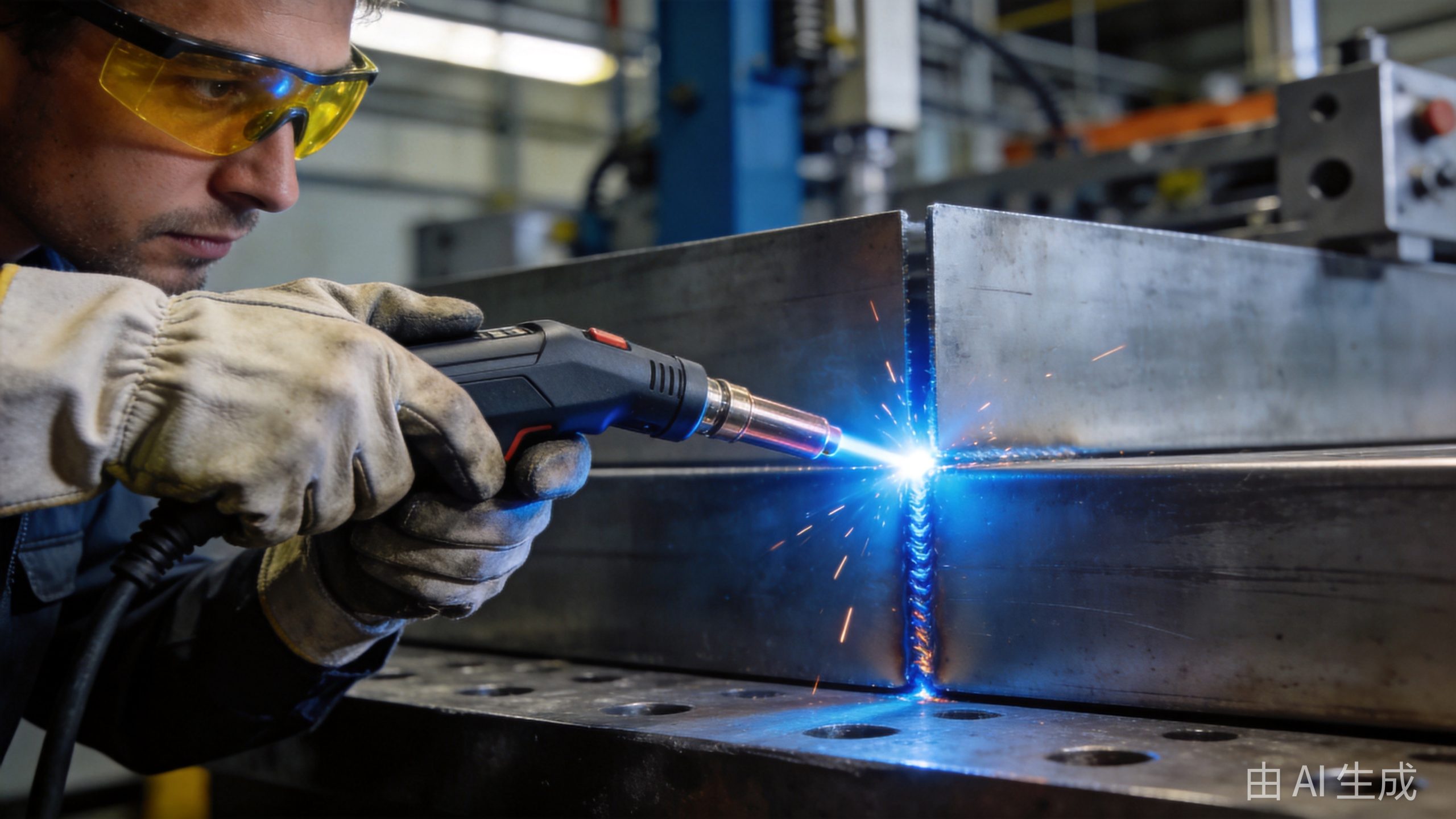
A handheld laser welding machine has become one of the fastest-growing tools in metal fabrication — and for good reason. Compared to traditional TIG or MIG welding, fiber laser handheld welders deliver 3–10x faster speeds, cleaner beads, minimal distortion, and far lower skill requirements for operators.
But not all handheld laser welders are created equal. Power output, wire feeding capability, cooling design, safety features, and software controls vary dramatically between models. Choosing the wrong specification can leave you underpowered for thick materials or overpaying for capacity you’ll never use.
This guide walks through every decision that matters when comparing handheld laser welding machines, with a practical buyer’s checklist at the end.
1. Laser Power: 1000W, 1500W, 2000W, or 3000W?
The single most important specification is laser power, measured in watts (W). It directly determines the maximum material thickness you can weld in a single pass.
| Power Level | Typical Single-Pass Weld Depth (Steel) | Best For |
|---|---|---|
| 1000W | 1.5 – 2.5 mm | Thin sheet metal, ductwork, signage, light assembly |
| 1500W | 2.5 – 4 mm | General fabrication, sheet metal up to 4mm |
| 2000W | 3 – 6 mm | Medium fabrication, structural components, pipes |
| 3000W+ | 5 – 8 mm+ | Heavy industrial, thick plates, multi-pass welding |
Key Recommendation
For most job shops and metal fabrication businesses, 1500W or 2000W is the sweet spot. 1500W handles the majority of sheet metal applications (0.5–4mm) and offers the best price-to-performance ratio. 2000W adds versatility for thicker materials and faster travel speeds.
Only step up to 3000W if you regularly weld steel thicker than 6mm or need maximum productivity on medium-gauge materials.
2. Wire Feeder: Yes or No?
Handheld laser welding can be done with or without filler wire — and this choice affects both machine cost and application range.
Without Wire (Autogenous Welding)
- Pros: Lower cost, simpler operation, faster setup, cleaner bead appearance
- Cons: Requires tight fit-up gaps (typically <0.5mm), cannot bridge gaps, limited to butt and lap joints with good fit
With Auto Wire Feeder
- Pros: Bridges gaps up to 2–3mm, stronger weld joints, better for fillet welds and corner joints, more forgiving of imperfect fit-up
- Cons: Higher machine cost, wire consumable cost, slightly more complex setup
Key Recommendation
Choose a machine with an auto wire feeder. The small additional cost is worth it for the versatility it adds. Most real-world fabrication jobs involve imperfect fit-up, and the ability to add filler metal makes the machine useful across a far wider range of applications.
Look for a wire feeder that supports 0.8mm–1.2mm wire diameters and has smooth, consistent feeding with adjustable speed.
3. Cooling System: Water-Cooled vs. Air-Cooled
Handheld laser welders generate significant heat during operation. The cooling system directly impacts duty cycle and machine lifespan.
Water-Cooled (Recommended for 1500W+)
- Continuous or near-continuous duty cycle
- Better for production environments
- More stable output power
- Longer laser source lifespan
- Requires periodic water changes and filter maintenance
Air-Cooled (Only for low-power models)
- Lower cost and simpler maintenance
- Limited duty cycle (typically 50–70%)
- Only practical for 1000W or lower
- Not recommended for production use
Key Recommendation
For any machine 1500W and above, water cooling is non-negotiable. Look for an industrial chiller with dual temperature control — one circuit for the laser source and another for the welding head. A water flow alarm and temperature protection are essential safety features.
4. Welding Head & Optics
The handheld welding head is where the work happens. Quality varies significantly between manufacturers.
What to Look For:
Swing Length / Focal Length
- Standard focal lengths: 100mm, 120mm, 150mm
- Longer focal length = more forgiving stand-off distance, but wider bead
- 120mm is the most common and versatile choice
Spot Size Control
- Adjustable spot size (typically 0.2–2mm) adds versatility
- Small spot for deep penetration, larger spot for wider beads
- Some models offer wobble (wobble width up to 5mm) for wider weld seams
Protective Windows
- Easy-to-replace protective windows are a must
- Check the cost and availability of replacement windows
- Look for heads with dual protective windows for better optics protection
Wobble Function
- Wobble (oscillation) widens the weld seam
- Essential for bridging larger gaps and for fillet welds
- Adjustable frequency and amplitude are preferred
5. Safety Features
Laser welding involves Class 4 laser radiation — safety is not optional.
Essential Safety Features:
- Laser safety glasses (wavelength-specific, OD 6+ for 1064nm)
- Interlock system — laser won’t fire if the door/chiller is open
- Contact sensor — laser only fires when the nozzle touches the workpiece
- Emergency stop button — easily accessible on both machine and gun
- Key switch — prevents unauthorized use
- Warning lights and audible alarm — indicates when laser is active
Additional Safety Recommendations:
- Welding curtain or booth for production environments
- Fume extraction system (laser welding produces metal fumes)
- Operator training on laser safety protocols
6. Control System & Software
Modern handheld laser welders come with digital control panels that make parameter setup straightforward.
What to Look For:
- Preset welding parameters — material-specific presets for steel, stainless, aluminum
- Adjustable parameters — power, frequency, pulse width, welding speed
- Multiple welding modes — continuous wave, pulse, spot welding
- Touchscreen interface — easier to navigate than button panels
- Memory presets — save and recall settings for different jobs
- Multi-language support — important if operators prefer different languages
Advanced Features (Premium Models):
- QCW (Quasi-Continuous Wave) mode for precision welding
- Cleaning mode (some machines double as laser cleaners)
- Cutting mode (limited, but useful for thin materials)
- WiFi connectivity for remote monitoring and firmware updates
7. Fiber Laser Source Quality
The laser source is the heart of the machine and typically accounts for 40–60% of the total cost.
Top Laser Source Brands:
- Raycus (China) — most common, good reliability, strong service network
- MAX (China) — popular mid-range option
- IPG (USA/Germany) — premium quality, higher cost, longer warranty
- nLIGHT (USA) — premium, excellent beam quality
- JPT (China) — good value, growing market share
Key Recommendation
For most B2B buyers, Raycus or MAX sources offer the best balance of performance, reliability, and cost. These brands have established service networks and proven track records in industrial applications.
IPG and nLIGHT are worth the premium if you need the absolute highest beam quality and longest source lifespan for 24/7 production environments.
8. After-Sales Service & Support
A handheld laser welding machine is a multi-year investment. The quality of after-sales support matters enormously.
Questions to Ask Suppliers:
- What is the warranty period? (Standard: 2–3 years for laser source, 1 year for parts)
- Do they provide on-site installation and training?
- What is the response time for technical issues?
- Do they stock spare parts locally?
- Is there online/remote technical support?
- What is the expected lifespan of the laser source? (Typically 50,000–100,000 hours)
Red Flags:
- No clear warranty terms
- No local service presence in your region
- Pushy sales without technical consultation
- Prices significantly below market average
9. Total Cost of Ownership
Don’t just look at the purchase price. Consider the total cost of ownership:
| Cost Category | Details |
|---|---|
| Initial Purchase | Machine + shipping + installation + training |
| Consumables | Protective windows ($5–20 each), nozzles, wire (if applicable) |
| Electricity | ~3–8 kW operating power |
| Maintenance | Water filter changes, annual inspection, occasional optics replacement |
| Labor | Operator training time (typically 1–3 days to become proficient) |
| Warranty & Service | Extended warranty options, service contracts |
Buyer’s Checklist
Before making a purchase decision, use this checklist to evaluate each machine:
Must-Have Features:
- [ ] Appropriate power level for your material thickness
- [ ] Auto wire feeder with adjustable speed
- [ ] Industrial water chiller with dual temperature control
- [ ] Wobble function for wider weld seams
- [ ] Contact sensor for safety
- [ ] Interlock system and emergency stop
- [ ] Reputable laser source (Raycus, MAX, IPG, or equivalent)
- [ ] Stainless steel / aluminum / carbon steel presets
- [ ] At least 2-year warranty on laser source
Nice-to-Have Features:
- [ ] Multi-function (welding + cleaning + cutting)
- [ ] Touchscreen control panel
- [ ] QCW mode for precision work
- [ ] Memory presets for job recall
- [ ] Remote monitoring capability
- [ ] Extended warranty option
Supplier Evaluation:
- [ ] Local service and spare parts availability
- [ ] Installation and training included
- [ ] Technical support response time < 24 hours
- [ ] Reference customers in similar industries
- [ ] Clear warranty and return policy
Further Reading
If you’re interested in other laser applications, learn about laser rust removal and industrial cleaning applications — many of our customers use both laser welding and laser cleaning machines in their fabrication workflow.
Conclusion
Choosing the right handheld laser welding machine comes down to matching the machine’s capabilities to your actual production needs. For most metal fabrication businesses, a 1500W or 2000W machine with wire feeder, water cooling, and wobble function from a reputable supplier will deliver the best return on investment.
Before you buy, request sample welds on your actual materials and thicknesses. Nothing beats seeing the machine’s performance on parts that match your production.
If you’re evaluating handheld laser welding machines for your business, make sure to compare not just price, but total cost of ownership, after-sales support, and the quality of core components.
Ready to explore handheld laser welding options? Contact our team for a free consultation and sample welding on your parts.