Introduction
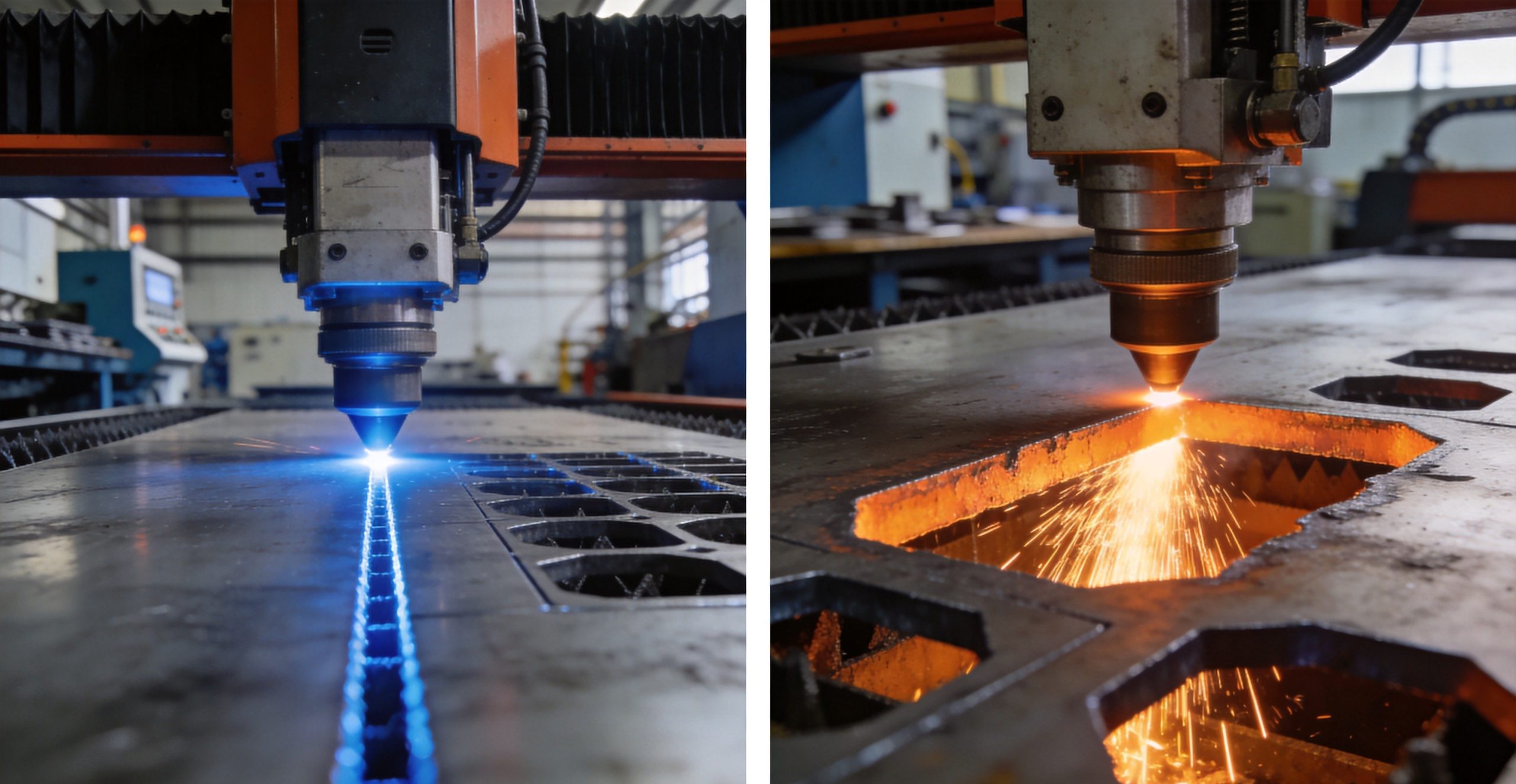
Fiber laser cutting vs plasma cutting — which one should you choose? It’s one of the most common questions among metal fabricators, job shop owners, and manufacturing engineers. Both technologies cut metal, but they work in fundamentally different ways and excel at different applications.
Plasma cutting has been around for decades and is known for its ability to cut thick metal at a relatively low cost. Fiber laser cutting is a newer technology that has exploded in popularity due to its incredible speed, precision, and low operating costs — especially as laser prices have dropped dramatically in recent years.
In this comprehensive comparison, we put fiber laser and plasma cutting head-to-head across 10+ critical factors: speed, cut quality, material compatibility, thickness capacity, operating costs, upfront price, maintenance, safety, and more. We also break down total cost of ownership over 5 years and help you determine which technology is the best fit for your specific applications and budget.
Quick Comparison Summary
| Factor | Fiber Laser Cutting | Plasma Cutting |
|---|---|---|
| **Upfront cost (industrial)** | $25,000 – $150,000+ | $5,000 – $50,000 |
| **Cutting speed (thin metal)** | 2–10x faster | Slower |
| **Cutting speed (thick metal)** | Good for up to ~25mm | Faster above 25mm |
| **Max thickness (mild steel)** | ~25–50mm (quality drops after 25mm) | ~50–150mm+ |
| **Cut quality / precision** | Excellent (±0.1mm) | Good (±0.5–1mm) |
| **Kerf width** | 0.1–0.5mm | 1–3mm |
| **Heat affected zone** | Very small | Larger |
| **Material versatility** | Metals only (best on reflective) | All conductive metals |
| **Operating cost per hour** | $1–$5 | $5–$20 |
| **Consumable cost** | Very low ($200–$500/yr) | High ($2,000–$10,000/yr) |
| **Maintenance requirements** | Low | Moderate to high |
| **Waste / fumes** | Minimal fumes, no slag | More fumes, dross/slag |
| **CNC capability** | Yes | Yes |
| **Learning curve** | Moderate | Easy |
How Each Technology Works
Fiber Laser Cutting
A fiber laser cutting machine uses a high-powered fiber laser beam to melt, burn, or vaporize metal. The laser is generated by a fiber laser source (typically 1–20kW), delivered through a fiber optic cable, and focused onto the workpiece through a cutting head lens. An assist gas (oxygen, nitrogen, or compressed air) blows away the molten material.
Key characteristics:
- Extremely focused beam (tiny spot size)
- Very high energy density
- Minimal heat affected zone
- Narrow kerf width
- High precision and repeatability
Plasma Cutting
Plasma cutting uses an electrically conductive gas (plasma) heated to extremely high temperatures (20,000–30,000°C) to melt and blow away metal. The plasma arc is formed by forcing gas through a small nozzle while an electrical arc heats the gas to plasma state.
Key characteristics:
- Wider cut (kerf) than laser
- Works on any electrically conductive metal
- Cuts very thick materials
- Lower upfront cost
- Higher consumable cost
Detailed Comparison by Factor
1. Cutting Speed
Winner: Fiber Laser (for thin to medium metal)
This is where fiber laser really shines. For thin to medium-gauge metal (0.5–12mm), a fiber laser is typically 2–10x faster than plasma.
| Material Thickness (mild steel) | Fiber Laser (3kW) | Plasma (100A) |
|---|---|---|
| 1mm | 20–30 m/min | 3–5 m/min |
| 3mm | 10–15 m/min | 3–6 m/min |
| 6mm | 5–8 m/min | 3–5 m/min |
| 12mm | 2–4 m/min | 2–4 m/min |
| 20mm | 1–2 m/min | 2–3 m/min |
| 30mm | 0.3–0.8 m/min | 1.5–2.5 m/min |
Crossover point: Around 20–25mm for mild steel, plasma catches up and eventually becomes faster for very thick materials.
2. Cut Quality and Precision
Winner: Fiber Laser (by a significant margin)
Fiber laser cutting produces significantly better cut quality than plasma:
| Quality Factor | Fiber Laser | Plasma |
|---|---|---|
| **Edge smoothness** | Smooth, almost mirror-like on thin material | Rougher, striated edges |
| **Dross / slag** | Minimal or none (with correct parameters) | Always present — requires grinding |
| **Kerf width** | 0.1–0.5mm | 1–3mm |
| **Precision / tolerance** | ±0.05–0.1mm | ±0.5–1.5mm |
| **Heat affected zone** | Very small (0.1–0.5mm) | Larger (1–3mm) |
| **Square edge** | Excellent (near 90°) | Tapered (5–15° bevel) |
| **Hole quality** | Round, clean holes with smooth walls | Less round, more taper, dross inside |
Bottom line: If you need clean, precise cuts that require minimal secondary finishing, fiber laser is the clear choice. Plasma cuts typically require grinding or deburring to remove dross and smooth edges.
3. Material Compatibility
Winner: Plasma (more versatile across all metals), but Laser is better for reflective metals
Both technologies cut ferrous and non-ferrous metals, but there are important differences:
| Material | Fiber Laser | Plasma | Notes |
|---|---|---|---|
| **Mild steel** | Excellent | Excellent | Both work well |
| **Stainless steel** | Excellent | Good | Laser produces cleaner edge |
| **Aluminum** | Excellent | Good | Laser handles reflective metal well |
| **Copper** | Excellent | Poor | Plasma struggles with copper; laser handles it |
| **Brass** | Good | Poor | Same as copper |
| **Galvanized steel** | Good | Good | Both work, laser is cleaner |
| **Cast iron** | Poor | Good | Laser struggles with cast iron |
| **Non-metals** | No | No | Neither cuts wood, plastic, etc. |
Key difference: Fiber lasers cut reflective metals (aluminum, copper, brass) much better than plasma. Plasma can cut them but with lower quality and shorter consumable life. However, plasma handles cast iron better than fiber laser.
4. Maximum Cutting Thickness
Winner: Plasma
Plasma can cut significantly thicker materials than a comparably-priced fiber laser:
| Technology | Typical Max Thickness (mild steel) |
|---|---|
| **Fiber laser (1kW)** | ~6–8mm |
| **Fiber laser (3kW)** | ~16–20mm |
| **Fiber laser (6kW)** | ~25–32mm |
| **Fiber laser (12kW)** | ~40–50mm |
| **Plasma (60A)** | ~12–16mm |
| **Plasma (100A)** | ~20–25mm |
| **Plasma (200A)** | ~40–50mm |
| **Plasma (400A+)** | ~80–150mm+ |
Practical note: While a 12kW laser can technically cut 50mm steel, the cut quality degrades significantly above 25mm, and speed drops dramatically. For production cutting of material over 25mm thick, plasma is usually more practical and cost-effective.
5. Upfront Cost
Winner: Plasma (significantly cheaper to get started)
Plasma cutting systems are substantially less expensive than fiber laser machines of equivalent table size:
| Machine Type | Entry Level | Mid-Range Industrial | High-End Production |
|---|---|---|---|
| **Plasma cutter (CNC table)** | $3,000 – $10,000 | $15,000 – $40,000 | $50,000 – $150,000 |
| **Fiber laser cutter** | $15,000 – $30,000 | $30,000 – $100,000 | $100,000 – $500,000+ |
Important: The gap narrows when you compare industrial-grade systems with similar features (CNC, automation, etc.). A high-end plasma system with all the bells and whistles can cost as much as a mid-range fiber laser.
6. Operating Cost and Consumables
Winner: Fiber Laser (dramatically lower operating cost)
This is where fiber laser has a huge advantage. Plasma cutting has much higher consumable costs:
| Cost Factor | Fiber Laser (3kW) | Plasma (100A) |
|---|---|---|
| **Nozzles / tips** | $5–$20 each, lasts months | $10–$50 each, lasts hours to days |
| **Electrodes** | N/A | $5–$20 each, lasts hours to days |
| **Shield caps** | N/A | $10–$30 each |
| **Swirl rings** | N/A | $5–$20 each |
| **Protective lens** | $10–$30 each, lasts weeks to months | N/A |
| **Annual consumable cost** | $200 – $1,000 | $2,000 – $10,000+ |
| **Electricity cost** | ~$1–$3/hour | ~$2–$5/hour |
| **Gas cost** | $0.50–$3/hour (oxygen/nitrogen) | $1–$4/hour (air/plasma gas) |
Bottom line: Plasma consumables cost 5–20x more than laser consumables. For a high-production shop, this can add up to tens of thousands of dollars per year.
7. Maintenance Requirements
Winner: Fiber Laser (less maintenance overall)
| Maintenance Task | Fiber Laser | Plasma |
|---|---|---|
| **Consumable replacement** | Rare (lens cleaning/replacement) | Frequent (tips, electrodes, shields) |
| **Optics / mirrors** | Minimal (fiber delivery) | None (no optics) |
| **Cooling system** | Regular water changes, filter changes | Smaller cooling system |
| **Mechanical wear** | Similar (rails, gears, belts) | Similar |
| **Plasma torch maintenance** | N/A | Regular — torch body, swirl ring, shield |
| **Dust / fume management** | Moderate | High (more dust and fumes) |
| **Annual maintenance cost** | $500 – $2,000 | $1,000 – $5,000 |
Fiber lasers have fewer moving parts in the cutting head and no consumable electrodes or nozzles that wear out quickly. However, laser sources and optics are more expensive to repair if something goes wrong.
8. Waste and Environmental Impact
Winner: Fiber Laser
- Fiber laser: Produces minimal waste — mostly vaporized metal fumes and small amounts of dross. No consumable parts to dispose of frequently.
- Plasma: Produces more fumes, more dross/slag, and frequent consumable replacement (nozzles, electrodes, shields that end up in the trash).
Both require fume extraction for worker safety, but plasma generates significantly more particulate matter.
9. Safety Considerations
Both technologies have safety risks, but they’re different:
| Safety Risk | Fiber Laser | Plasma |
|---|---|---|
| **Eye damage** | **High risk** — invisible IR laser radiation | Low — bright visible light |
| **Burns / fire** | High — intense heat | High — molten metal |
| **Electrical hazard** | Moderate | **High** — high-voltage plasma power supply |
| **Fumes / dust** | Moderate | **High** — more metal fumes |
| **Noise** | Moderate | **High** — very loud |
| **Required PPE** | Laser safety glasses, gloves | Welding helmet, hearing protection, gloves |
Key difference: Laser radiation is invisible and can cause permanent eye damage even from scattered reflections. Plasma is loud and produces bright UV light that requires a welding helmet. Both require proper safety training and equipment.
10. Ease of Use and Learning Curve
Winner: Plasma (easier to learn)
- Plasma: Relatively simple to learn the basics. Operators can be productive in a few days. The technology is more forgiving of parameter mistakes.
- Fiber laser: More complex to set up and optimize. Many parameters (power, speed, frequency, duty cycle, gas pressure, focus position) affect cut quality. Becoming proficient takes weeks to months.
However, once the parameters are set correctly, laser cutting is more consistent and requires less operator intervention.
Total Cost of Ownership: 5-Year Comparison
Let’s compare the total cost of ownership for a mid-range industrial 5’x10′ cutting table with equivalent cutting capacity:
| Cost Factor | Fiber Laser (3kW) | Plasma (100A Hi-Def) |
|---|---|---|
| **Machine purchase** | $60,000 | $25,000 |
| **Installation / setup** | $2,000 | $1,000 |
| **Training** | $2,000 | $1,000 |
| **Consumables (5 years)** | $3,000 | $30,000 |
| **Electricity (5 years)** | $4,000 | $6,000 |
| **Gas (5 years)** | $6,000 | $8,000 |
| **Maintenance & repairs (5 years)** | $5,000 | $8,000 |
| **Labor (5 years)** | $200,000 | $300,000 |
| **Secondary finishing (grinding)** | $5,000 | $50,000 |
| **5-Year Total** | **$287,000** | **$429,000** |
Assumptions: 1 operator, 8 hours/day, 250 days/year, average labor cost $20/hr. Laser is 2-3x faster and produces cleaner cuts requiring less secondary finishing.
Key takeaway: Even though the fiber laser costs more than twice as much upfront, it can save $140,000+ over 5 years due to higher productivity, lower consumable costs, and less secondary finishing. The payback period is typically 1–2 years for a busy shop.
Which One Should You Choose?
Choose Fiber Laser If:
✅ You primarily cut thin to medium-gauge metal (0.5–20mm)
✅ You need high precision and clean cut quality
✅ You want to minimize secondary operations (grinding, deburring)
✅ You cut reflective metals (aluminum, copper, brass)
✅ You have high production volume
✅ You want low operating costs
✅ You can afford the higher upfront investment
✅ You have or can hire skilled operators
Choose Plasma If:
✅ You primarily cut thick metal (25mm+)
✅ You need the lowest possible upfront cost
✅ You cut a wide variety of metals including cast iron
✅ You need a portable or field-usable cutting solution
✅ Your operators have plasma experience already
✅ You don’t need high precision
✅ You have lower production volume
Consider Both If:
If you cut a wide range of material thicknesses — from thin sheet to heavy plate — you might benefit from having both technologies. Many fabrication shops use laser for thin to medium material and plasma for thick material, getting the best of both worlds.
Another option: Some machines offer both laser and plasma cutting heads on the same gantry, though these hybrid systems are more expensive.
The Impact of Chinese Laser Manufacturers
The rise of Chinese fiber laser manufacturers has dramatically changed the cost equation. A 3kW fiber laser machine that cost $200,000+ from a Western brand 10 years ago now costs $50,000–$80,000 from a reputable Chinese manufacturer.
This price drop has made fiber laser cutting accessible to small and medium job shops that previously could only afford plasma. For many businesses, the question has shifted from “can we afford a laser?” to “how fast will it pay for itself?”
Chinese plasma machines have also gotten cheaper, but the price gap between laser and plasma has narrowed significantly, making laser much more competitive than it used to be.
Frequently Asked Questions
Can a fiber laser cut thicker than plasma?
No, not at equivalent price points. Plasma can cut much thicker material. However, a high-power fiber laser (12kW+) can cut up to 40–50mm of steel, which overlaps with medium-power plasma. For very thick material (50mm+), plasma is still the clear winner.
Is laser cutting cheaper than plasma?
It depends on how you measure. Plasma is cheaper to buy, but laser is cheaper to operate. For high-volume production of thin to medium metal, laser is usually cheaper overall when you factor in speed, consumables, and labor. For low-volume or thick-metal cutting, plasma is cheaper.
How long does a fiber laser source last?
Quality fiber laser sources have a rated lifespan of 50,000–100,000 hours, which translates to 10–20 years of normal single-shift operation. Plasma torches last much shorter — consumables need to be replaced every few hours to few days of cutting time.
Can I upgrade from plasma to laser on the same table?
Generally no. The cutting head, drive system, power supply, and software are all different. Some manufacturers offer hybrid machines with both plasma and laser heads, but these are purpose-built, not field-upgradable.
Which is better for a small job shop?
For a small job shop that does a mix of work, it depends on your typical material thickness. If most of your work is 12mm or thinner, a fiber laser will probably give you better quality and faster turnaround. If you regularly cut 20mm+, plasma may be more practical. Many small shops start with plasma and add a laser as they grow.
Final Verdict
There’s no universal “winner” — the best choice depends on your specific applications, production volume, material types, and budget.
For most modern metal fabrication shops working with sheet metal up to 20mm thick, fiber laser is the better long-term investment. The speed, quality, and low operating costs more than justify the higher upfront price, with typical ROI of 1–2 years.
For shops that primarily cut thick metal (25mm+), or for businesses on a tight budget just getting started, plasma remains a solid choice. It’s affordable, versatile, and proven technology.
For many growing shops, the answer is both — using laser for thin to medium material and plasma for heavy plate, maximizing productivity across the full range of jobs.
Still not sure which is right for your business? [Contact Transon Laser](https://transonlaser.com/contact-us/) for expert advice and a customized recommendation based on your specific needs.
Further Reading
- Fiber Laser vs CO2 Laser Cutting Machine: Which One Should You Buy? — Compare the two most popular laser cutting technologies.
- How Much Does a Fiber Laser Cutting Machine Cost in 2026? — Complete price guide for fiber laser cutting machines.
- Fiber Laser Cutting Thickness & Speed Chart: 1kW to 20kW — Detailed cutting speed and thickness reference tables.
- How to Choose a Fiber Laser Cutting Machine — Step-by-step buyer’s guide.
- How Does a Fiber Laser Cutting Machine Work?
- Fiber Laser Cutting Machine Parameters: A Complete Technical Reference
Further Reading: Check out our ranking of the 12 Best Fiber Laser Cutting Machine Brands & Manufacturers to see how the top manufacturers compare.
Explore our full range of fiber laser cutting machines from Transon Laser. Contact us today for a free quote on our precision laser cutter.