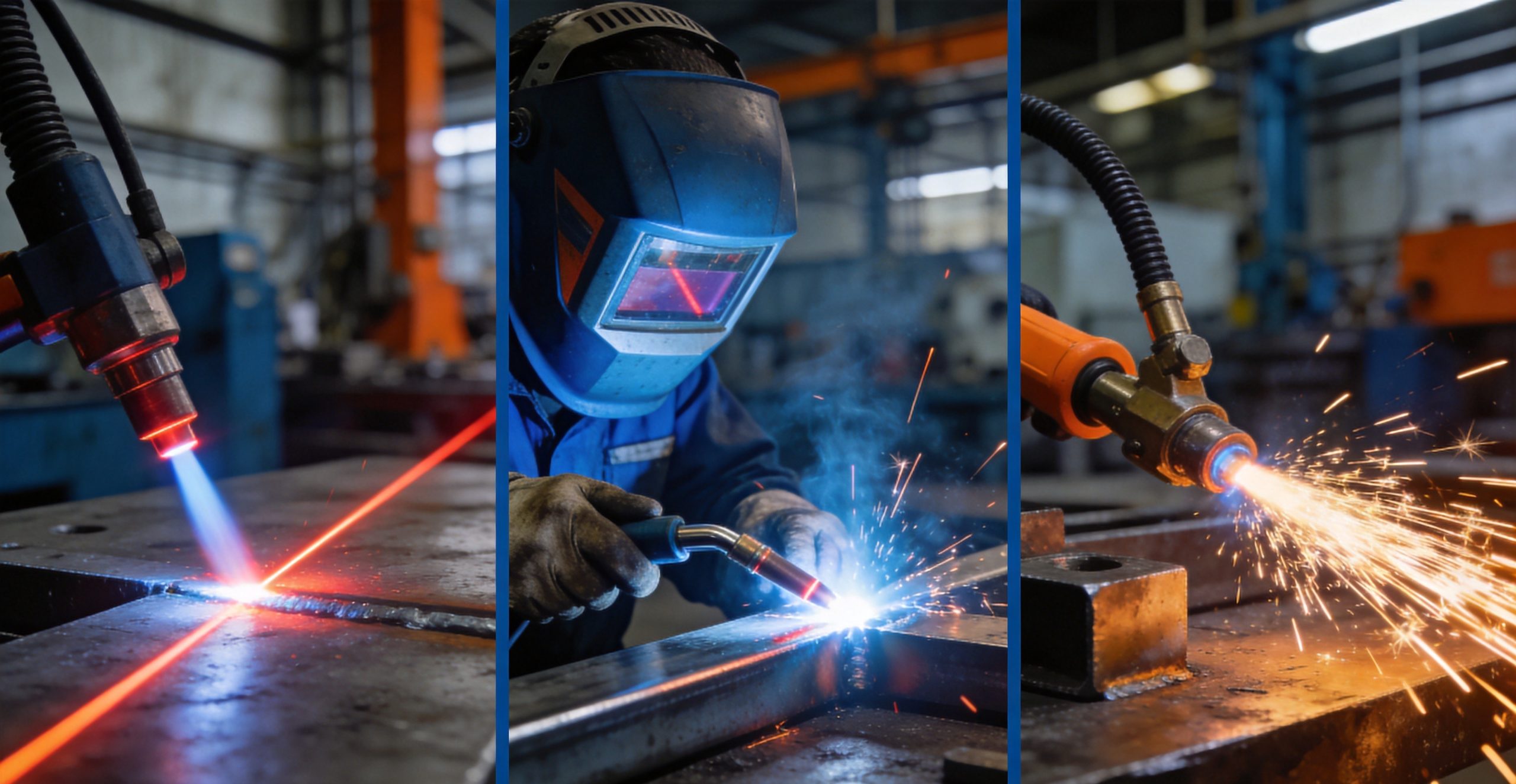
When it comes to industrial metal joining, manufacturers have more options than ever. Traditional methods like arc welding, TIG, and MIG have been around for decades, but fiber laser welding is rapidly gaining ground — especially in precision manufacturing, automotive, and aerospace.
But which welding process is right for your application? In this comprehensive guide, we compare laser welding, TIG welding, MIG welding, and traditional arc welding across 12 key factors: speed, quality, cost, precision, material compatibility, operator skill, and more.
Whether you’re upgrading your production line, starting a new fabrication shop, or simply evaluating whether laser welding is worth the investment, this comparison will help you make an informed decision.
—
Quick Summary: Key Differences at a Glance
| Factor | Laser Welding | TIG Welding | MIG Welding | Arc/Stick Welding |
|---|---|---|---|---|
| Speed | Very fast (2–10x faster) | Slow | Medium-Fast | Slow-Medium |
| Precision | Excellent (0.1mm) | Very Good | Good | Fair |
| Heat Input | Low (narrow HAZ) | Low-Medium | Medium | High (wide HAZ) |
| Distortion | Minimal | Low | Medium | High |
| Material Thickness | 0.1–6mm (single pass) | 0.5–10mm | 1–25mm | 2–50mm |
| Operator Skill | Low-Medium | Very High | Medium | Medium |
| Equipment Cost | High ($5k–$50k) | Low-Medium | Medium | Low |
| Consumables | Minimal (gas only) | High (tungsten + gas + filler) | Medium (wire + gas) | Low (electrodes) |
| Weld Quality | Excellent | Excellent | Good-Great | Fair-Good |
| Automation Ready | Yes (robotics, CNC) | Limited | Yes | No |
| Portability | Low-Medium | Medium | Medium-High | High |
—
1. Welding Speed & Productivity
Winner: Laser Welding
When it comes to raw speed, laser welding dominates. A fiber laser welder can join metal at 2–10 times the speed of TIG welding and 2–5 times faster than MIG welding for thin-to-medium materials.
- Laser welding: 500–5000 mm/min (depending on material thickness and laser power)
- MIG welding: 200–1000 mm/min
- TIG welding: 50–300 mm/min
- Arc/Stick welding: 75–400 mm/min
Why laser is faster: The concentrated laser beam creates a deep, narrow “keyhole” weld that penetrates quickly with a single pass. There’s no need to preheat or build up multiple beads for most applications under 6mm.
Productivity impact: For high-volume production, laser welding can reduce cycle time by 60–80% compared to TIG. A single handheld laser welding operator can match the output of 3–4 TIG welders on thin-gauge materials.
—
2. Weld Quality & Precision
Winner: Laser Welding (tied with TIG for aesthetic quality)
Both laser and TIG produce extremely high-quality welds, but they excel in different ways:
Laser Welding Quality
- Narrow, consistent weld bead — minimal material waste
- Low heat-affected zone (HAZ) — less metallurgical change around the weld
- Minimal distortion — parts stay flat and true
- No porosity when properly parameterized
- Smooth, clean finish — often requires no post-weld grinding
- Precision down to 0.1mm — ideal for micro-welding and fine parts
TIG Welding Quality
- Excellent aesthetic appearance — the “prettiest” welds
- Full control over heat input (foot pedal)
- No spatter
- Great for thin materials — as thin as 0.5mm
- Smooth, uniform bead when done by a skilled welder
MIG Welding Quality
- Good overall quality with proper settings
- Some spatter (reduced with pulse MIG)
- Fair-to-good bead appearance
- Good for thicker materials with multi-pass technique
Arc/Stick Welding Quality
- Functional but rough — requires significant cleanup
- High spatter and slag — chipping and grinding required
- Wider HAZ — more distortion
- Not suitable for thin materials — burn-through risk
—
3. Equipment Cost
Winner: Arc/Stick Welding (lowest initial cost)
| Process | Entry-Level | Industrial/Production |
|---|---|---|
| Laser Welding | $5,000–$15,000 (handheld) | $20,000–$100,000+ (automated) |
| TIG Welding | $500–$2,000 | $3,000–$10,000 |
| MIG Welding | $300–$1,500 | $2,000–$8,000 |
| Arc/Stick Welding | $100–$500 | $1,000–$3,000 |
Laser welding cost breakdown:
- Handheld fiber laser welder (1500W): $6,000–$10,000
- Handheld fiber laser welder (2000W): $8,000–$15,000
- Handheld fiber laser welder (3000W): $12,000–$20,000
- Automated/robotic laser welding cell: $50,000–$200,000+
Important: While laser welding has the highest upfront cost, it often delivers the fastest ROI in high-volume production due to:
- 2–10x faster welding speed
- Lower labor cost (less skill required)
- Minimal post-weld processing
- Lower consumable cost
—
4. Operating Cost & Consumables
Winner: Laser Welding (lowest per-meter cost in production)
| Process | Consumables | Approx. Cost per Hour |
|---|---|---|
| Laser Welding | Shielding gas (argon), occasional lens cleaning | $1–$3 |
| TIG Welding | Tungsten electrodes, filler rod, argon gas, ceramic cups | $3–$8 |
| MIG Welding | Wire spool, shielding gas (CO2 or mix), contact tips | $2–$6 |
| Arc/Stick Welding | Electrodes (stick), grinding wheels | $1–$4 |
Laser welding operating cost details:
- No filler wire needed for most applications (autogenous welding)
- No electrodes to replace
- No tips or nozzles to wear out
- Shielding gas only — typically argon, at lower flow rates than TIG
- Laser source lifespan: 100,000+ hours (fiber laser diodes) — essentially maintenance-free
Note: For very high-volume production, laser welding has the lowest per-part cost because the speed advantage and minimal consumables far outweigh the higher equipment investment.
—
5. Material Compatibility
| Material | Laser Welding | TIG Welding | MIG Welding | Arc Welding |
|---|---|---|---|---|
| Carbon Steel | ✓ Excellent | ✓ Excellent | ✓ Excellent | ✓ Excellent |
| Stainless Steel | ✓ Excellent | ✓ Excellent | ✓ Excellent | ✓ Good |
| Aluminum | ✓ Excellent | ✓ Excellent | ✓ Good | ✗ Poor |
| Copper | ✓ Good | ✓ Good | ✗ Poor | ✗ Poor |
| Brass | ✓ Good | ✓ Fair | ✗ Poor | ✗ Poor |
| Titanium | ✓ Excellent | ✓ Excellent | ✓ Good | ✗ Poor |
| Dissimilar Metals | ✓ Good | ✓ Good | ✓ Fair | ✗ Poor |
| Thin Sheet (<1mm) | ✓ Excellent | ✓ Good | ✗ Difficult | ✗ Poor |
| Thick Plate (>10mm) | △ Multi-pass needed | ✓ Excellent | ✓ Excellent | ✓ Excellent |
Key takeaway: Laser welding excels at thin materials, reflective metals, and dissimilar metal joining — areas where traditional methods struggle. For very thick materials (above 10mm), MIG, TIG, or arc welding may be more practical due to deeper penetration per pass with multi-pass techniques.
—
6. Operator Skill Requirement
Winner: MIG Welding (easiest to learn) / Laser Welding (surprisingly easy)
| Process | Learning Curve | Typical Training Time |
|---|---|---|
| Laser Welding | Easy-Medium | 2–7 days for basic proficiency |
| MIG Welding | Easy | 1–4 weeks |
| Arc/Stick Welding | Medium | 2–8 weeks |
| TIG Welding | Very Difficult | 3–12 months+ |
Why laser welding is easier than you think:
- No filler rod manipulation — most laser welding is autogenous (no filler)
- No arc starting skill — just point and press the trigger
- Consistent results — the laser parameters stay the same; the operator just moves the gun
- Handheld models feature wobble welding heads that compensate for gap variation
- Minimal cleanup — no slag, minimal spatter
TIG is the hardest because it requires coordinating three things simultaneously: foot pedal (heat control), filler rod (one hand), and torch (other hand). It’s often compared to “playing the piano” while welding.
Labor cost impact: In regions with high labor costs, laser welding can save significantly because you don’t need certified master welders — a general factory worker can be trained in a week.
—
7. Heat Input & Distortion
Winner: Laser Welding
Heat input is one of the most critical differences between welding processes. High heat input causes:
- Warping and distortion
- Residual stress
- Changes in material properties (hardness, ductility)
- Post-weld straightening and rework
Heat Input Comparison (Relative)
- Laser welding: Very Low (1x) — concentrated energy, minimal HAZ
- TIG welding: Low-Medium (2–3x) — controlled but broader heat
- MIG welding: Medium (3–5x) — significant heat input
- Arc/Stick welding: High (5–10x) — massive heat, wide HAZ
Real-world impact:
- Laser welded sheet metal parts often require no straightening or flattening after welding
- TIG welded parts may need light straightening for thin materials
- MIG and arc welded thin sheets often require significant post-weld flattening, fixturing, or both
For industries like electronics enclosures, medical devices, and precision sheet metal where flatness and dimensional accuracy matter, laser welding is often the only viable option.
—
8. Automation Capability
Winner: Laser Welding
| Process | Automation Level | Common Applications |
|---|---|---|
| Laser Welding | Fully automated (robotics, CNC, galvo scanning) | Automotive, aerospace, medical, electronics |
| MIG Welding | Highly automatable (robotic welding cells) | Automotive, heavy equipment, pipe welding |
| TIG Welding | Limited automation (orbital TIG for pipe) | Aerospace, precision tubing |
| Arc/Stick Welding | Not practical for automation | Field repair, construction |
Laser welding automation advantages:
- Non-contact process — no tool wear, no force on the part
- Precise and repeatable — consistent quality 24/7
- Galvo scanning — can weld complex patterns without moving the part
- Vision systems — seam tracking and quality inspection built-in
- Flexible — same machine can weld, cut, and clean with different heads
—
9. Portability & Field Use
Winner: Arc/Stick Welding
| Process | Portability | Field Use Suitability |
|---|---|---|
| Arc/Stick Welding | Excellent — small, lightweight, works anywhere | Construction, repair, outdoor |
| MIG Welding | Good — but needs gas bottle and wire spool | Shop + some field use |
| TIG Welding | Fair — gas bottle, tungsten, filler rod | Shop primarily |
| Laser Welding | Fair-Good — handheld units are portable but need power | Shop + on-site with power |
Laser welding portability note: Modern handheld fiber laser welders are surprisingly portable. A 1500W unit weighs 80–150kg and can be moved with a pallet jack or forklift. Some models come on wheels for easy shop floor movement.
However, laser welders require electrical power (220V single-phase or 380V three-phase) and aren’t suitable for remote locations without a generator.
—
10. Safety Considerations
All welding processes carry safety risks, but the hazards differ:
Laser Welding Safety
- Eye protection: Laser safety glasses (Class 4 laser — can cause permanent eye damage)
- Skin protection: Avoid direct or scattered laser exposure
- Fume extraction: Welding fumes (metal oxides) must be ventilated
- Fire risk: Laser can ignite flammable materials near the weld zone
- Enclosure recommended: Automated systems should have light-tight enclosures
Traditional Welding Safety
- UV/IR radiation: Welding helmet with proper shade (same for all arc processes)
- Fume inhalation: Welding fumes — ventilation required
- Electric shock: All arc welding processes carry shock risk
- Burns: Hot metal, sparks, and spatter
- Fire: Sparks can ignite nearby combustibles
Bottom line: Both laser and arc welding require proper PPE and ventilation. The main difference is that laser welding uses a Class 4 laser beam rather than an electric arc — different hazard, similar safety rigor required.
—
11. When to Choose Each Process
Choose Laser Welding When:
- You need high speed and productivity
- Precision and minimal distortion are critical
- You work with thin materials (0.1–6mm)
- You want to reduce labor cost (less skill required)
- You’re joining reflective or dissimilar metals
- You plan to automate in the future
- Post-weld grinding and cleanup must be minimized
Choose TIG Welding When:
- You need the highest aesthetic weld quality
- You work with thin to medium materials (0.5–10mm)
- You weld aluminum, stainless steel, or titanium
- You have skilled welders available
- One-off or low-volume precision work
- Equipment budget is limited
Choose MIG Welding When:
- You need good speed at a moderate cost
- You work with medium to thick materials (1–25mm)
- You want semi-automation or robotic capability
- You need versatility — works on most metals
- Medium to high production volume
- Operator training time is limited
Choose Arc/Stick Welding When:
- You need maximum portability and low cost
- You work with thick, dirty, or rusty materials
- Outdoor or field work — wind doesn’t affect it
- Maintenance and repair applications
- Budget is very tight
- Material thickness is above 3mm
—
12. ROI Analysis: When Does Laser Welding Pay Off?
The biggest question for most businesses: is a laser welder worth the investment?
Break-Even Calculation Example
| Factor | TIG Welding | Laser Welding |
|---|---|---|
| Equipment cost | $3,000 | $10,000 |
| Hourly labor cost | $25 (skilled welder) | $15 (general operator) |
| Welding speed | 100 mm/min | 500 mm/min |
| Parts per hour | 5 parts | 25 parts |
| Labor cost per part | $5.00 | $0.60 |
| Daily output (8h) | 40 parts | 200 parts |
Savings per part: $4.40
Additional investment: $7,000
Break-even point: ~1,591 parts = ~8 production days
This is a simplified example, but it illustrates the core math: laser welding’s speed and labor advantages can deliver ROI in weeks or months for high-volume production.
Factors That Speed Up ROI:
- High production volume (more parts = more savings)
- High labor costs (skilled welders are expensive)
- Currently using TIG (slowest process, biggest speed gain)
- Post-weld grinding is currently required (laser eliminates it)
- Multiple shifts (machine utilization > 8 hours/day)
Factors That Slow Down ROI:
- Low production volume (job shop with variable work)
- Very thick materials (laser advantage diminishes)
- Already using automated MIG (smaller speed gap)
- Single shift operation only
—
Final Recommendation
For precision manufacturing, sheet metal fabrication, automotive components, medical devices, and any application where speed, quality, and low distortion matter — laser welding is the clear winner. It’s faster, cleaner, more precise, and easier to operate than TIG, and it produces better quality results than MIG or arc welding.
For job shops, field work, and heavy structural welding — traditional methods still have their place. Arc welding is unbeatable for portability and cost. MIG is the workhorse of medium-thickness fabrication. TIG remains the gold standard for hand-made aesthetic welds.
The sweet spot for handheld laser welding:
- Materials: 0.5–6mm steel, stainless, aluminum
- Production: Medium to high volume
- Quality requirement: High (minimal distortion, clean welds)
- Labor: Difficult to find skilled TIG welders
If your business fits this profile, a 1500W or 2000W handheld fiber laser welder will likely pay for itself within 3–6 months.
—
Ready to explore laser welding for your business? [Browse our handheld laser welding machines](https://www.transonlaser.com/product-category/laser-welder/) or [contact us](https://www.transonlaser.com/contact-us/) for a free consultation and application test.
*Got questions about which welding process is right for you? Drop a comment below or reach out to our engineering team — we’re happy to help.*
Further Reading: Wondering what laser welding is used for? See our guide to 10 Industrial Applications of Laser Welding across 10 industries.
Explore our full range of laser welding equipment from Transon Laser. Contact us today for a free quote on our handheld laser welder.