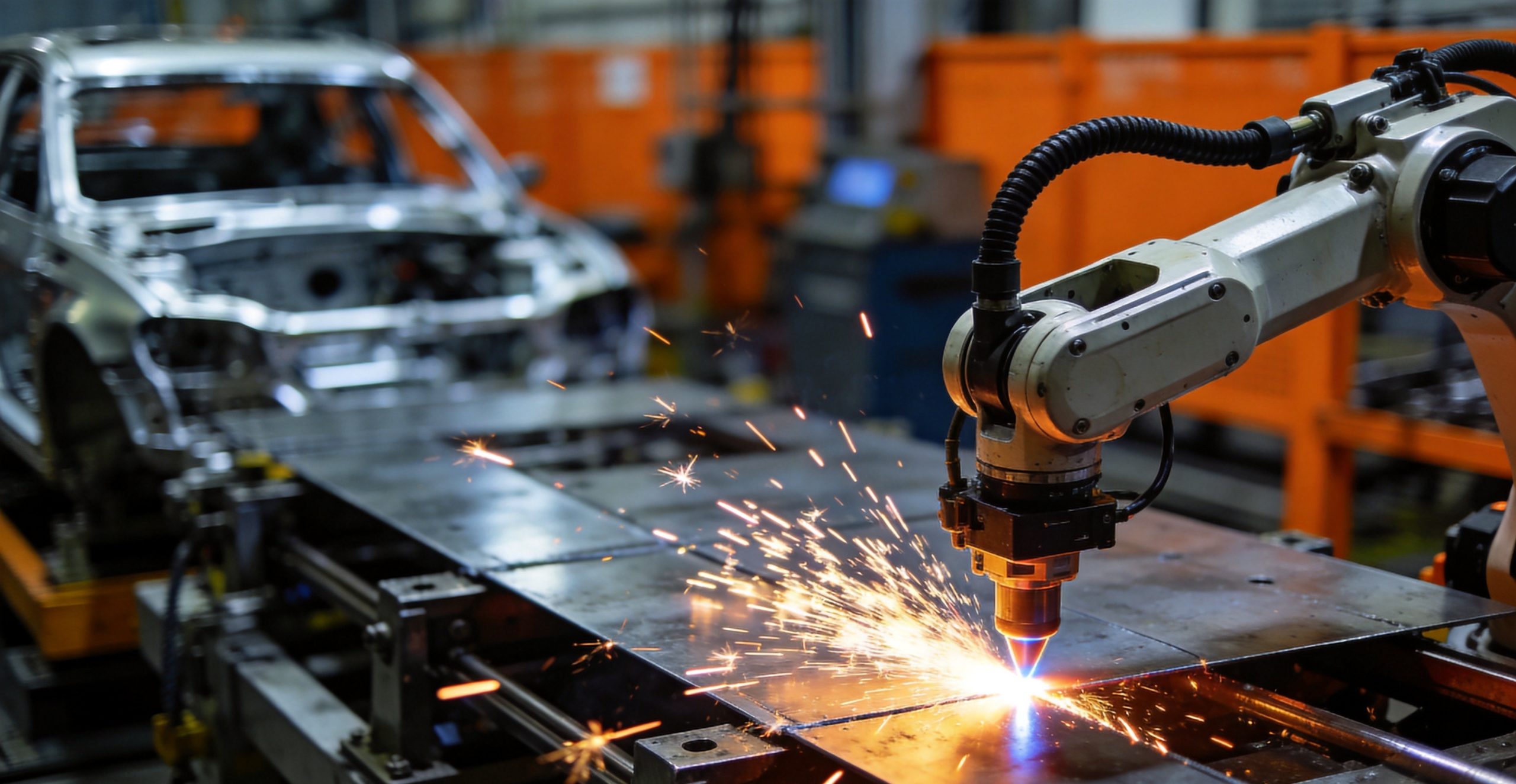
Laser welding has transformed industrial manufacturing over the past two decades. What was once a niche technology for aerospace and medical devices is now used across dozens of industries — from automotive assembly to jewelry making.
The advantages are clear: laser welding is faster, more precise, and produces higher quality welds than traditional methods like TIG and MIG. It works on almost any metal, requires minimal filler material, and is easily automated.
But what exactly is laser welding used for in industry? In this guide, we break down 10 major industrial applications of laser welding, including real-world examples, why laser is chosen over other methods, and what types of laser welders are used for each application.
Whether you’re considering investing in a laser welding machine or just curious about how this technology is shaping modern manufacturing, this guide will give you a comprehensive overview.
—
Why Laser Welding Is Taking Over Manufacturing
Before diving into specific applications, let’s quickly review why laser welding has become so popular:
- Speed: 2–10x faster than TIG welding
- Precision: Can weld parts as thin as 0.1mm with minimal distortion
- Quality: Clean, consistent welds with minimal post-processing
- Automation-ready: Easily integrated with robots and CNC systems
- Non-contact: No tool wear, no force on the part
- Versatility: Works on steel, stainless steel, aluminum, copper, titanium, and more
- Low heat input: Narrow heat-affected zone means less warping
These advantages make laser welding the preferred choice for high-precision, high-volume manufacturing.
—
1. Automotive Manufacturing
Industry: Automotive & Transportation
Laser type: Fiber laser (mostly robotic, some handheld)
Power range: 1000W – 6000W
The automotive industry is the largest user of laser welding worldwide. Modern cars and trucks contain hundreds of laser-welded components, from body panels to engine parts.
Common Automotive Applications:
- Body-in-white (BIW) welding: Roof panels, door frames, floor pans
- Tailored blanks: Welding different thicknesses of steel together before stamping
- Exhaust systems: Manifolds, pipes, mufflers, catalytic converters
- Engine components: Valve seats, piston rings, connecting rods
- Transmission parts: Gears, shafts, clutch components
- Battery welding: EV battery cells and modules (ultrasonic + laser)
- Fuel injectors: Precision welding of tiny components
- Airbag components: Inflator housings, igniters
Why Laser for Automotive?
- High speed: Matches the fast pace of auto assembly lines
- Consistent quality: Critical for safety components
- Lightweight materials: Can weld aluminum and advanced high-strength steel (AHSS)
- Automation: Works perfectly with robotic welding cells
- Reduced weight: Narrower weld flanges mean lighter vehicles (better fuel economy)
Fun fact: A single modern vehicle can have 500+ laser welds on its body and components.
—
2. Aerospace & Aviation
Industry: Aerospace, Defense & Aviation
Laser type: Fiber laser + Nd:YAG laser (robotic and CNC)
Power range: 500W – 10,000W
Aerospace was one of the first industries to adopt laser welding, and it remains at the cutting edge of the technology. When lives depend on weld quality, you need the best — and that’s laser welding.
Common Aerospace Applications:
- Turbine blades: Repair and manufacturing of jet engine blades
- Engine components: Combustion chambers, fuel nozzles, turbine disks
- Airframe structures: Fuselage panels, wing components, stringers
- Landing gear: Hydraulic cylinders, structural components
- Fuel systems: Tanks, pipes, fittings
- Heat exchangers: Lightweight, high-efficiency heat exchangers
- Satellite components: Precision welding of lightweight alloys
- Rocket engines: Nozzles, combustion chambers (extreme conditions)
Why Laser for Aerospace?
- Exceptional quality: Meets the strictest aerospace standards (NADCAP, FAA)
- Difficult materials: Welds titanium, Inconel, and other superalloys
- Precision: Critical for components operating at extreme temperatures and pressures
- Reduced distortion: Important for aerodynamic surfaces
- Traceability: Automated systems provide full quality documentation
Note: Aerospace laser welding is heavily regulated and requires extensive certification. The process parameters for each part must be qualified before production.
—
3. Medical Device Manufacturing
Industry: Medical Devices & Healthcare
Laser type: Fiber laser, pulsed Nd:YAG, UV laser (micro-welding)
Power range: 10W – 500W (mostly low power for tiny parts)
Medical devices are getting smaller and more complex every year. From surgical instruments to implantable devices, laser welding enables the precision that modern medicine demands.
Common Medical Applications:
- Surgical instruments: Forceps, scissors, scalpels, endoscopes
- Dental devices: Implants, braces, dental tools
- Orthopedic implants: Hip replacements, knee implants, bone screws
- Cardiovascular devices: Stents, pacemaker casings, catheters
- Syringes and needles: Cannula welding, needle hub attachment
- Hearing aids: Tiny components and housings
- Insulin pumps: Precision assembly of small parts
- Medical sensors: Thermometers, pressure sensors, glucose monitors
Why Laser for Medical Devices?
- Micro-precision: Can weld parts smaller than a grain of rice
- Clean process: No contamination — critical for implants
- Biocompatible: Welds don’t affect material biocompatibility
- Hermetic sealing: Creates gas-tight seals for electronic implants
- No contact: No tool wear means consistent quality
- Stainless steel compatibility: Most medical devices are stainless steel
Regulatory note: Medical device welding must comply with FDA (US), CE (EU), and other regulatory standards. Full process validation and documentation are required.
—
4. Electronics & Semiconductors
Industry: Electronics, Semiconductors & PCB Manufacturing
Laser type: Fiber laser, UV laser, green laser (micro-welding)
Power range: 10W – 500W
The electronics industry pushes the boundaries of miniaturization, and laser welding is the only technology that can join components at the micron scale reliably.
Common Electronics Applications:
- PCB assembly: Surface mount components, connectors, flex circuits
- Battery manufacturing: EV batteries, phone batteries, laptop batteries
- Wires and cables: Fine wire bonding, ribbon cable splicing
- Connectors: Electrical connectors, terminals, pins
- Semiconductor packaging: Die attachment, wire bonding, package sealing
- LED manufacturing: LED chips, heat sinks, housings
- Sensors: Automotive sensors, industrial sensors, consumer electronics
- Solar panels: Photovoltaic cell welding, panel framing
Why Laser for Electronics?
- Ultra-fine precision: Can weld features as small as 10μm
- Low heat input: Doesn’t damage sensitive electronic components
- Non-contact: No mechanical stress on delicate parts
- High speed: Matches high-volume electronics production
- Consistent quality: Critical for reliability of electronic devices
- Multiple materials: Can weld copper, aluminum, gold, and dissimilar metals
Battery welding is booming: The growth of electric vehicles and consumer electronics has made battery laser welding one of the fastest-growing applications.
—
5. Jewelry & Watchmaking
Industry: Jewelry, Watches & Luxury Goods
Laser type: Pulsed fiber laser, Nd:YAG laser (precision spot welding)
Power range: 50W – 200W
Jewelry was one of the earliest adopters of laser welding. Before lasers, jewelers used torches and soldering — a messy, imprecise process that could easily damage delicate pieces.
Common Jewelry Applications:
- Ring sizing: Adding or removing metal to resize rings
- Chain repair: Fixing broken links in necklaces and bracelets
- Stone setting: Prong repair and setting work
- Clasp repair: Repairing clasps and fasteners
- Custom design: Building custom jewelry pieces
- Casting repair: Fixing porosity and defects in castings
- Platinum welding: Platinum is difficult to weld with traditional methods — laser excels at it
- Watch repair: Band links, case repair, movement components
Why Laser for Jewelry?
- Precision: Can weld tiny features without damaging nearby areas
- No heat damage: The heat-affected zone is tiny — gemstones nearby are safe
- Hands-free: Jewelers can use both hands to position the piece
- Clean process: No flux, no solder, no cleanup
- Strong welds: Stronger than soldered joints
- All precious metals: Works on gold, silver, platinum, palladium, and more
Fun fact: Most jewelry store repair shops now use desktop laser welders — they’ve become essential equipment for any serious jeweler.
—
6. Mold & Tool Repair
Industry: Mold Manufacturing, Die Casting, Plastic Injection
Laser type: Pulsed fiber laser (mold repair / laser deposition welding)
Power range: 200W – 2000W
Molds and tools are expensive — sometimes costing tens or hundreds of thousands of dollars. When they develop wear, cracks, or defects, you don’t want to replace them — you want to repair them. That’s where laser mold repair comes in.
Common Mold Repair Applications:
- Wear repair: Rebuilding worn edges and surfaces on injection molds
- Crack repair: Fixing cracks and fractures in die casting dies
- Cavity modification: Modifying mold cavities for design changes
- Surface defects: Repairing porosity, sink marks, and blemishes
- Edge chipping: Rebuilding chipped cutting edges and corners
- Texturing: Adding or repairing surface texture on molds
- Die repair: Stamping dies, forging dies, extrusion dies
- Tool repair: Cutting tools, milling cutters, drill bits
Why Laser for Mold Repair?
- Precision: Can build up material exactly where it’s needed
- Minimal heat: Doesn’t warp or distort the mold (unlike TIG welding)
- No preheating: Most mold materials don’t need preheating with laser
- Hard welds: Can produce welds as hard as the base material
- Fine control: Can add material in layers as thin as 0.1mm
- Fast turnaround: Much faster than sending the mold out for repair or replacement
Cost savings: Laser mold repair can save 70–90% compared to replacing a mold, and turnaround time is days instead of weeks.
—
7. Sheet Metal Fabrication
Industry: Sheet Metal, HVAC, Metal Furniture, Enclosures
Laser type: Handheld fiber laser, robotic fiber laser
Power range: 1000W – 3000W
Sheet metal fabrication is one of the fastest-growing applications for handheld laser welding. Traditional methods like TIG and MIG require skilled welders and produce significant distortion on thin sheets.
Common Sheet Metal Applications:
- Metal enclosures: Electrical boxes, server racks, control cabinets
- HVAC ducts: Ductwork, vents, air handling units
- Kitchen equipment: Stainless steel sinks, countertops, appliances
- Metal furniture: Chairs, tables, shelves, racks
- Doors and windows: Aluminum and steel door frames, window frames
- Signage: Metal letters, signs, displays
- Elevator components: Panels, doors, frames
- Food equipment: Conveyors, tanks, processing equipment
Why Laser for Sheet Metal?
- No distortion: Thin sheets stay flat — no straightening needed
- No filler: Most sheet metal welding is autogenous (no filler wire)
- Fast: 3–5x faster than TIG for thin materials
- Clean welds: Minimal grinding or polishing needed
- Easy to learn: Operators can be trained in days, not months
- Stainless steel beauty: Produces clean, color-matched welds on stainless
Handheld laser welding revolution: The invention of handheld fiber laser welders has brought laser welding to thousands of small fabrication shops that could never afford robotic systems.
—
8. Pipe & Tube Welding
Industry: Plumbing, HVAC, Oil & Gas, Automotive Exhaust
Laser type: Fiber laser (orbital / rotary welding systems)
Power range: 1000W – 4000W
Pipe and tube welding is a huge industry — everything from plumbing pipes to oil pipelines needs to be joined. Laser welding is increasingly the method of choice for high-precision, high-volume tube welding.
Common Pipe & Tube Applications:
- Automotive exhaust: Pipes, mufflers, catalytic converters, manifolds
- Hydraulic tubes: High-pressure hydraulic lines for machinery
- HVAC pipes: Copper and steel piping for heating and cooling
- Stainless steel tubing: Food, beverage, and pharmaceutical industries
- Oil and gas: Pipeline construction (large diameter, high power)
- Bicycle frames: Lightweight aluminum and steel tube frames
- Furniture tubing: Chair frames, table legs, tubular furniture
- Heat exchangers: Tube-to-tubesheet welding
Why Laser for Pipe & Tube Welding?
- Consistent round welds: Orbital laser systems produce perfect circumferential welds
- High speed: Much faster than TIG orbital welding
- No filler: Many tube applications don’t require filler material
- Thin wall capability: Can weld very thin-walled tubes without burn-through
- Automated: Easily integrated into tube production lines
- Clean process: No slag, minimal spatter
—
9. Battery Manufacturing (EV & Energy Storage)
Industry: Electric Vehicles, Energy Storage, Consumer Electronics
Laser type: Fiber laser (galvo scanning, high-speed)
Power range: 1000W – 6000W
Battery manufacturing is the fastest-growing application for laser welding, driven by the electric vehicle revolution. Every EV battery pack contains thousands of individual cells, all of which need to be welded together.
Common Battery Applications:
- Cell-to-busbar welding: Connecting battery cells to busbars (tabs)
- Module assembly: Welding battery modules and packs
- Battery case welding: Sealing battery cell casings (hermetic seal)
- Battery terminals: Welding terminal posts and connectors
- Cooling systems: Welding cooling plates and tubes for battery thermal management
- BMS components: Battery management system circuit boards
- Charging connectors: EV charging plugs and ports
- Capacitors: Supercapacitor and ultracapacitor assembly
Why Laser for Battery Welding?
- Speed: Can weld thousands of tabs per minute with galvo scanning
- Precision: Welds tiny tabs without damaging the battery cell
- Consistency: Critical for battery performance and safety
- Dissimilar metals: Can weld copper, aluminum, and nickel combinations
- Low heat input: Doesn’t overheat the battery cells
- Non-contact: No tool wear, no contamination
- Automation: Perfect for high-volume battery production lines
Market growth: The global EV battery laser welding market is projected to grow at 20%+ CAGR through 2030 as EV adoption accelerates.
—
10. Defense & Military
Industry: Defense, Military & Homeland Security
Laser type: Fiber laser, Nd:YAG laser (robotic and precision systems)
Power range: 500W – 10,000W
The defense industry was an early investor in laser technology, and military applications continue to push the boundaries of what laser welding can do.
Common Defense Applications:
- Armored vehicles: Hull welding, armor plate joining
- Weapons systems: Rifle barrels, missile components, artillery parts
- Naval vessels: Ship hulls, submarine components, marine systems
- Aircraft: Military jets, helicopters, drones (similar to aerospace)
- Ammunition: Shell casings, projectiles, fuses
- Communications equipment: Antennas, radomes, enclosures
- Protective gear: Body armor components, helmets
- Guidance systems: Precision components for missiles and smart bombs
Why Laser for Defense?
- Strength and reliability: Welds must perform under extreme conditions
- Advanced materials: Welds armor steel, titanium, and specialty alloys
- Precision: Critical for guidance systems and precision weapons
- Consistency: Every weld must meet strict military specifications
- Reduced weight: Laser welding enables lighter, stronger structures
- Security: Automated systems reduce human error and improve quality control
—
Honorable Mentions: Other Growing Applications
3D Printing Additive Manufacturing
Laser welding is the foundation of selective laser melting (SLM) and direct metal laser sintering (DMLS) — the most common metal 3D printing technologies.
Solar Panel Manufacturing
Lasers weld solar cell interconnects and panel frames, enabling high-efficiency photovoltaic production.
Shipbuilding
Large shipyards are increasingly using high-power lasers for welding hull plates and structural components.
Construction & Architecture
Laser welding is used for architectural metalwork, curtain walls, and structural steel — especially where appearance matters.
Food & Beverage Equipment
Stainless steel tanks, conveyors, and processing equipment are commonly laser welded for clean, sanitary joints.
—
How to Choose the Right Laser Welder for Your Application
With so many types and power levels available, choosing the right laser welder can be overwhelming. Here’s a quick guide:
By Material
| Material | Recommended Laser Type | Typical Power |
|---|---|---|
| Stainless steel | Fiber laser | 1000–2000W |
| Carbon steel | Fiber laser | 1000–3000W |
| Aluminum | Fiber laser (higher power) | 1500–3000W |
| Copper/brass | Fiber laser (blue/green for very thin) | 2000–4000W |
| Titanium | Fiber laser (with shielding gas) | 1000–2000W |
| Gold/silver | Pulsed fiber / Nd:YAG | 50–200W |
| Plastics | Diode laser (transmission welding) | 50–200W |
By Production Volume
- Low volume / job shop: Handheld fiber laser (1500–2000W)
- Medium volume: Semi-automated workstation with rotary fixture
- High volume: Robotic laser welding cell or dedicated automated line
- Micro / precision: Desktop pulsed laser with microscope and precision stages
By Budget
- Entry-level ($3,000–$8,000): 1000–1500W handheld fiber laser
- Mid-range ($8,000–$20,000): 1500–3000W handheld or desktop
- Industrial ($20,000–$100,000+): Robotic cell or automated system
—
The Future of Laser Welding in Industry
Laser welding technology continues to evolve rapidly. Here are some key trends to watch:
1. Higher Power, Lower Cost
Fiber laser power levels continue to increase while prices fall. What cost $50,000 ten years ago now costs $10,000 — and the trend continues.
2. AI and Smart Welding
Machine learning and computer vision are making laser welders smarter. Future systems will automatically adjust parameters, detect defects, and self-optimize.
3. Blue and Green Lasers
New blue (450nm) and green (532nm) lasers are much better at welding copper and other reflective metals. Expect to see more of these in battery and electronics manufacturing.
4. In-Line Quality Inspection
Laser welding systems will increasingly include built-in quality inspection — using the laser itself to inspect the weld as it’s made.
5. Cobots and Collaborative Welding
Collaborative robots (cobots) combined with laser welding heads will bring automated laser welding to smaller manufacturers who can’t afford full robotic cells.
—
Final Thoughts
Laser welding has come a long way from its early days in aerospace labs. Today, it’s a mainstream manufacturing technology used in every major industry, from automotive to jewelry, from medical devices to battery manufacturing.
The key advantages — speed, precision, quality, and versatility — make laser welding the best choice for an ever-growing list of applications. And as the technology continues to improve and become more affordable, even more industries will adopt it.
If you’re considering adding laser welding to your manufacturing process, now is a great time. The technology is mature, the prices are reasonable, and the ROI is proven across hundreds of applications.
—
Ready to explore laser welding for your application? [Browse our handheld laser welding machines](https://www.transonlaser.com/product-category/laser-welder/) or [contact us](https://www.transonlaser.com/contact-us/) for a free consultation. We can test your parts with our laser welders and show you the results — no obligation.
*Which industry uses laser welding that surprised you the most? Drop a comment below — we’d love to hear your thoughts.*
Further Reading
- handheld laser welding machine buying guide
- laser welding machine price guide
- laser welding vs TIG vs MIG comparison
- How Does a Handheld Laser Welding Machine Work?
- Handheld Laser Welding Machine Parameters: A Complete Technical Reference
- 12 Best Handheld Laser Welding Machine Brands & Manufacturers in 2026
Explore our full range of industrial laser welding machines from Transon Laser. Contact us today for a free quote on our portable laser welding machine.