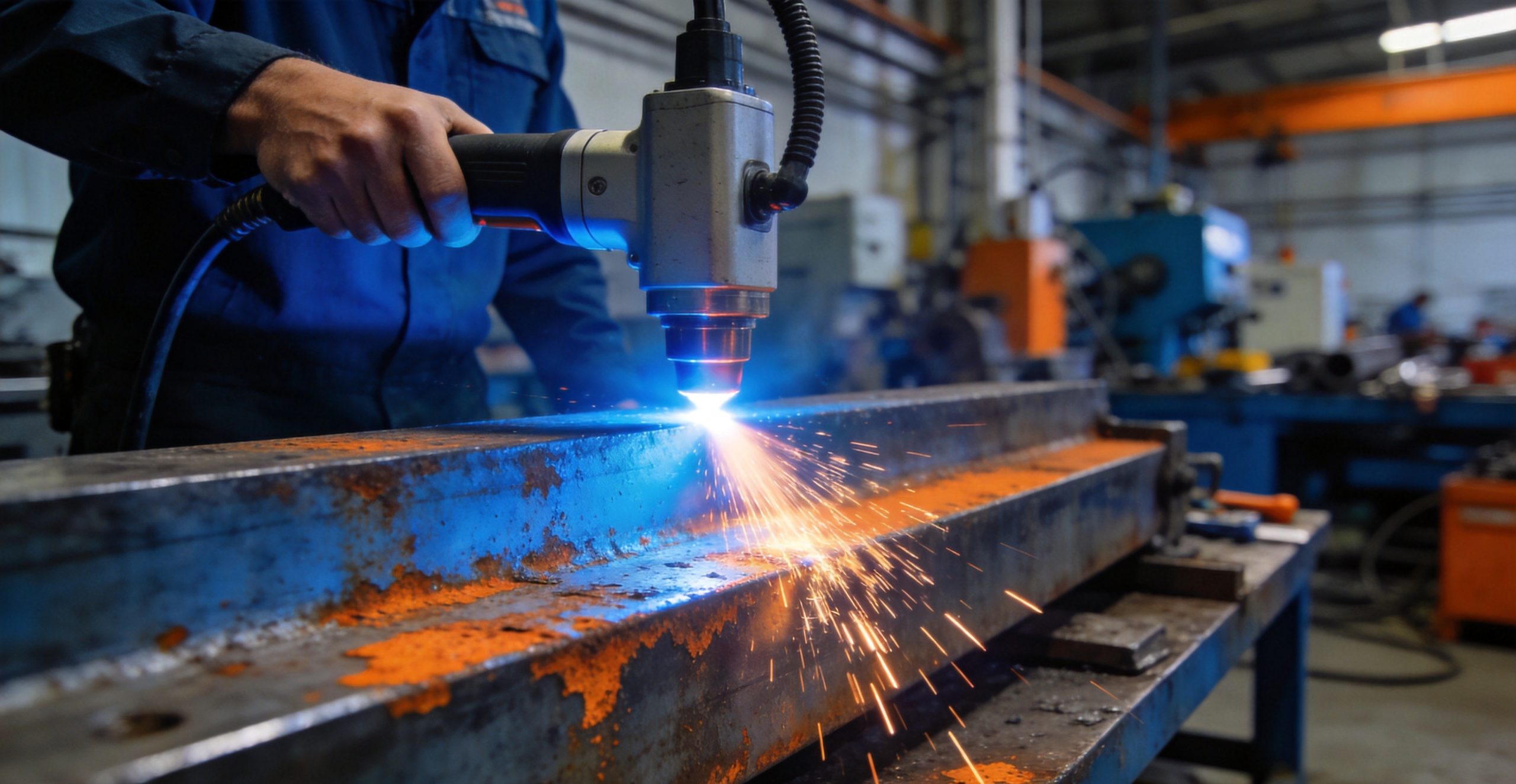
Laser cleaning is one of the fastest-growing industrial surface treatment technologies. What started as a niche process for precision cleaning has now become a mainstream solution across dozens of industries — from automotive manufacturing to heritage restoration.
Unlike traditional methods like sandblasting, chemical cleaning, and manual grinding, laser cleaning uses a focused laser beam to remove contaminants without damaging the base material. It’s faster, cleaner, more precise, and far more environmentally friendly.
But what exactly is laser cleaning used for? In this comprehensive guide, we explore 10 major industrial applications of laser cleaning, including real-world use cases, why laser is chosen over other methods, and what types of laser cleaners are used for each application.
Whether you’re considering investing in a laser cleaning machine or just curious about how this technology is transforming industry, this guide will give you a thorough overview.
—
Why Laser Cleaning Is Taking Over Industry
Before diving into specific applications, let’s quickly review why laser cleaning has become so popular:
- Precision: Can target areas as small as 0.1mm without damaging surrounding material
- Speed: Much faster than manual cleaning, often faster than sandblasting for precision work
- No consumables: No abrasive media, no chemicals, no water — just electricity
- Eco-friendly: Zero hazardous waste, zero water usage, minimal fumes (with extraction)
- Non-contact: No tool wear, no force on the part
- Automation-ready: Easily integrated with robots and production lines
- Safe: No flying abrasive particles, no chemical exposure (with proper PPE)
These advantages make laser cleaning the preferred choice for an ever-growing list of industrial applications.
—
1. Mold Cleaning (Injection Molding & Die Casting)
Industry: Mold Manufacturing, Plastic Injection, Die Casting, Rubber Molding
Laser type: Pulsed fiber laser (handheld or automated)
Power range: 100W – 1000W
Mold cleaning is the largest and fastest-growing application for laser cleaning. Traditional mold cleaning methods — dry ice blasting, ultrasonic cleaning, chemical dipping — are slow, messy, and can damage delicate mold surfaces.
Common Mold Cleaning Applications:
- Injection molds: Removing release agent buildup, plastic residue, and carbon deposits
- Rubber molds: Cleaning rubber residue, vulcanization byproducts, and release agents
- Die casting dies: Removing aluminum/zinc buildup, oxides, and lubricant residue
- Blow molds: Cleaning PET bottle molds, cosmetic container molds
- Precision molds: Micro-molds, connector molds, medical device molds
- Mold texturing: Cleaning textured mold surfaces without damaging the texture
- Mold repair prep: Cleaning before welding repair or surface treatment
- Hot runner systems: Cleaning nozzles, manifolds, and gates
Why Laser for Mold Cleaning?
- No damage: Doesn’t alter mold dimensions or surface finish (unlike sandblasting)
- No disassembly: Can clean many molds in-place on the machine
- Precision: Cleans tiny features, vents, and ejector pins without damage
- Fast: 3–10x faster than manual or chemical cleaning
- No media residue: No grit or chemicals left behind (critical for food/medical molds)
- Less downtime: Faster cleaning = more production time
ROI example: A medium-sized injection molding shop with 20 molds can save $50,000–$200,000 per year by switching from manual/chemical cleaning to laser cleaning — mainly from reduced downtime and labor cost.
—
2. Rust Removal & Corrosion Treatment
Industry: Metal Fabrication, Shipbuilding, Infrastructure, Restoration
Laser type: Continuous wave or quasi-continuous fiber laser
Power range: 1000W – 3000W
Rust and corrosion are billion-dollar problems for industry. Laser cleaning provides a fast, precise, and eco-friendly way to remove rust and prepare surfaces for painting, coating, or welding.
Common Rust Removal Applications:
- Steel structures: Bridges, buildings, towers, pipelines
- Ship hulls: Deck rust, hull corrosion, marine growth
- Automotive restoration: Classic car body panels, frames, engine parts
- Railway: Tracks, rail cars, signal equipment
- Oil & gas: Pipelines, storage tanks, refinery equipment
- Aerospace: Aircraft skin corrosion, landing gear, engine components
- Infrastructure: Bridges, dams, power transmission towers
- Manufacturing: Steel coils, sheets, and fabricated parts
Why Laser for Rust Removal?
- No abrasive media: No spent grit to dispose of
- No chemicals: No acid etching or hazardous waste
- Precise: Can remove just the rust, leaving good paint intact
- Variable depth: Can remove surface rust or deep corrosion
- Surface profiling: Can create ideal surface roughness for coating adhesion
- Automated: Robotic systems for large structures
- Dust only: Waste is just iron oxide dust (collected by extraction)
Note: For very heavy rust (thick scale), sandblasting may still be faster. But for light-to-medium rust and precision applications, laser is superior.
—
3. Paint & Coating Removal
Industry: Automotive, Aerospace, Marine, Construction
Laser type: Fiber laser (high power)
Power range: 1000W – 5000W
Paint and coating removal is another major application for laser cleaning. Whether you’re stripping old paint for refinishing or removing coatings for inspection, laser cleaning offers significant advantages over chemical strippers and sandblasting.
Common Paint & Coating Removal Applications:
- Automotive: Paint stripping for repair, customization, or recycling
- Aerospace: Aircraft paint removal for inspection and maintenance
- Marine: Boat hull paint and antifouling removal
- Railway: Rail car paint stripping and refurbishment
- Construction: Architectural metalwork paint removal
- Electronics: Coating removal from wires, connectors, PCBs
- Oil & gas: Pipeline coating removal for inspection and repair
- Furniture: Wood and metal furniture paint stripping
Why Laser for Paint Removal?
- Selective stripping: Can remove top coat without damaging primer or base material
- No chemicals: No toxic paint strippers or hazardous fumes
- No media: No spent abrasive to dispose of
- Precise: Can strip paint from specific areas only
- Fast: Much faster than chemical stripping (minutes vs. hours)
- Clean surface: Ready for re-coating immediately (no neutralizing/rinsing)
- Automation: Robotic systems for production lines
Environmental benefit: Paint stripping is one of the most polluting industrial processes. Laser paint removal eliminates the need for toxic chemical strippers, making it much more environmentally friendly.
—
4. Weld Seam Cleaning & Preparation
Industry: Metal Fabrication, Automotive, Aerospace, Pipe Welding
Laser type: Pulsed or CW fiber laser (handheld or inline)
Power range: 200W – 2000W
Weld quality depends heavily on surface preparation. Contaminants like oil, grease, rust, and oxides can cause porosity, inclusions, and weak welds. Laser cleaning provides a fast, consistent way to prepare weld surfaces.
Common Welding Applications:
- Weld prep: Cleaning oil, grease, rust, and oxides before welding
- Post-weld cleaning: Removing weld discoloration (heat tint), slag, and spatter
- Pipe welding: Bevel preparation and post-weld cleaning (orbital systems)
- Automotive welding: Body-in-white weld prep and post-cleaning
- Aluminum welding: Removing oxide layer (critical for quality aluminum welds)
- Stainless steel: Removing heat tint and restoring corrosion resistance
- Tube & pipe: Weld seam cleaning for sanitary applications (food/pharma)
- Weld inspection: Cleaning before NDT (non-destructive testing)
Why Laser for Weld Cleaning?
- Consistent quality: Every weld gets the same clean surface
- Fast: Cleans weld joints in seconds
- No chemicals: No pickling paste or acid (common for stainless steel)
- No abrasives: No grit to remove before welding
- Improved weld quality: Reduces porosity and inclusions
- Restores corrosion resistance: Critical for stainless steel (removes chromium-depleted layer)
- Inline integration: Can be built into automated welding cells
Stainless steel note: Laser cleaning replaces toxic pickling paste (nitric/hydrofluoric acid) for removing weld heat tint — a major safety and environmental improvement.
—
5. Heritage & Monument Restoration
Industry: Cultural Heritage, Historic Preservation, Art Restoration
Laser type: Pulsed Nd:YAG or fiber laser (precision)
Power range: 50W – 500W
Laser cleaning has revolutionized heritage restoration. Conservators can now remove centuries of dirt, pollution, and over-painting without damaging the original surface — something that was impossible with traditional methods.
Common Heritage Restoration Applications:
- Stone monuments: Removing pollution crust, biological growth, and graffiti
- Historical buildings: Facade cleaning, statue restoration
- Artwork: Painting restoration, sculpture cleaning
- Archaeological artifacts: Cleaning metal, stone, and ceramic artifacts
- Textiles: Delicate cleaning of fabrics and tapestries (specialized)
- Metal artifacts: Removing corrosion from coins, weapons, and tools
- Glass and ceramics: Cleaning stained glass, pottery, and mosaics
- Wood: Removing varnish, paint, and soot from wooden artifacts
Why Laser for Heritage Restoration?
- Precision: Can remove microns of material at a time
- Selective: Targets the contaminant without affecting the original surface
- No chemicals: No risk of chemical damage to delicate artifacts
- No abrasives: No mechanical wear on fragile surfaces
- Controllable: Adjustable parameters for different materials and contaminants
- Dry process: No water or moisture (critical for water-sensitive artifacts)
- Reversible: Can stop at any point and assess results
Fun fact: Laser cleaning was used to restore famous landmarks like the Statue of Liberty, the Colosseum, and countless medieval cathedrals across Europe.
—
6. Food & Beverage Equipment
Industry: Food Processing, Beverage Production, Pharmaceutical
Laser type: Pulsed fiber laser (sanitary design)
Power range: 100W – 1000W
Food and beverage production requires the highest standards of cleanliness and hygiene. Laser cleaning provides a dry, chemical-free way to maintain production equipment.
Common Food & Beverage Applications:
- Conveyor belts: Removing food residue, grease, and buildup
- Processing equipment: Tanks, mixers, fillers, cappers
- Packaging machinery: Sealing jaws, forming tools, cutting blades
- Baking equipment: Oven belts, baking pans, dough rollers
- Dairy equipment: Pasteurizers, separators, filling nozzles
- Brewery & winery: Tanks, pipes, bottling lines
- Meat processing: Grinders, slicers, smokehouses
- Molds & dies: Candy molds, chocolate molds, snack food dies
Why Laser for Food & Beverage?
- No chemicals: No risk of chemical contamination
- Dry process: No moisture to promote bacterial growth
- No media: No abrasive grit to get into food
- High temperature resistance: Cleans hot equipment without cool-down
- IP65 options: Some machines are washdown-safe
- FDA compliant: Suitable for food contact surfaces (when properly validated)
- Reduced downtime: Faster cleaning than traditional methods
Regulatory note: Laser cleaning equipment used in food production must meet FDA and local health department requirements. Always verify compliance for your specific application.
—
7. Tire & Rubber Manufacturing
Industry: Tire Manufacturing, Rubber Processing, Automotive
Laser type: Pulsed fiber laser (mold cleaning)
Power range: 200W – 1000W
Tire molds are notoriously difficult to clean. The intricate tread patterns and tiny vent holes trap rubber residue and release agent buildup, and traditional cleaning methods (sandblasting, dry ice, chemical) can damage the delicate mold features.
Common Tire & Rubber Applications:
- Tire mold cleaning: Removing rubber residue, release agent, and sulfur buildup
- Tread pattern cleaning: Cleaning intricate tread designs without damage
- Vent hole cleaning: Clearing tiny vent holes (0.1–0.5mm) that get clogged
- Sidewall molds: Cleaning lettering, logos, and sidewall patterns
- Rubber extrusion dies: Removing rubber buildup from die openings
- Rubber molds: Industrial rubber products, seals, gaskets
- Mold maintenance: Regular preventive maintenance cleaning
- Mold repair prep: Cleaning before welding repair
Why Laser for Tire Molds?
- Precision: Cleans tiny vent holes and fine tread details without damage
- No media: No grit stuck in vent holes (a major problem with sandblasting)
- Fast: Much faster than manual or chemical cleaning
- In-place cleaning: Some systems can clean molds on the press
- Longer mold life: No abrasive wear on mold surfaces
- Consistent quality: Every mold gets the same level of clean
- No disassembly: Can clean assembled molds in many cases
Industry impact: Most major tire manufacturers have switched to laser mold cleaning because it improves quality, reduces costs, and extends mold life.
—
8. Aerospace & Aviation Maintenance
Industry: Aerospace, Aviation, MRO (Maintenance, Repair & Overhaul)
Laser type: Pulsed fiber laser, Nd:YAG laser (precision)
Power range: 100W – 1000W
Aircraft maintenance requires the highest standards of quality and precision. Laser cleaning is increasingly used in aerospace MRO for a wide range of applications where traditional methods fall short.
Common Aerospace Applications:
- Paint stripping: Aircraft skin paint removal for inspection and repainting
- Engine maintenance: Turbine blade cleaning, compressor blade refurbishment
- Corrosion removal: Treating corrosion on airframe and structural components
- Weld prep & cleaning: Preparing surfaces for welding and post-weld cleaning
- Composite repair: Preparing composite surfaces for repair and bonding
- Landing gear: Removing grease, corrosion, and old coatings
- Fastener inspection: Cleaning around rivets and bolts for crack inspection
- NDT preparation: Cleaning before non-destructive testing (ultrasonic, eddy current)
Why Laser for Aerospace?
- Precision: Critical for expensive, safety-critical components
- No damage: Doesn’t affect base material properties or dimensions
- Controllable: Can remove specific layers without damaging underlying materials
- No media: No grit to get into bearings, hydraulics, or avionics
- Automated: Robotic systems for consistent, repeatable results
- Certifiable: Process can be qualified for aerospace specifications
- Reduced waste: No hazardous chemical waste or spent abrasive
Regulatory note: Aerospace laser cleaning processes must be qualified according to aerospace standards (NADCAP, company specifications) before being used on flight-critical components.
—
9. Electronics & Semiconductor Manufacturing
Industry: Electronics, Semiconductors, PCB Manufacturing
Laser type: UV laser, pulsed fiber laser (micro-cleaning)
Power range: 10W – 200W
Electronics manufacturing deals with tiny, delicate components where even microscopic contamination can cause failure. Laser cleaning provides the precision needed for micro-electronic applications.
Common Electronics Applications:
- PCB cleaning: Removing flux residue, oxidation, and contamination
- Wire bonding: Cleaning bond pads before wire bonding (critical for bond strength)
- Semiconductor wafers: Cleaning wafers between processing steps
- Connectors: Removing oxidation and contamination from electrical contacts
- Display manufacturing: Cleaning LCD, OLED, and microLED panels
- Solar cells: Cleaning photovoltaic cells before processing
- Battery manufacturing: Cleaning battery tabs and busbars before welding
- Sensors: Cleaning precision sensor components
Why Laser for Electronics?
- Ultra-fine precision: Can clean features as small as 10μm
- Non-contact: No mechanical stress on delicate components
- No damage: Doesn’t affect sensitive electronic components
- No residues: No flux, chemicals, or abrasive left behind
- Dry process: No water or moisture (critical for electronics)
- High speed: Matches high-volume electronics production
- Selective: Can clean specific areas without affecting the rest
—
10. Automotive Manufacturing & Refinishing
Industry: Automotive OEM, Aftermarket, Restoration
Laser type: Fiber laser (handheld and automated)
Power range: 500W – 3000W
The automotive industry uses laser cleaning throughout the manufacturing process — from stamping and welding to final assembly and aftermarket repair.
Common Automotive Applications:
- Body-in-white: Weld prep and post-weld cleaning on body panels
- Chassis & frame: Rust removal, weld prep, frame cleaning
- Engine components: Cylinder head cleaning, valve refurbishing, carbon removal
- Brake components: Cleaning brake calipers, rotors, and pads
- Paint shop: Paint stripping for repair and refinishing
- Classic car restoration: Rust removal, paint stripping, metal preparation
- Wheels & rims: Removing brake dust, corrosion, and old coatings
- Underbody: Undercarriage cleaning and rust treatment
- Battery manufacturing: EV battery cell and module cleaning
Why Laser for Automotive?
- Fast: Matches high-volume production line speeds
- Consistent: Every part gets the same quality clean
- Automated: Easily integrated into robotic production lines
- No consumables: Lower operating cost than other methods
- Precise: Can clean specific areas without masking
- Improved quality: Better weld quality, better paint adhesion
- Eco-friendly: No chemicals, no waste media
—
Honorable Mentions: More Growing Applications
3D Printing Post-Processing
Removing powder residue and support structures from metal 3D printed parts.
Firearms & Defense
Cleaning gun parts, removing rust and old coatings, and preparing surfaces for refinishing.
Marine & Shipbuilding
Hull cleaning, propeller polishing, deck rust removal, and marine growth removal.
Pharmaceutical & Medical Equipment
Cleaning stainless steel equipment, tools, and production surfaces to the highest hygiene standards.
Glass & Solar Panel Manufacturing
Cleaning glass surfaces, removing coatings, and preparing surfaces for coating.
Oil & Gas Pipeline
Pipeline inspection prep, coating removal, weld joint cleaning, and corrosion treatment.
—
How to Choose the Right Laser Cleaner
By Application
| Application | Recommended Type | Typical Power |
|---|---|---|
| Mold cleaning | Pulsed fiber laser | 200–500W |
| Rust removal | CW fiber laser | 1000–2000W |
| Paint removal | CW fiber laser | 1500–3000W |
| Weld cleaning | Pulsed or CW fiber | 200–1000W |
| Heritage restoration | Pulsed Nd:YAG/fiber | 50–200W |
| Tire molds | Pulsed fiber laser | 200–500W |
| Electronics | UV or pulsed fiber | 10–100W |
| General industrial | Handheld fiber laser | 1000–2000W |
By Budget
- Entry-level ($5,000–$10,000): 1000W handheld fiber laser (light rust, paint, weld cleaning)
- Mid-range ($10,000–$25,000): 1500–2000W handheld or workstation
- Industrial ($25,000–$100,000+): Automated system, robotic cell, or high-power
Key Features to Look For
- Laser source quality: Reputable brand with long lifespan
- Scanner quality: Galvanometer scanner for speed and precision
- Handheld vs. stationary: Portable vs. production use
- Fume extraction: Built-in or external extraction system
- Safety features: Interlocks, enclosure, laser safety glasses
- Software: User-friendly interface, multiple cleaning modes
- Warranty & support: Service and spare parts availability
—
The Future of Laser Cleaning
Laser cleaning technology continues to advance rapidly. Here are key trends to watch:
1. Higher Power, Lower Cost
Fiber laser power levels continue to increase while prices fall. What cost $50,000 ten years ago now costs $10,000.
2. Robotic & Automated Systems
More manufacturers are integrating laser cleaning into automated production lines — combining cleaning with welding, cutting, and inspection in a single cell.
3. AI and Smart Cleaning
Machine learning and computer vision will enable laser cleaners to automatically detect contaminants, adjust parameters, and verify cleaning quality.
4. Portable & Handheld Growth
Handheld laser cleaners are bringing laser cleaning to small and medium businesses that could never afford automated systems.
5. Environmental Regulations
As environmental regulations tighten around sandblasting (silicosis) and chemical cleaning (hazardous waste), laser cleaning becomes not just the better choice — but the only compliant choice.
—
Final Thoughts
Laser cleaning has come a long way from its early days in aerospace labs. Today, it’s used across every major industry — from mold cleaning to heritage restoration, from rust removal to electronics manufacturing.
The key advantages — precision, speed, eco-friendliness, and versatility — make laser cleaning the best choice for an ever-growing list of applications. And as the technology continues to improve and become more affordable, even more industries will adopt it.
If you’re considering adding laser cleaning to your operation, now is a great time. The technology is mature, the prices are reasonable, and the ROI is proven across hundreds of applications.
—
Ready to explore laser cleaning for your application? [Browse our laser cleaning machines](https://www.transonlaser.com/product-category/laser-cleaner/) or [contact us](https://www.transonlaser.com/contact-us/) for a free consultation. We can test your parts with our laser cleaners and show you the results — no obligation.
*Which laser cleaning application surprised you the most? Drop a comment below — we’d love to hear your thoughts.*