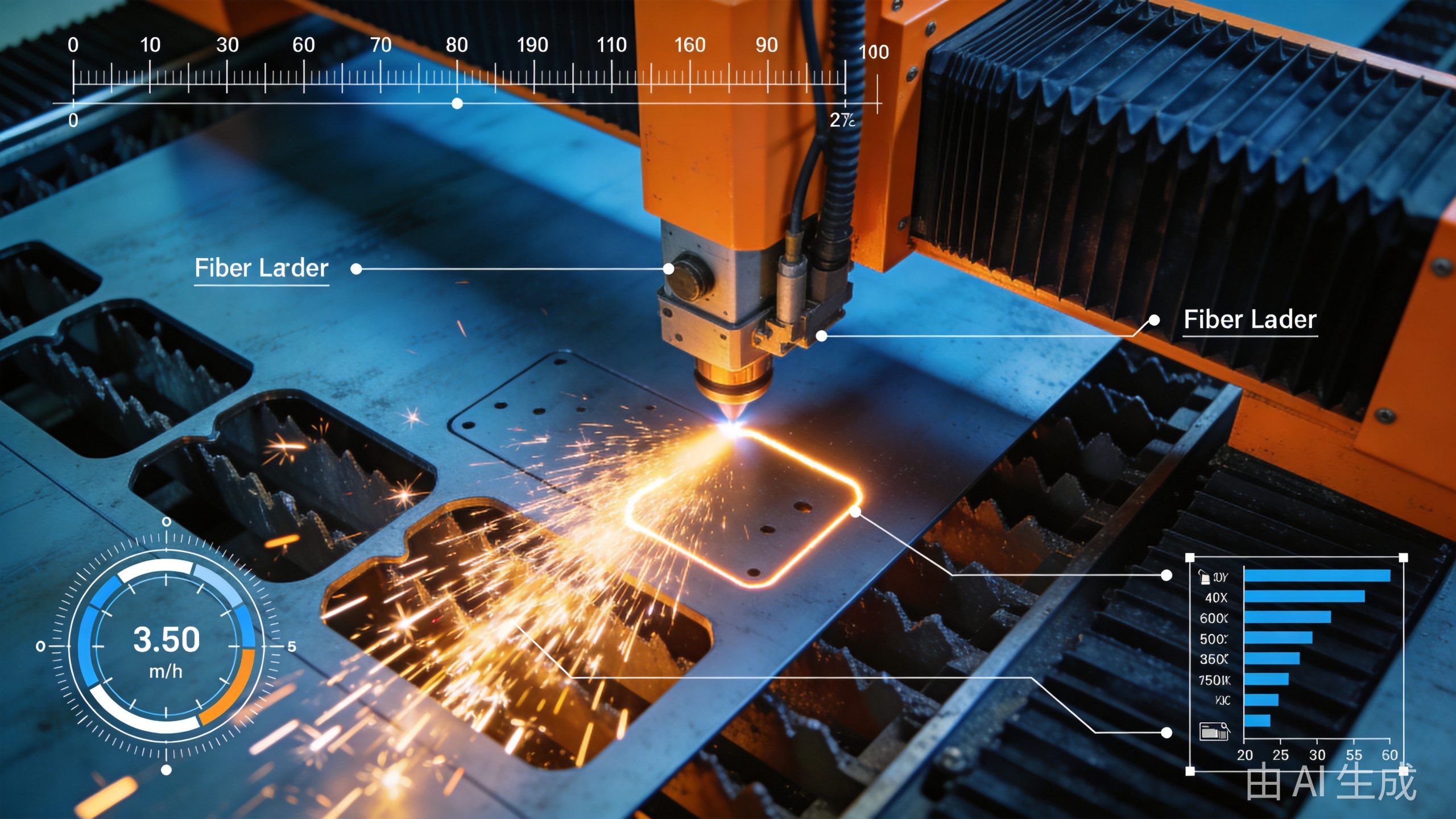
When shopping for a fiber laser cutting machine, you’ll encounter a long list of technical parameters — laser power, cutting speed, beam quality, positioning accuracy, and more. But what do these numbers actually mean, and which ones matter most for your application?
In this complete reference guide, we break down every key parameter of fiber laser cutting machines, explain what each one means, and provide typical values for different machine sizes. Whether you’re comparing models, evaluating quotes, or just want to understand the specs, this is your go-to resource.
Quick Navigation
– Laser Source Parameters
– Cutting Performance Parameters
– Motion System Parameters
– Worktable & Machine Parameters
– Assist Gas Parameters
– Parameter Comparison by Power Level
– Which Parameters Matter Most?
Laser Source Parameters
The laser source is the heart of the machine. These parameters define the laser beam itself.
Laser Power (Output Power)
What it is: The maximum power the laser source can deliver to the workpiece, measured in watts (W) or kilowatts (kW).
Why it matters: Laser power is the single biggest factor determining:
– How thick a material the machine can cut
– How fast it can cut
– The overall productivity of the machine
Typical values:
| Power Level | Typical Applications | Max Steel Thickness |
|---|---|---|
| 500W–1kW | Thin sheet, hobby, prototyping | 3–6 mm |
| 1.5kW–2kW | General sheet metal fabrication | 8–12 mm |
| 3kW–4kW | Medium-heavy fabrication | 16–20 mm |
| 6kW–8kW | Heavy industrial | 25–30 mm |
| 10kW–15kW | Thick plate, high production | 35–50 mm |
| 20kW–30kW+ | Ultra-thick, maximum productivity | 50–80+ mm |
Important: More power isn’t always better. A 15kW machine cutting 1mm sheet will waste energy and may produce lower-quality cuts than a 2kW machine optimized for thin material.
Wavelength
What it is: The wavelength of the laser light, measured in nanometers (nm).
Why it matters: Wavelength determines how well the laser beam is absorbed by different materials.
Typical value: ~1064 nm (near-infrared) for ytterbium-doped fiber lasers.
At 1064 nm:
– Metals (steel, aluminum, copper, brass) absorb well
– Non-metals (wood, acrylic, fabric) absorb poorly (that’s why CO2 lasers at 10,600 nm are used for those)
– Reflective metals (copper, aluminum, gold) absorb better at 1064 nm than at 10,600 nm — one reason fiber lasers excel at cutting non-ferrous metals
Beam Quality (BPP / M² Factor)
What it is: A measure of how “good” the laser beam is — how tightly it can be focused and how close it is to an ideal Gaussian beam.
Two common measurements:
– BPP (Beam Parameter Product): Measured in mm·mrad. Lower = better beam quality.
– M² Factor: How many times the beam is worse than a perfect Gaussian beam. M² = 1 = perfect. Lower = better.
Why it matters: Better beam quality means:
– Smaller focal spot size
– Higher energy density at the focus
– Better cut quality (narrower kerf, cleaner edges)
– Longer focal depth (more consistent cut through thick material)
Typical values:
| Laser Type | BPP (mm·mrad) | M² Factor |
|---|---|---|
| Single-mode fiber | < 0.4 | < 1.2 |
| Multi-mode fiber (low power) | 2–4 | 2–4 |
| Multi-mode fiber (high power) | 5–10 | 5–10 |
| CO2 laser (slab) | 8–15 | — |
| CO2 laser (fast axial) | 2–5 | — |
For cutting: Multi-mode fiber lasers (BPP 2–8 mm·mrad) are the standard. Single-mode offers better quality but is limited to lower powers and thinner materials.
Pulse Frequency (for pulsed lasers)
What it is: How many laser pulses are emitted per second, measured in kilohertz (kHz).
Why it matters: Most fiber laser cutters use continuous wave (CW) lasers, but some have pulsed capability. Pulsing can:
– Improve piercing quality on thick material
– Reduce heat input on thin materials
– Enable certain specialty applications
Typical values: 0.5–50 kHz (pulsed mode) / CW (continuous wave) for most cutting.
Modulation Rate
What it is: How quickly the laser can be turned on and off, measured in kilohertz (kHz).
Why it matters: Faster modulation allows:
– Crispier corners and finer details
– Better control during piercing
– More precise power control during cutting
Typical values: 10–100 kHz
Fiber Cable Length
What it is: The length of the fiber optic cable that delivers the laser beam from the source to the cutting head.
Why it matters: Longer cables give more working flexibility but:
– Slightly reduce beam quality (higher BPP)
– Add cost
– Increase energy loss (slightly)
Typical values: 5–20 meters for standard machines; longer for robotic or custom installations.
Laser Source Lifetime
What it is: The expected operating lifetime of the laser source before significant power degradation.
Why it matters: The laser source is the most expensive component. A longer lifetime means lower cost of ownership.
Typical values: 50,000–100,000 hours for fiber lasers. Many manufacturers warranty 100,000 hours.
For comparison: CO2 laser tubes typically last 5,000–20,000 hours and need replacement.
Cutting Performance Parameters
These parameters describe what the machine can actually cut.
Maximum Cutting Thickness
What it is: The thickest material the machine can cut through (with acceptable quality).
Why it matters: This is the most commonly cited performance spec — but read the fine print.
Important caveats:
– “Maximum cutting thickness” usually means mild steel with oxygen. Stainless steel and aluminum will be less.
– Maximum thickness doesn’t always mean good quality at that thickness. The cut may be slow, rough, or require multiple passes.
– Always check the cut quality at your target thickness, not just the maximum number.
Typical values by power (mild steel, oxygen assist):
| Laser Power | Max Cutting Thickness | Good Quality Thickness |
|---|---|---|
| 1kW | 6 mm | 4 mm |
| 1.5kW | 8 mm | 6 mm |
| 2kW | 10–12 mm | 8 mm |
| 3kW | 16–20 mm | 12 mm |
| 4kW | 20–22 mm | 16 mm |
| 6kW | 25–30 mm | 20 mm |
| 8kW | 30–35 mm | 25 mm |
| 10kW | 35–40 mm | 30 mm |
| 15kW | 45–50 mm | 35–40 mm |
| 20kW | 50–60 mm | 45 mm |
| 30kW | 70–80+ mm | 50–60 mm |
For stainless steel (nitrogen assist): typically 50–70% of mild steel thickness.
For aluminum (nitrogen assist): typically 40–60% of mild steel thickness.
Cutting Speed
What it is: How fast the machine can move the cutting head while maintaining a complete cut through the material, measured in meters per minute (m/min) or millimeters per second (mm/s).
Why it matters: Cutting speed directly affects productivity and cost per part.
Cutting speed depends on:
– Laser power (more power = faster)
– Material thickness (thinner = faster)
– Material type (mild steel with oxygen = fastest)
– Assist gas type and pressure
– Beam quality
– Desired cut quality
Typical cutting speeds (mild steel, oxygen assist):
| Material Thickness | 1kW | 2kW | 3kW | 6kW | 10kW |
|---|---|---|---|---|---|
| 1 mm | 12–15 m/min | 20–25 m/min | 25–30 m/min | 35–40 m/min | 45–60 m/min |
| 3 mm | 5–7 m/min | 10–14 m/min | 14–18 m/min | 22–28 m/min | 30–40 m/min |
| 5 mm | 2–3 m/min | 5–7 m/min | 7–10 m/min | 12–16 m/min | 18–25 m/min |
| 8 mm | 1–1.5 m/min | 3–4 m/min | 4–6 m/min | 8–12 m/min | 14–18 m/min |
| 10 mm | 0.6–1 m/min | 2–3 m/min | 3–4 m/min | 6–8 m/min | 10–14 m/min |
| 12 mm | — | 1.5–2 m/min | 2.5–3.5 m/min | 5–7 m/min | 8–12 m/min |
| 16 mm | — | — | 1.5–2 m/min | 3.5–5 m/min | 6–9 m/min |
| 20 mm | — | — | 0.8–1.2 m/min | 2.5–3.5 m/min | 4–6 m/min |
Note: These are approximate values for reference only. Actual speeds vary by manufacturer, machine configuration, and cut quality requirements.
Positioning Speed (Rapid Traverse Speed)
What it is: How fast the cutting head can move when it’s NOT cutting (moving between cuts), measured in meters per minute (m/min).
Why it matters: Faster positioning reduces non-cutting time, which is especially important for parts with many holes or features.
Typical values:
– Entry-level: 20–40 m/min
– Mid-range: 60–100 m/min
– High-end (linear motors): 120–200+ m/min
Positioning Accuracy
What it is: How accurately the machine can position the cutting head at a target location, measured in millimeters (mm) or micrometers (µm).
Why it matters: Positioning accuracy determines how precisely parts are cut and how well features align with each other.
Typical values:
– Entry-level: ±0.1 mm
– Mid-range: ±0.05 mm
– High-precision: ±0.02–0.03 mm
Repeatability (Repositioning Accuracy)
What it is: How consistently the machine returns to the same position when commanded to go there multiple times.
Why it matters: Repeatability is often more important than absolute accuracy for production — it means every part is identical.
Typical values:
– Entry-level: ±0.05 mm
– Mid-range: ±0.02–0.03 mm
– High-precision: ±0.01 mm
Kerf Width
What it is: The width of the cut — how much material is removed by the laser, measured in millimeters (mm).
Why it matters:
– Narrower kerf = less material waste
– Narrower kerf = finer detail capability
– Kerf width must be accounted for in part programming (kerf compensation)
Typical values: 0.1–0.5 mm
– Thinner material + better beam quality = narrower kerf
– Thicker material + higher power = wider kerf
Cut Edge Roughness (Ra)
What it is: The surface roughness of the cut edge, measured in micrometers (µm) using the Ra (roughness average) scale.
Why it matters: Cut quality directly affects whether post-processing (grinding, deburring) is needed.
Typical values:
– Excellent quality: Ra 1.6–3.2 µm (mirror-like, no post-processing needed)
– Good quality: Ra 6.3–12.5 µm (minor dross, light deburring)
– Acceptable: Ra 12.5–25 µm (dross removal needed)
Motion System Parameters
Drive Type
What it is: The mechanism that moves the gantry and cutting head.
Common types:
– Ball screw + servo motor: Economical, good accuracy, moderate speed. Most common in entry and mid-range machines.
– Linear motor: Very fast acceleration and high speed, excellent precision, higher cost. Used in high-end production machines.
– Rack and pinion: Used for very large machines where ball screws aren’t practical. Good speed, lower precision.
Acceleration
What it is: How quickly the machine can reach full speed, measured in G (gravitational acceleration) or m/s².
Why it matters: Acceleration is often more important than top speed for parts with many features (lots of starts, stops, and direction changes).
Typical values:
– Ball screw: 0.5–1.5 G
– Linear motor: 2–5 G+
X-Axis Travel (Length)
What it is: The maximum distance the gantry can move along the long axis of the machine.
Why it matters: Determines the maximum length of sheet that can be processed.
Typical values:
– Small format: 1500 mm (5 ft)
– Standard: 3000 mm (10 ft)
– Large format: 4000–6000 mm (13–20 ft)
– Extra large: 8000–12000 mm (26–40 ft)
Y-Axis Travel (Width)
What it is: The maximum distance the cutting head can move along the cross axis.
Why it matters: Determines the maximum width of sheet that can be processed.
Typical values:
– Small format: 1000–1500 mm
– Standard: 1500–2000 mm
– Wide format: 2500–3000 mm
Z-Axis Travel
What it is: The vertical travel range of the cutting head.
Why it matters: Determines how much vertical adjustment is available for different material thicknesses and focus positions.
Typical values: 80–200 mm
Guide Rail Type
What it is: The type of linear guide rails used for motion.
Common types:
– Linear guideways (ball rails): Most common, good precision and load capacity
– Square linear guides: Higher precision and rigidity
– V-guide: Lower cost, less precision
Worktable & Machine Parameters
Worktable Size
What it is: The dimensions of the cutting table.
Standard sizes (length × width):
– 1500 × 1000 mm (5×3 ft)
– 1500 × 1500 mm (5×5 ft)
– 3000 × 1500 mm (10×5 ft) — most common
– 4000 × 2000 mm (13×6.5 ft)
– 6000 × 2500 mm (20×8 ft)
Maximum Load Capacity
What it is: The maximum weight the worktable can support, measured in kilograms (kg) or pounds (lbs).
Why it matters: Important for thick plates and heavy materials.
Typical values:
– Thin-sheet machine: 100–300 kg
– Standard: 500–1000 kg
– Heavy plate: 1500–3000 kg+
Pallet Changer
What it is: A dual-pallet system that allows loading/unloading on one pallet while the machine cuts on the other.
Why it matters: Significantly reduces non-productive time. Without a pallet changer, the machine sits idle while the operator loads/unloads parts.
Types:
– Side-to-side (shuttle): Pallets slide in from the side
– Front-to-back: Pallets move front to back
– Rotary: Pallets rotate into position
Exchange time: Typically 15–30 seconds.
Overall Machine Dimensions
What it is: The total footprint of the machine, including the laser source cabinet, chiller, and dust collector.
Why it matters: Determines how much floor space you need.
Typical for a 3015 (3×1.5m) machine:
– Length: 8–12 meters
– Width: 3–5 meters
– Height: 2–2.5 meters
Machine Weight
What it is: The total weight of the machine.
Why it matters: Affects foundation requirements and installation logistics.
Typical for a 3015 machine:
– Entry-level: 3,000–5,000 kg
– Mid-range: 6,000–10,000 kg
– High-end: 12,000–20,000 kg+
Heavier machines generally have better rigidity and vibration damping, which improves cut quality.
Power Consumption
What it is: The electrical power the machine draws during operation, measured in kilowatts (kW).
Why it matters: Affects operating cost and electrical infrastructure requirements.
Typical values:
| Laser Power | Total Machine Power Draw |
|---|---|
| 1kW | 5–8 kW |
| 2kW | 8–12 kW |
| 3kW | 12–18 kW |
| 6kW | 20–30 kW |
| 10kW | 30–45 kW |
| 15kW | 45–65 kW |
| 20kW | 60–85 kW |
Important: This is total machine power (laser + chiller + drives + controls). The laser source itself is about 40–60% of the total, depending on efficiency.
Power Supply Requirements
What it is: The electrical service needed to run the machine.
Typical requirements:
– Voltage: 380V / 400V / 480V (3-phase)
– Frequency: 50/60 Hz
– Amperage: 30–200+ A depending on power
Always verify with the specific machine manufacturer and consult a licensed electrician.
Cooling System
What it is: The water chiller that keeps the laser source and optics at proper operating temperature.
Key parameters:
– Cooling capacity: Measured in kW or BTU. Must match the laser waste heat.
– Temperature stability: Typically ±0.5°C or better
– Dual circuit: Separate loops for laser source and optics (standard on most machines)
– Water quality: Requires deionized or distilled water
Assist Gas Parameters
Gas Types
The choice of assist gas significantly affects cutting performance and cost.
| Gas | Best For | Advantages | Disadvantages |
|---|---|---|---|
| Oxygen | Mild steel, carbon steel | Fast cutting (exothermic reaction), low gas cost | Oxidized edge, may need post-processing |
| Nitrogen | Stainless steel, aluminum, copper, brass | Clean, oxide-free edge, no discoloration | More expensive, slower cutting |
| Compressed Air | Thin sheet, general purpose | Very low cost | Moderate quality, not for thick material |
| Argon | Specialty, very thick | Maximum inertness | Very expensive |
Gas Pressure
What it is: The pressure of the assist gas at the nozzle, measured in bar or psi.
Typical values:
– Oxygen (mild steel): 0.5–3 bar
– Nitrogen (stainless/aluminum): 8–20 bar
– Compressed air: 8–15 bar
Higher pressure is generally needed for:
– Thicker materials
– Faster cutting speeds
– Nitrogen cutting (needs higher pressure to blow out molten material)
Gas Consumption
What it is: How much assist gas the machine uses, measured in liters per minute (L/min) or cubic meters per hour (m³/h).
Typical values:
– Oxygen: 10–30 L/min
– Nitrogen: 15–50 L/min
– Compressed air: 50–200 L/min (but at lower cost)
Gas cost can be a significant part of operating expense, especially for nitrogen.
Nozzle Diameter
What it is: The diameter of the nozzle orifice at the tip of the cutting head.
Common sizes: 1.0 mm, 1.5 mm, 2.0 mm, 2.5 mm, 3.0 mm
Guidelines:
– Smaller nozzle: Better cut quality, lower gas consumption, for thinner material
– Larger nozzle: Higher gas flow, for thicker material
– Nozzle type: Single (for oxygen) vs. double (for nitrogen / high pressure)
Parameter Comparison by Power Level
Here’s a side-by-side comparison of typical fiber laser cutting machine parameters across common power levels:
| Parameter | 1kW | 2kW | 3kW | 6kW | 10kW | 15kW |
|---|---|---|---|---|---|---|
| Max mild steel cut | 6 mm | 12 mm | 20 mm | 30 mm | 40 mm | 50 mm |
| Max stainless cut | 3 mm | 6 mm | 10 mm | 16 mm | 25 mm | 30 mm |
| Max aluminum cut | 2 mm | 4 mm | 6 mm | 12 mm | 20 mm | 25 mm |
| Cut speed (1mm steel) | 12 m/min | 22 m/min | 28 m/min | 40 m/min | 50 m/min | 60 m/min |
| Cut speed (5mm steel) | 2.5 m/min | 6 m/min | 9 m/min | 15 m/min | 22 m/min | 30 m/min |
| Positioning speed | 40 m/min | 80 m/min | 100 m/min | 120 m/min | 140 m/min | 160 m/min |
| Positioning accuracy | ±0.1 mm | ±0.05 mm | ±0.05 mm | ±0.03 mm | ±0.03 mm | ±0.03 mm |
| Repeatability | ±0.05 mm | ±0.03 mm | ±0.03 mm | ±0.02 mm | ±0.02 mm | ±0.02 mm |
| BPP (beam quality) | 3–6 mm·mrad | 3–6 mm·mrad | 4–8 mm·mrad | 5–10 mm·mrad | 6–12 mm·mrad | 8–15 mm·mrad |
| Wavelength | 1064 nm | 1064 nm | 1064 nm | 1064 nm | 1064 nm | 1064 nm |
| Total power draw | 6 kW | 10 kW | 15 kW | 25 kW | 35 kW | 50 kW |
| Laser lifetime | 100,000 hr | 100,000 hr | 100,000 hr | 100,000 hr | 100,000 hr | 100,000 hr |
*Note: These are approximate reference values. Actual parameters vary by manufacturer and model.*
Which Parameters Matter Most?
The importance of each parameter depends on your specific application, but here’s a general priority guide:
Most Important
1. Laser power — determines what you can cut and how fast
2. Worktable size — must fit your standard sheet size
3. Cutting speed at your target thickness — not just max speed, but speed on the material you actually cut
4. Beam quality (BPP) — affects cut quality, especially on thicker material
Important
5. Positioning accuracy & repeatability — critical for precision parts
6. Positioning speed & acceleration — affects productivity for parts with many features
7. Pallet changer — can double effective productivity
8. Assist gas options — affects operating cost and cut quality
Nice to Have
9. Z-axis travel — usually sufficient for most applications
10. Machine weight — heavier is generally better but not critical
11. Modulation rate — matters for fine detail work
12. Fiber cable length — only matters for robotic or special installations
How to Use This Guide
When comparing machines from different manufacturers, be sure to:
1. Compare apples to apples: Make sure you’re comparing the same power level, table size, and configuration
2. Ask for cut samples: Numbers on a spec sheet don’t tell the whole story. Get actual cut samples in your material and thickness.
3. Check the fine print: “Maximum cutting thickness” often means with oxygen on mild steel at slow speed — not necessarily production-quality cutting.
4. Consider total cost of ownership: Include electricity, gas, consumables, and maintenance, not just purchase price.
5. Test before you buy: If possible, run a production trial on the actual machine.
For help choosing the right machine, see our Fiber Laser Cutting Machine Buyer’s Guide or check out how much they cost.
Further Reading:
– Fiber Laser Cutting Thickness & Speed Chart
– How to Choose a Fiber Laser Cutting Machine
– How Much Does a Fiber Laser Cutting Machine Cost?
– Fiber Laser vs CO2 Laser Cutting Machine Comparison
– 12 Best Fiber Laser Cutting Machine Brands & Manufacturers