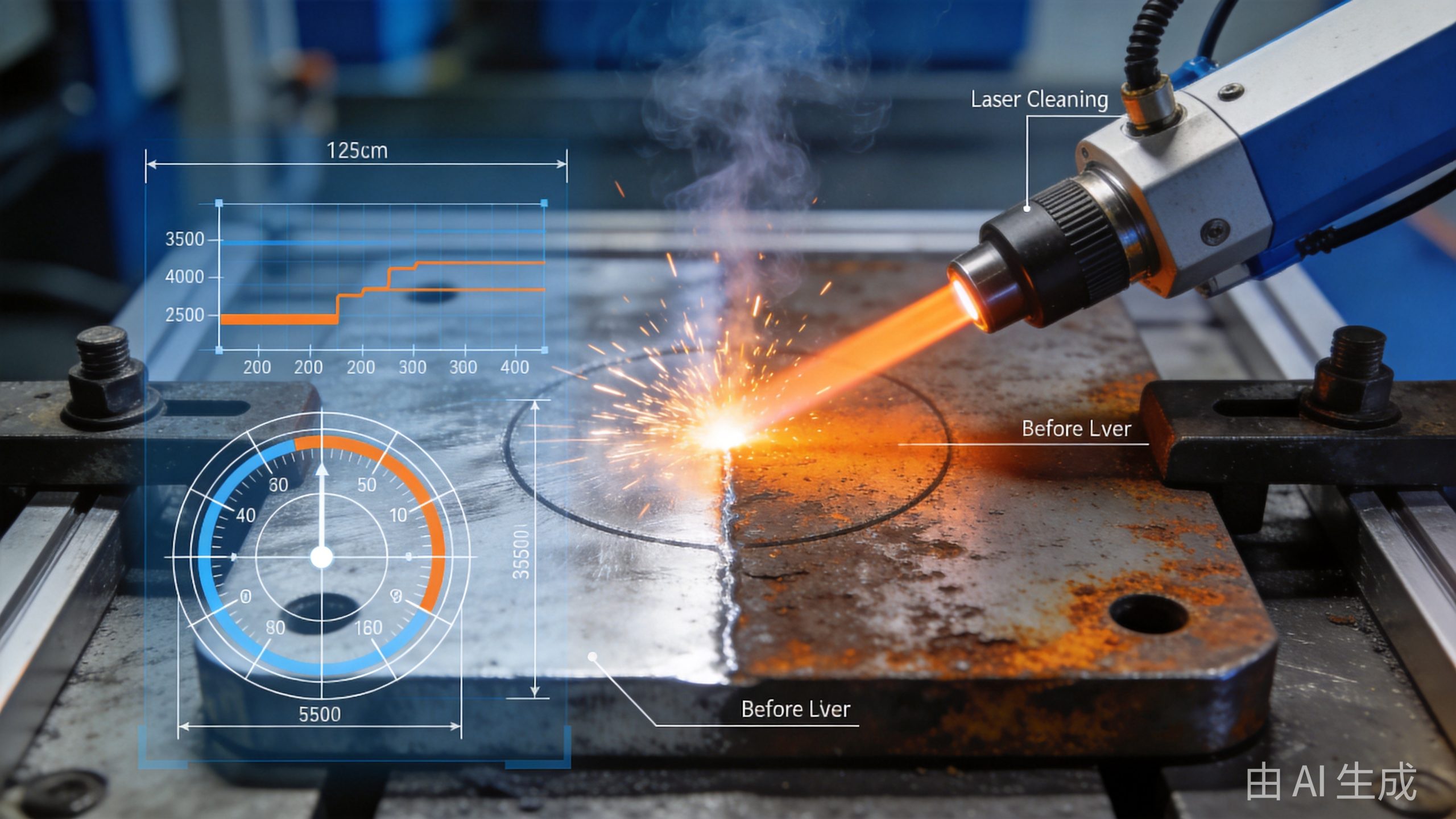
When evaluating laser cleaning machines, you’ll encounter a long list of technical specifications — laser power, scan width, pulse frequency, cleaning speed, and more. But what do these numbers actually mean, and which ones matter most for your application?
In this complete reference guide, we break down every key parameter of laser cleaning machines, explain what each one means, and provide typical values across different power levels and machine types. Whether you’re comparing models, evaluating quotes, or just want to understand the specs, this is your go-to resource.
Quick Navigation
– Laser Source Parameters
– Cleaning Performance Parameters
– Scanning System Parameters
– Motion & Positioning Parameters
– Fume Extraction Parameters
– Cooling System Parameters
– Machine & Enclosure Parameters
– Parameter Comparison by Power Level
– Which Parameters Matter Most?
Laser Source Parameters
The laser source is the heart of the cleaning machine. These parameters define the laser beam itself.
Laser Power (Output Power)
What it is: The maximum average power the laser source can deliver, measured in watts (W).
Why it matters: Laser power is the single biggest factor determining:
– How fast the machine can clean
– What types and thicknesses of contamination it can remove
– Overall productivity
Common power levels for laser cleaning:
| Power Level | Typical Applications | Contaminant Types |
|---|---|---|
| 50–100W | Precision cleaning, delicate surfaces, light duty | Light oil, fine dust, thin oxide |
| 200–300W | General purpose, most common | Rust, paint, oil, medium oxide |
| 500W | Production cleaning, heavier contamination | Thick rust, heavy paint, coatings |
| 1000W+ | Heavy-duty, high-volume production | Very thick coatings, heavy corrosion, large areas |
Important: More power isn’t always better. Too much power on delicate surfaces can damage the base material. Match the power to your application.
Wavelength
What it is: The wavelength of the laser light, measured in nanometers (nm).
Why it matters: Wavelength determines how well the laser beam is absorbed by different materials — both the contaminant and the base material.
Typical value: ~1064 nm (near-infrared) for ytterbium-doped fiber lasers.
At 1064 nm:
– Metals (steel, aluminum, copper) absorb well — both the contaminant and the base metal
– Organic contaminants (oil, grease, paint, rubber) absorb well
– Inorganic contaminants (oxides, rust) absorb well
– The selective absorption principle: the contaminant absorbs more energy than the base material, so it vaporizes first
Pulse Duration (Pulse Width)
What it is: How long each laser pulse lasts, measured in nanoseconds (ns).
Why it matters: Pulse duration is one of the most important parameters for cleaning quality and base material protection.
– Shorter pulses (1–10 ns): Higher peak power, less heat affected zone, better for delicate materials, more “cold” ablation
– Medium pulses (10–100 ns): Good balance of cleaning power and material safety. Most common for general industrial cleaning.
– Longer pulses (100–500 ns): More heat input, better for heavy contamination, but higher risk of base material damage
Typical values: 5–200 ns for most industrial cleaning lasers.
Pulse Energy
What it is: The energy contained in each laser pulse, measured in millijoules (mJ).
Why it matters: Pulse energy determines how much material each pulse can remove.
Calculation: Pulse energy (mJ) = Average power (W) / Pulse frequency (kHz)
Example: A 200W laser at 20 kHz = 10 mJ per pulse.
Typical values: 1–50 mJ per pulse for most cleaning applications.
Peak Power
What it is: The maximum power during a single pulse, measured in kilowatts (kW).
Why it matters: Peak power determines the intensity at the surface, which drives the ablation process.
Calculation: Peak power (kW) = Pulse energy (mJ) / Pulse duration (ns) × 1,000,000
Example: 10 mJ pulse with 100 ns duration = 100 kW peak power.
Typical values: 10–500 kW peak power for cleaning lasers.
Pulse Frequency (Repetition Rate)
What it is: How many laser pulses are emitted per second, measured in kilohertz (kHz).
Why it matters:
– Higher frequency = more pulses per second = faster cleaning
– Lower frequency = more energy per pulse = better for heavy contamination
– Frequency affects the overlap between pulses and the resulting surface finish
Typical range: 1–200 kHz
– Low frequency (1–10 kHz): Heavy rust, thick coatings, deep cleaning
– Medium frequency (10–50 kHz): General purpose, most common
– High frequency (50–200 kHz): Light cleaning, fine surfaces, high speed
Beam Quality (BPP / M² Factor)
What it is: A measure of how “good” the laser beam is — how tightly it can be focused.
– BPP (Beam Parameter Product): Measured in mm·mrad. Lower = better.
– M² Factor: How close to a perfect Gaussian beam. M² = 1 = perfect. Lower = better.
Why it matters: Better beam quality means:
– Smaller focal spot size
– Higher energy density
– More precise cleaning
– Better energy uniformity across the scan area
Typical values:
– High-quality cleaning lasers: BPP < 2 mm·mrad, M² < 1.5
- Standard cleaning lasers: BPP 2–6 mm·mrad, M² 1.5–3
- Lower-cost lasers: BPP > 6 mm·mrad, M² > 3
For cleaning, beam quality affects both cleaning speed and the ability to work at longer focal distances.
Laser Source Lifetime
What it is: The expected operating lifetime of the laser source before significant power degradation.
Why it matters: The laser source is the most expensive component.
Typical value: 50,000–100,000 hours for fiber lasers.
Cleaning Performance Parameters
These parameters describe how well and how fast the machine can clean.
Cleaning Speed
What it is: How fast the machine can clean while achieving the desired cleanliness, measured in square meters per hour (m²/h) or square centimeters per second (cm²/s).
Why it matters: Cleaning speed directly affects productivity and cost per part.
Cleaning speed depends on:
– Laser power (more power = faster)
– Contamination type and thickness (lighter = faster)
– Desired cleanliness level (light cleaning = faster than deep cleaning)
– Scan width and scan speed
– Base material and surface condition
Typical cleaning speeds (for reference only):
| Application | 100W | 200W | 500W | 1000W |
|---|---|---|---|---|
| Light oil removal | 5–10 m²/h | 10–20 m²/h | 25–40 m²/h | 50–80 m²/h |
| Light rust (flash rust) | 2–5 m²/h | 5–10 m²/h | 12–20 m²/h | 25–40 m²/h |
| Medium rust / paint | 0.5–2 m²/h | 1–4 m²/h | 3–8 m²/h | 8–15 m²/h |
| Heavy rust / thick coating | — | 0.2–1 m²/h | 0.5–2 m²/h | 2–5 m²/h |
*Note: These are very approximate values. Actual speeds vary significantly by application, machine quality, and cleanliness requirements.*
Maximum Cleaning Thickness (Removal Depth)
What it is: The maximum thickness of contaminant that can be removed in a single pass (or multiple passes).
Why it matters: Determines what types of contamination the machine can handle.
Typical values per pass:
– Light cleaning (oil, dust): < 1 µm
- Medium cleaning (light rust, thin paint): 1–10 µm
- Heavy cleaning (thick rust, heavy coatings): 10–50+ µm
Multiple passes can remove thicker layers, but at reduced effective speed.
Cleaning Width (Scan Width)
What it is: The width of the cleaning path in a single pass, measured in millimeters (mm).
Why it matters: Wider cleaning width = fewer passes needed = faster cleaning.
Typical values:
– Narrow: 10–30 mm (precision cleaning, high power density)
– Standard: 50–100 mm (most common)
– Wide: 100–200 mm+ (high-volume, large surface areas)
Scan width is determined by the f-theta lens focal length and the scanner mirror deflection angle.
Cleaning Uniformity
What it is: How evenly the laser energy is distributed across the cleaning area.
Why it matters: Poor uniformity means some areas are over-cleaned (potential damage) while others are under-cleaned (incomplete removal).
Factors affecting uniformity:
– Beam quality (top-hat vs Gaussian profile)
– Scanner calibration
– Pulse overlap
– Scan pattern
Good quality machines achieve > 90% uniformity across the scan area.
Surface Roughness After Cleaning
What it is: The roughness of the base material surface after cleaning, measured in Ra (roughness average, µm).
Why it matters: Determines whether the cleaning process changes the surface finish.
Typical values:
– Gentle cleaning: Ra unchanged or slightly reduced (smoother)
– Moderate cleaning: Ra changes by < 0.5 µm
- Aggressive cleaning: Ra increases by 1–3 µm (surface is slightly textured)
For most industrial applications, the change in surface roughness is negligible or even beneficial (improves paint adhesion, for example).
Base Material Damage Threshold
What it is: The maximum laser energy density that won’t damage the base material, measured in J/cm².
Why it matters: This is the key safety margin — you want enough energy to clean the contaminant but not enough to damage the substrate.
Typical damage thresholds (approximate):
– Steel: 1–5 J/cm² (depending on alloy and pulse duration)
– Aluminum: 0.5–2 J/cm²
– Copper: 2–10 J/cm²
– Glass / ceramics: varies widely
Proper parameter tuning ensures energy density stays above the cleaning threshold but below the damage threshold.
Scanning System Parameters
Scanner Type (Galvanometer Scanner)
What it is: The type of scanning system used to move the laser beam across the surface.
Common types:
– 2-axis galvo scanner: Two galvanometer mirrors (X and Y). Most common, fastest.
– 3-axis galvo scanner: Adds a dynamic focus lens (Z-axis) for varying working distances.
– Polygon scanner: Rotating polygon mirror for very high-speed line scanning. Less common.
Scan Speed
What it is: How fast the laser beam moves across the surface, measured in meters per second (m/s).
Why it matters: Faster scan speed covers more area per unit time.
Typical values: 1–20 m/s
– Precision cleaning: 1–5 m/s
– General purpose: 5–10 m/s
– High-speed production: 10–20 m/s
Scan Pattern
What it is: The pattern in which the laser beam scans the surface.
Common patterns:
– Line scan (unidirectional): Beam scans back and forth along one axis. Simple, fast.
– Boustrophedon (bidirectional): Beam scans back and forth, alternating direction. Efficient.
– Cross-hatch: Two passes at 90° angles. More uniform but slower.
– Circular / spiral: For spot cleaning or round areas.
– Random / dither: Random pattern for more uniform energy distribution.
Pulse Overlap
What it is: How much each laser pulse overlaps with the previous one, expressed as a percentage.
Why it matters: Overlap affects cleaning uniformity and total energy per unit area.
Calculation: Overlap = (1 – Scan speed / (Spot diameter × Frequency)) × 100%
Typical values:
– Low overlap (30–50%): Faster, lighter cleaning
– Medium overlap (50–70%): Most common, good balance
– High overlap (70–90%): Slower, more aggressive cleaning
Field Size (Marking Field)
What it is: The maximum area the scanner can cover in a single position without moving, measured in mm × mm.
Why it matters: Larger field size = fewer repositionings needed for large parts.
Typical values:
– Small field: 70×70 mm to 100×100 mm (high precision)
– Medium field: 150×150 mm to 200×200 mm (most common)
– Large field: 300×300 mm to 500×500 mm (large area cleaning)
Larger field sizes use longer focal length lenses, which typically result in larger spot sizes and lower energy density.
F-theta Lens Focal Length
What it is: The focal length of the flat-field (f-theta) lens that focuses the scanned beam.
Why it matters: Determines the field size and spot size:
– Shorter focal length = smaller field, smaller spot, higher energy density
– Longer focal length = larger field, larger spot, lower energy density
Common focal lengths: 80mm, 100mm, 160mm, 254mm, 330mm, 420mm
Motion & Positioning Parameters
These parameters apply to automated systems (gantry, robot, etc.). Handheld systems don’t have motion system parameters.
Machine Type
Common configurations:
– Handheld: Operator holds the cleaning gun. Most flexible, lowest cost.
– Gantry / XYZ: Automated 3-axis system for flat parts.
– Robotic: 6-axis robot arm for 3D parts.
– Conveyor / inline: Parts pass under a fixed scanner on a belt.
– Rotary: For cylindrical parts (pipes, shafts).
Positioning Accuracy
What it is: How accurately the machine can position the cleaning head.
Typical values:
– Gantry system: ±0.05–0.2 mm
– Robot system: ±0.1–0.5 mm
– Handheld: N/A (operator-controlled)
Travel Speed (Automated Systems)
What it is: How fast the cleaning head or workpiece moves during cleaning.
Typical values:
– Gantry: 0.1–2 m/s
– Robot: 0.05–1 m/s
– Conveyor: 0.1–50 m/min
X / Y / Z Travel
What it is: The maximum travel distance along each axis.
Determines the maximum part size the machine can handle. Varies widely by machine size.
Fume Extraction Parameters
Extraction Type
What it is: How fumes and particulates are captured.
Types:
– Nozzle extraction: Small nozzle near the cleaning point. Captures fumes at the source.
– Enclosure extraction: For enclosed machines, extracts from the entire enclosure.
– Dust collector: Standalone unit with filters, connected by ducting.
Airflow Rate
What it is: How much air the extraction system moves, measured in cubic meters per hour (m³/h) or cubic feet per minute (CFM).
Why it matters: Must be sufficient to capture all fumes generated during cleaning.
Typical values:
– Small / handheld: 200–500 m³/h
– Medium / gantry: 500–1500 m³/h
– Large / production: 1500–5000 m³/h
Filter Type & Efficiency
What it is: The type of filters used and their efficiency.
Common filter stages:
– Pre-filter: Captures large particles. Washable or disposable.
– HEPA filter: Captures 99.97% of particles 0.3 µm and larger. Essential for particulate.
– Activated carbon filter: Adsorbs gaseous contaminants and odors.
– Optional: Catalytic converters for specific organic compounds.
Filter Life
What it is: How long filters last before needing replacement.
Depends on: Application (how much dust/fumes), operating time, filter size.
Typical: 500–2000 operating hours for HEPA filters.
Noise Level
What it is: The noise produced by the fume extraction system, measured in decibels (dB).
Typical values: 60–80 dB at 1 meter distance.
– < 65 dB: Quiet office-level noise
- 65–75 dB: Moderate (similar to a vacuum cleaner)
- > 75 dB: Loud, hearing protection may be needed for extended exposure
Cooling System Parameters
Cooling Type
– Air cooling: Only for very low power (< 100W). Simple, less effective. - Water cooling (chiller): Most common for 100W+. Efficient, precise temperature control.
Cooling Capacity
What it is: How much heat the chiller can remove, measured in kW.
Typical values:
– 100W laser: ~1 kW chiller
– 200W laser: ~2–3 kW chiller
– 500W laser: ~4–6 kW chiller
– 1000W laser: ~8–12 kW chiller
Temperature Stability
Typical value: ±0.5°C or better for stable laser performance.
Dual Circuit vs Single Circuit
– Dual circuit: Separate loops for laser source and optics. Standard on quality machines.
– Single circuit: Simpler but less precise. Only on basic machines.
Machine & Enclosure Parameters
Machine Dimensions & Weight
Varies widely by type and power. Here are typical ranges:
| Machine Type | Typical Footprint | Weight |
|---|---|---|
| Handheld (cabinet + gun) | 0.5–1 m² | 50–200 kg |
| Desktop / benchtop | 0.3–0.8 m² | 30–100 kg |
| Gantry (small) | 2–4 m² | 500–1500 kg |
| Gantry (large) | 10–30 m² | 2000–10,000 kg |
| Robotic cell | 5–20 m² | 1000–5000 kg |
Power Consumption
What it is: Total electrical power the machine draws.
Typical values:
| Laser Power | Total Machine Power Draw |
|---|---|
| 100W | 1.5–3 kW |
| 200W | 3–5 kW |
| 500W | 6–10 kW |
| 1000W | 12–20 kW |
Power Supply Requirements
– Voltage: 220V single-phase (small machines) or 380V 3-phase (500W+)
– Frequency: 50/60 Hz
– Amperage: 5–60 A depending on power
Control Interface
– Touchscreen: Most modern machines. Intuitive parameter setting.
– Software (PC): Advanced programming, recipe management.
– PLC / industrial control: For automated production integration.
Cleaning Presets / Recipes
Pre-programmed parameter sets for different contaminants and materials. Makes operation easier and more consistent.
Safety Features
– Enclosure interlocks: Laser shuts off if doors open (enclosed machines)
– Emergency stop: E-stop button
– Key switch: Power authorization
– Light curtain: For open machines, stops if operator reaches in
– Laser safety class labeling: Clear Class 4 labeling
– Beam path enclosure: Fully enclosed beam path
Parameter Comparison by Power Level
Here’s a side-by-side comparison of typical laser cleaning machine parameters across common power levels:
| Parameter | 100W | 200W | 500W | 1000W |
|---|---|---|---|---|
| Laser type | Pulsed fiber | Pulsed fiber | Pulsed fiber | Pulsed / CW |
| Wavelength | 1064 nm | 1064 nm | 1064 nm | 1064 nm |
| Pulse duration | 2–20 ns | 5–50 ns | 10–100 ns | 50–200 ns |
| Pulse frequency | 1–100 kHz | 1–100 kHz | 1–50 kHz | 1–50 kHz |
| Beam quality (BPP) | < 2 mm·mrad | < 3 mm·mrad | < 6 mm·mrad | < 10 mm·mrad |
| Max scan width | 80–150 mm | 100–200 mm | 150–300 mm | 200–400 mm |
| Scan speed | 1–15 m/s | 1–15 m/s | 1–12 m/s | 1–10 m/s |
| Light rust speed | 2–5 m²/h | 5–10 m²/h | 12–20 m²/h | 25–40 m²/h |
| Medium rust speed | 0.5–1 m²/h | 1–3 m²/h | 3–6 m²/h | 8–12 m²/h |
| Field size options | 70–150 mm | 100–200 mm | 150–300 mm | 200–400 mm |
| Focal length options | 80–160 mm | 100–254 mm | 160–330 mm | 254–420 mm |
| Fiber cable length | 3–10 m | 5–15 m | 5–20 m | 5–20 m |
| Cooling | Air / water | Water chiller | Water chiller | Water chiller |
| Fume extraction | 200–500 m³/h | 300–800 m³/h | 500–1500 m³/h | 1000–2500 m³/h |
| Total power draw | 1.5–3 kW | 3–5 kW | 6–10 kW | 12–20 kW |
| Laser lifetime | 100,000 hr | 100,000 hr | 100,000 hr | 100,000 hr |
*Note: These are approximate reference values. Actual parameters vary by manufacturer and model.*
Which Parameters Matter Most?
The importance of each parameter depends on your specific application, but here’s a general priority guide:
Most Important
1. Laser power — determines what you can clean and how fast
2. Pulse duration / pulse energy — affects cleaning quality and base material safety
3. Scan width / field size — determines coverage speed
4. Beam quality — affects uniformity, precision, and working distance
Important
5. Fume extraction capacity — critical for operator safety and regulatory compliance
6. Cooling system quality — affects laser stability and lifetime
7. Machine type (handheld vs automated) — must match your production flow
8. Safety features — essential for Class 4 laser equipment
Nice to Have
9. Multiple lens options — adds flexibility for different applications
10. Cleaning presets / recipes — makes operation easier
11. Data logging / monitoring — for quality control and traceability
12. Remote diagnostics — reduces downtime for service
How to Use This Guide
When comparing machines from different manufacturers:
1. Compare apples to apples: Same power level, same configuration
2. Ask for cleaning samples: Numbers on a spec sheet don’t tell the whole story. Test with your actual parts and contamination.
3. Check the fine print: “Maximum cleaning speed” may be for the lightest contamination at the widest scan. What’s the speed for your specific application?
4. Consider total cost of ownership: Include electricity, filters, consumables, and maintenance.
5. Verify safety compliance: Make sure the machine meets relevant laser safety standards (IEC 60825, CDRH, etc.).
For help choosing the right machine, see our Laser Cleaning Machine Cost Guide or check out Transon Laser’s laser cleaner lineup.
Further Reading:
– How Much Does a Laser Cleaning Machine Cost?
– How Does a Laser Cleaning Machine Work?
– Laser Rust Removal: 7 Industrial Applications
– Laser Cleaning vs Sandblasting vs Chemical Cleaning
– 10 Industrial Applications of Laser Cleaning
– 12 Best Laser Cleaning Machine Brands & Manufacturers in 2026