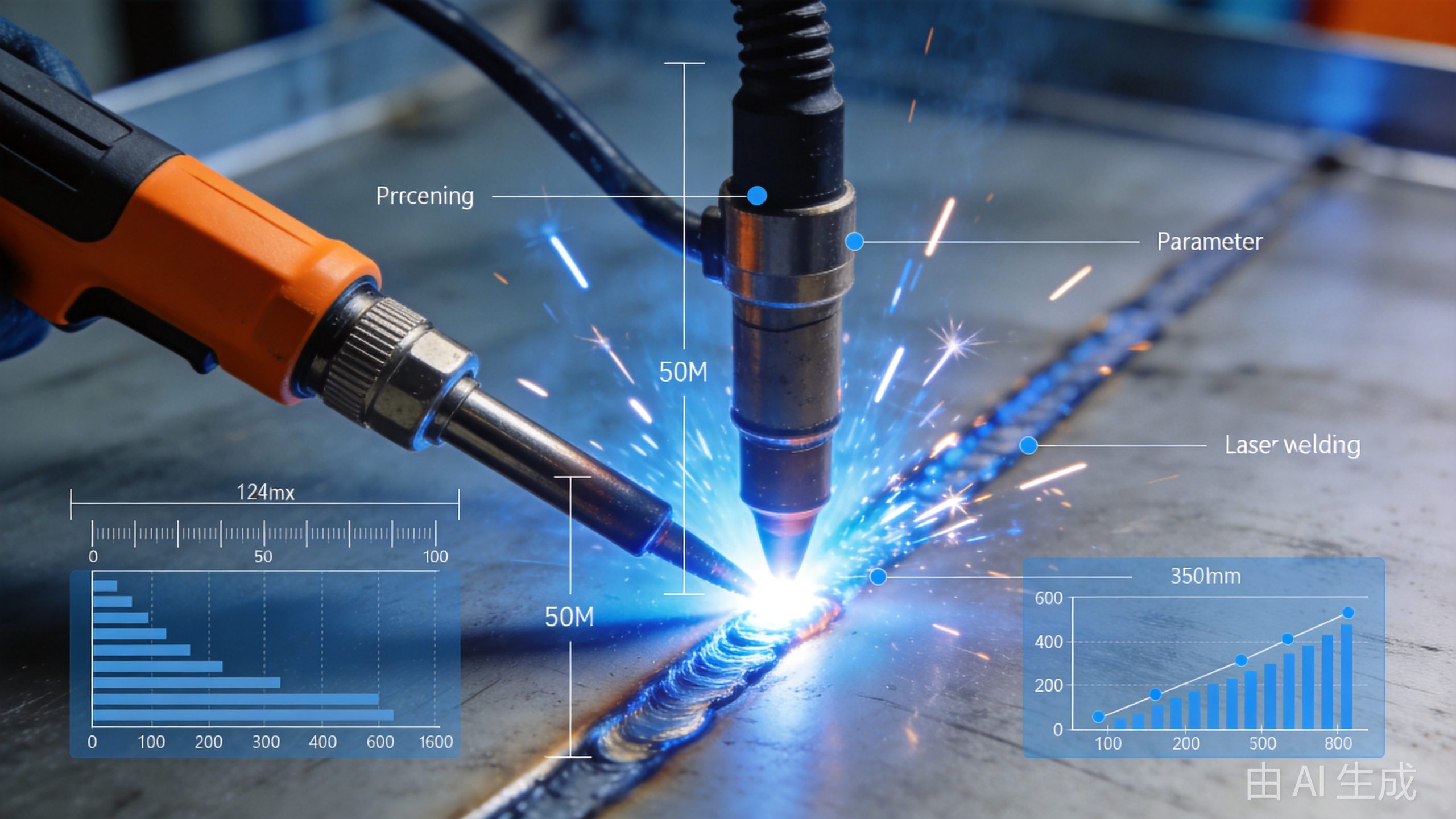
When comparing handheld laser welding machines, the spec sheets can be overwhelming — laser power, wire feed speed, wobble frequency, cooling capacity, and a dozen other numbers. But which parameters actually matter for your welding applications?
In this complete reference guide, we break down every key parameter of handheld laser welding machines, explain what each one means, and provide typical values across different power levels. Whether you’re comparing models, evaluating quotes, or just want to understand the specs, this is your go-to resource.
Quick Navigation
– Laser Source Parameters
– Welding Performance Parameters
– Welding Gun Parameters
– Wire Feeder Parameters
– Motion & Positioning Parameters
– Cooling System Parameters
– Gas System Parameters
– Machine & Enclosure Parameters
– Parameter Comparison by Power Level
– Which Parameters Matter Most?
Laser Source Parameters
The laser source is the heart of the welding machine. These parameters define the laser beam itself.
Laser Power (Output Power)
What it is: The maximum power the laser source can deliver to the workpiece, measured in watts (W) or kilowatts (kW).
Why it matters: Laser power is the single biggest factor determining:
– How thick material you can weld
– How fast you can weld
– Weld penetration depth
– Overall productivity
Common power levels for handheld welding:
| Power Level | Typical Applications | Max Weldable Thickness (steel) |
|---|---|---|
| 1000W (1kW) | Entry-level, thin sheet, light fabrication | 1–2 mm |
| 1500W (1.5kW) | Most popular, general fabrication | 2–3 mm |
| 2000W (2kW) | Higher productivity, medium thickness | 3–4 mm |
| 3000W (3kW) | Heavy-duty, thick material, high volume | 4–6 mm |
Important: Welding thickness depends on joint type, material, and whether filler wire is used. The numbers above are for butt welds on mild steel with filler wire.
Wavelength
What it is: The wavelength of the laser light, measured in nanometers (nm).
Why it matters: Wavelength determines how well the laser beam is absorbed by different materials.
Typical value: ~1064 nm (near-infrared) for ytterbium-doped fiber lasers.
At 1064 nm:
– Metals (steel, stainless steel, aluminum, copper, brass) absorb well
– Highly reflective metals (copper, aluminum) absorb better at 1064 nm than at 10,600 nm (CO2), making fiber lasers ideal for welding non-ferrous metals
– Plastics generally don’t absorb 1064 nm well (specialty plastics or laser-absorbing additives needed)
Beam Quality (BPP)
What it is: Beam Parameter Product (BPP) measures how “good” the laser beam is — how tightly it can be focused. Measured in mm·mrad. Lower = better.
Why it matters: Better beam quality means:
– Smaller focal spot size
– Higher energy density
– Deeper, more consistent weld penetration
– Better weld quality at higher speeds
Typical values for handheld welders: 8–20 mm·mrad
– Lower BPP = better quality, but more expensive
– For welding, moderate BPP (10–15 mm·mrad) is usually optimal — provides good penetration without being too sensitive to focus position
Laser Type: CW vs Pulsed
What it is: Whether the laser operates in continuous wave (always on) or pulsed mode.
Why it matters:
– CW (Continuous Wave): Most common for handheld welding. Provides steady, consistent heat for smooth welds.
– Pulsed: Delivers energy in short pulses. Useful for very thin materials, heat-sensitive parts, or spot welding. Some machines offer both modes.
Typical pulse parameters (for pulsed machines):
– Pulse frequency: 1–1000 Hz
– Pulse width: 0.1–20 ms
– Peak power: 2–10x average power
Modulation Capability
What it is: Whether the laser power can be rapidly adjusted (modulated) during welding.
Why it matters: Power modulation enables:
– Wobble welding: Power varies with beam position for uniform heating
– Start/end ramp: Gradual power ramp at weld start and end to prevent craters
– Corner control: Power adjustment at corners for consistent penetration
– Stitch welding: Rapid on/off for intermittent welds
Typical modulation frequency: 1–100 kHz
Fiber Cable Length
What it is: The length of the fiber optic cable connecting the laser source to the welding gun.
Why it matters: Longer cable gives more working radius but:
– Slightly reduces beam quality
– Adds cost
– Is heavier and less flexible
Typical values:
– Standard: 5–10 meters
– Extended: 15–20 meters
– Most handheld welders: 10m is the sweet spot for most workshops
Laser Source Lifetime
What it is: The expected operating lifetime before significant power degradation.
Why it matters: The laser source is the most expensive component.
Typical value: 50,000–100,000 hours for fiber lasers.
For comparison, Nd:YAG laser rods typically last 5,000–15,000 hours.
Welding Performance Parameters
Maximum Welding Thickness
What it is: The thickest material the machine can weld through with full penetration.
Why it matters: Determines what jobs the machine can handle.
Important caveats:
– Maximum thickness depends on material type, joint design, and whether filler wire is used
– It’s usually specified for mild steel butt welds with filler wire
– Other materials (stainless, aluminum) may have different limits
– Maximum thickness doesn’t always mean good quality at that thickness
Typical values by power (mild steel, butt joint, with wire):
| Laser Power | Max Penetration | Good Quality Range |
|---|---|---|
| 1000W | 2 mm | 0.5–1.5 mm |
| 1500W | 3 mm | 0.8–2.5 mm |
| 2000W | 4 mm | 1–3 mm |
| 3000W | 5–6 mm | 1.5–4 mm |
For stainless steel: Similar or slightly less than mild steel.
For aluminum: Generally 50–70% of mild steel thickness (more reflective).
Welding Speed
What it is: How fast the operator can move the gun while maintaining full penetration welds, measured in millimeters per second (mm/s) or meters per minute (m/min).
Why it matters: Welding speed directly affects productivity and cost per part.
Typical welding speeds (mild steel, fillet weld, with wire):
| Material Thickness | 1000W | 1500W | 2000W | 3000W |
|---|---|---|---|---|
| 0.5 mm | 30–50 mm/s | 50–80 mm/s | 60–100 mm/s | 80–120 mm/s |
| 1 mm | 15–25 mm/s | 25–40 mm/s | 35–55 mm/s | 50–70 mm/s |
| 2 mm | 5–10 mm/s | 10–20 mm/s | 15–30 mm/s | 25–40 mm/s |
| 3 mm | — | 3–8 mm/s | 8–15 mm/s | 15–25 mm/s |
| 4 mm | — | — | 3–8 mm/s | 8–15 mm/s |
*Note: These are approximate reference values. Actual speeds vary by joint type, material, wire feed speed, and operator skill.*
Weld Seam Width
What it is: The width of the weld bead, measured in millimeters.
Why it matters: Determines gap bridging capability and weld strength.
Typical values:
– Fixed beam: 0.2–1.0 mm
– Wobble mode: 1–5 mm (adjustable via wobble amplitude)
Wider weld seams can bridge larger gaps but require more heat and filler material.
Gap Bridging Capability
What it is: The maximum gap between parts that can still be welded successfully.
Why it matters: Real-world parts never fit perfectly. Better gap bridging means less fixturing and prep time.
Typical values:
– Without wire, fixed beam: < 0.2 mm
- With wire, fixed beam: 0.3–0.5 mm
- With wire + wobble: 0.5–2.0 mm (depending on wobble width)
Wobble welding is the key technology that makes handheld laser welding practical for real-world fabrication.
Weld Strength
What it is: The mechanical strength of the weld joint, usually measured in MPa (tensile strength) or as a percentage of base material strength.
Why it matters: Determines if the weld meets structural requirements.
Typical values:
– Properly executed laser welds can achieve 80–100% of base material strength
– Weld strength depends on penetration, fusion quality, and material compatibility
– Always verify with destructive testing for critical applications
Welding Gun Parameters
Gun Weight
What it is: The weight of the handheld welding gun, measured in kilograms (kg) or pounds (lbs).
Why it matters: Lighter guns reduce operator fatigue and improve precision, especially for long production runs.
Typical values: 0.7–1.5 kg
– Entry-level: 1.2–1.5 kg
– High-end: 0.7–1.0 kg
Gun Length / Dimensions
What it is: The physical size of the welding gun.
Why it matters: Compact guns are easier to maneuver in tight spaces.
Typical values:
– Length: 200–350 mm
– Width: 50–100 mm
– Nozzle diameter: 10–25 mm
Nozzle Types
What it is: The type and size of nozzle tips available for the gun.
Common nozzle types:
– Standard nozzle: General purpose, most common
– Angle nozzle: Bent tip for accessing tight corners
– Wire feed nozzle: Integrated wire feed tip
– Cleaning nozzle: Special nozzle for laser cleaning mode (if equipped)
Nozzles are consumable items that wear over time and need replacement.
Safety Interlocks
What it is: Safety features that prevent the laser from firing unless conditions are safe.
Common interlocks:
– Contact sensor: Laser only fires when nozzle touches workpiece
– Trigger switch: Must be pressed to fire
– Key switch: Power authorization
– Temperature sensor: Shuts down if gun overheats
– Emergency stop: Immediate shutoff
Control Buttons on Gun
What it is: Buttons or controls located on the welding gun itself.
Common controls:
– Laser trigger (main button)
– Wire feed speed adjustment (some models)
– Power adjustment (some models)
– Mode switch (weld / clean / spot)
– Wire feed manual (for feeding wire before starting)
Wire Feeder Parameters
Wire Feed Speed
What it is: How fast filler wire is fed into the weld pool, measured in meters per minute (m/min) or millimeters per second (mm/s).
Why it matters: Wire feed speed must be matched to welding speed and laser power for consistent weld quality.
Typical range: 0.5–10 m/min (0–15 m/min on some machines)
| Material Thickness | Typical Wire Feed Speed |
|---|---|
| 0.5–1 mm | 0.5–2 m/min |
| 1–2 mm | 1–4 m/min |
| 2–3 mm | 2–6 m/min |
| 3–4 mm | 4–8 m/min |
Wire Diameter
What it is: The diameter of the filler wire, measured in millimeters (mm).
Why it matters: Wire diameter affects deposition rate and weld bead size.
Common sizes:
– 0.6 mm: Thin material, fine welds
– 0.8 mm: Most common, general purpose
– 1.0 mm: Thicker material, higher deposition
– 1.2 mm: Heavy-duty, thick material
Wire Material Compatibility
What it is: What types of filler wire the machine can handle.
Common wire materials:
– ER308L / ER309L / ER316L (stainless steel)
– ER70S-6 (mild steel / carbon steel)
– ER4043 / ER5356 (aluminum)
– ERCuSi-A (silicon bronze / copper alloy)
– Nickel-based alloys
Wire Spool Size
What it is: The size of wire spool the machine can accommodate.
Common sizes:
– 1 kg spool: Small, portable
– 5 kg spool: Most common
– 15 kg spool: Production use, fewer changeovers
Wire Feeder Location
What it is: Where the wire feeder mechanism is located.
Types:
– Gun-integrated: Wire feeder is built into the welding gun. More compact but adds weight.
– Remote / base unit: Wire feeder is in the main cabinet, with a push-pull system feeding wire to the gun. Lighter gun but more complex mechanism.
– Push-pull: Both base and gun have drive motors for reliable feeding, especially with soft wires like aluminum.
Wobble Welding Parameters
Most modern handheld laser welders offer wobble (oscillation) welding. Here are the key parameters:
Wobble Amplitude
What it is: How wide the beam oscillates — effectively the width of the weld seam. Measured in millimeters.
Why it matters: Larger amplitude = wider weld = better gap bridging, but slower effective welding speed.
Typical range: 0–5 mm (some machines up to 8 mm)
Wobble Frequency
What it is: How many times per second the beam oscillates, measured in Hertz (Hz).
Why it matters: Higher frequency = smoother weld bead, but more heat input per unit length.
Typical range: 0–300 Hz
– Low frequency (10–50 Hz): Visible oscillation pattern, good for gap filling
– Medium frequency (50–150 Hz): Smooth weld, most common
– High frequency (150–300 Hz): Very smooth, almost like a fixed wider beam
Wobble Pattern
What it is: The shape of the beam oscillation.
Common patterns:
– Circular: Most common, good all-around
– “8” shape / Infinity: Good for wider gaps
– Linear (side-to-side): Simple, fast
– Triangular / sawtooth: Less common
Wobble Mode Switching
What it is: Whether the machine can switch between wobble and fixed-beam modes.
Why it matters: Different applications need different modes — e.g., fixed beam for thin material speed welding, wobble for gap bridging on thicker material.
Cooling System Parameters
Cooling Type
What it is: How the laser source and optics are cooled.
Types:
– Water chiller (liquid cooling): Most common for 1kW+ machines. Efficient, compact.
– Air cooling: Only for very low power (<500W) machines. Simpler but less effective.
Cooling Capacity
What it is: How much heat the chiller can remove, measured in kilowatts (kW).
Why it matters: Must be matched to the laser source waste heat.
Typical values:
– 1kW laser: ~2–3 kW chiller
– 1.5kW laser: ~3–4 kW chiller
– 2kW laser: ~4–6 kW chiller
– 3kW laser: ~6–10 kW chiller
Temperature Stability
What it is: How precisely the chiller maintains water temperature, measured in °C.
Why it matters: Stable temperature ensures consistent laser power and beam quality.
Typical value: ±0.5°C or better
Dual Circuit vs Single Circuit
What it is: Whether the chiller has separate cooling loops for the laser source and the optics/gun.
Why it matters:
– Dual circuit: Separate loops prevent contamination between laser and optics. Standard on quality machines.
– Single circuit: Simpler but less precise. Only on very basic machines.
Water Quality Requirements
What it is: What type of water is required for the cooling system.
Requirements:
– Deionized (DI) water or distilled water
– Specific conductivity range (usually 5–10 µS/cm)
– Regular filter changes
– Periodic water replacement (every 3–6 months)
Gas System Parameters
Shielding Gas Type
What it is: What type of gas is used to shield the weld pool from atmospheric contamination.
Common gases:
| Gas | Best For | Notes |
|---|---|---|
| Argon (Ar) | Most metals, general purpose | Most common, good shielding |
| Argon + CO₂ (95/5 or 98/2) | Mild steel | Adds some heat, deeper penetration |
| Argon + Hydrogen (95/5 or 98/2) | Stainless steel | Cleaner, brighter welds |
| Helium (He) or Ar/He mix | Aluminum, thick material | Hotter arc, deeper penetration, more expensive |
| Nitrogen | Some specialty apps | Not common for laser welding |
Gas Flow Rate
What it is: How much shielding gas flows through the nozzle, measured in liters per minute (L/min).
Why it matters: Too little = insufficient shielding = porosity. Too much = turbulence = air entrainment = porosity.
Typical values: 10–25 L/min
– Thin material: 10–15 L/min
– Medium material: 15–20 L/min
– Thick material: 20–25 L/min
Gas Pressure
What it is: The pressure of the shielding gas at the regulator.
Typical value: 0.3–0.8 MPa (3–8 bar) at the regulator.
Gas Consumption
What it is: How much gas the machine uses. Affects operating cost.
Typical: 10–25 L/min during welding.
– A standard 50L argon cylinder (200 bar) contains about 10,000 liters
– At 15 L/min, that’s roughly 11 hours of arc time per cylinder
Machine & Enclosure Parameters
Machine Dimensions
What it is: The overall size of the main unit (laser source + chiller + controls).
Typical for a 1500W machine:
– Height: 800–1200 mm
– Width: 600–900 mm
– Depth: 600–900 mm
Machine Weight
What it is: The total weight of the main unit.
Typical values:
– 1000W: 100–150 kg
– 1500W: 150–200 kg
– 2000W: 200–300 kg
– 3000W: 300–450 kg
Mobility Features
What it is: How easy the machine is to move around.
Common features:
– Caster wheels: Standard on most machines
– Handle / push bar: For maneuvering
– Brake locks: On wheels for safety
– Cable management: Hooks or reels for fiber cable and gas hose
Power Consumption
What it is: Total electrical power the machine draws, measured in kilowatts (kW).
Typical values:
| Laser Power | Total Machine Power Draw |
|---|---|
| 1000W | 4–6 kW |
| 1500W | 6–9 kW |
| 2000W | 8–12 kW |
| 3000W | 12–18 kW |
Power Supply Requirements
What it is: The electrical service needed.
Typical:
– Voltage: 220V single-phase (small machines) or 380V 3-phase (1.5kW+)
– Frequency: 50/60 Hz
– Amperage: 15–60 A depending on power
Always verify with the specific manufacturer and consult a licensed electrician.
Control Interface
What it is: How the operator interacts with the machine.
Common types:
– Touchscreen: Most modern machines. Intuitive, easy to set parameters.
– Physical buttons + display: More durable in harsh environments.
– Software on PC: For advanced parameter control and recipe management.
Weld Presets / Recipes
What it is: Pre-programmed welding parameter sets for different materials and thicknesses.
Why it matters: Makes the machine easy to use — operators just select the right preset instead of manually adjusting 10+ parameters.
Typical features:
– 20–100+ built-in presets
– Custom user-savable presets
– Parameter locking (admin only can change)
– Password protection
Multi-Function Capability
What it is: Whether the machine can do more than just welding.
Common additional functions:
– Laser cleaning: Same machine can remove rust, oxide, paint. Very useful for cleaning weld seams before or after welding.
– Spot welding: Single-pulse spot welding mode
– Seam cleaning: Post-weld cleaning of oxidation
– Cutting: Some machines have limited thin-sheet cutting capability
Parameter Comparison by Power Level
Here’s a side-by-side comparison of typical handheld laser welding machine parameters across common power levels:
| Parameter | 1000W | 1500W | 2000W | 3000W |
|---|---|---|---|---|
| Max steel penetration | 2 mm | 3 mm | 4 mm | 5–6 mm |
| Weld speed (1mm steel) | 15–25 mm/s | 25–40 mm/s | 35–55 mm/s | 50–70 mm/s |
| Weld speed (2mm steel) | 5–10 mm/s | 10–20 mm/s | 15–30 mm/s | 25–40 mm/s |
| Beam quality (BPP) | 10–15 mm·mrad | 10–18 mm·mrad | 12–20 mm·mrad | 15–25 mm·mrad |
| Wavelength | 1064 nm | 1064 nm | 1064 nm | 1064 nm |
| Wobble amplitude | 0–3 mm | 0–5 mm | 0–5 mm | 0–5 mm |
| Wobble frequency | 0–200 Hz | 0–300 Hz | 0–300 Hz | 0–300 Hz |
| Wire feed speed | 0.5–6 m/min | 0.5–8 m/min | 0.5–10 m/min | 0.5–12 m/min |
| Wire diameter range | 0.6–1.0 mm | 0.6–1.2 mm | 0.6–1.2 mm | 0.8–1.6 mm |
| Fiber cable length | 5–10 m | 10–15 m | 10–15 m | 10–20 m |
| Gun weight | 0.8–1.2 kg | 0.8–1.3 kg | 0.9–1.5 kg | 1.0–1.5 kg |
| Gas flow rate | 10–15 L/min | 10–20 L/min | 15–20 L/min | 15–25 L/min |
| Total power draw | 4–6 kW | 6–9 kW | 8–12 kW | 12–18 kW |
| Machine weight | 100–150 kg | 150–200 kg | 200–300 kg | 300–450 kg |
| Laser lifetime | 100,000 hr | 100,000 hr | 100,000 hr | 100,000 hr |
| Cooling | Water chiller | Water chiller | Water chiller | Water chiller |
*Note: These are approximate reference values. Actual parameters vary by manufacturer and model.*
Which Parameters Matter Most?
The importance of each parameter depends on your specific application, but here’s a general priority guide:
Most Important
1. Laser power — determines what you can weld and how fast
2. Wire feeder quality — reliable wire feeding is critical for consistent welds
3. Wobble capability — essential for real-world fabrication with imperfect fit-up
4. Gun weight & ergonomics — operators use this all day; comfort matters
Important
5. Fiber cable length — must reach your largest parts
6. Welding speed at your target thickness — not just max speed
7. Beam quality — affects penetration consistency and weld appearance
8. Shielding gas options — affects weld quality and operating cost
Nice to Have
9. Multi-function (cleaning + welding) — adds versatility
10. Weld preset library — makes setup faster
11. Touchscreen interface — easier to use
12. Caster wheel quality — for moving the machine around
How to Use This Guide
When comparing machines from different manufacturers:
1. Compare apples to apples: Same power level, same configuration
2. Ask for weld samples: Specs don’t tell the whole story. Test with your actual parts and material.
3. Check the fine print: “Max welding thickness” may be for ideal conditions. What’s the practical working range?
4. Consider total cost of ownership: Include electricity, gas, wire, and consumables.
5. Test before you buy: Have your operator try the gun — ergonomics and ease of use matter more than you think.
For help choosing the right machine, see our Handheld Laser Welding Machine Buyer’s Guide or check out how much they cost.
Further Reading:
– How to Choose a Handheld Laser Welding Machine
– How Much Does a Handheld Laser Welding Machine Cost?
– How Does a Handheld Laser Welding Machine Work?
– Laser Welding vs TIG vs MIG vs Arc Welding
– 10 Industrial Applications of Laser Welding
– 12 Best Handheld Laser Welding Machine Brands & Manufacturers in 2026