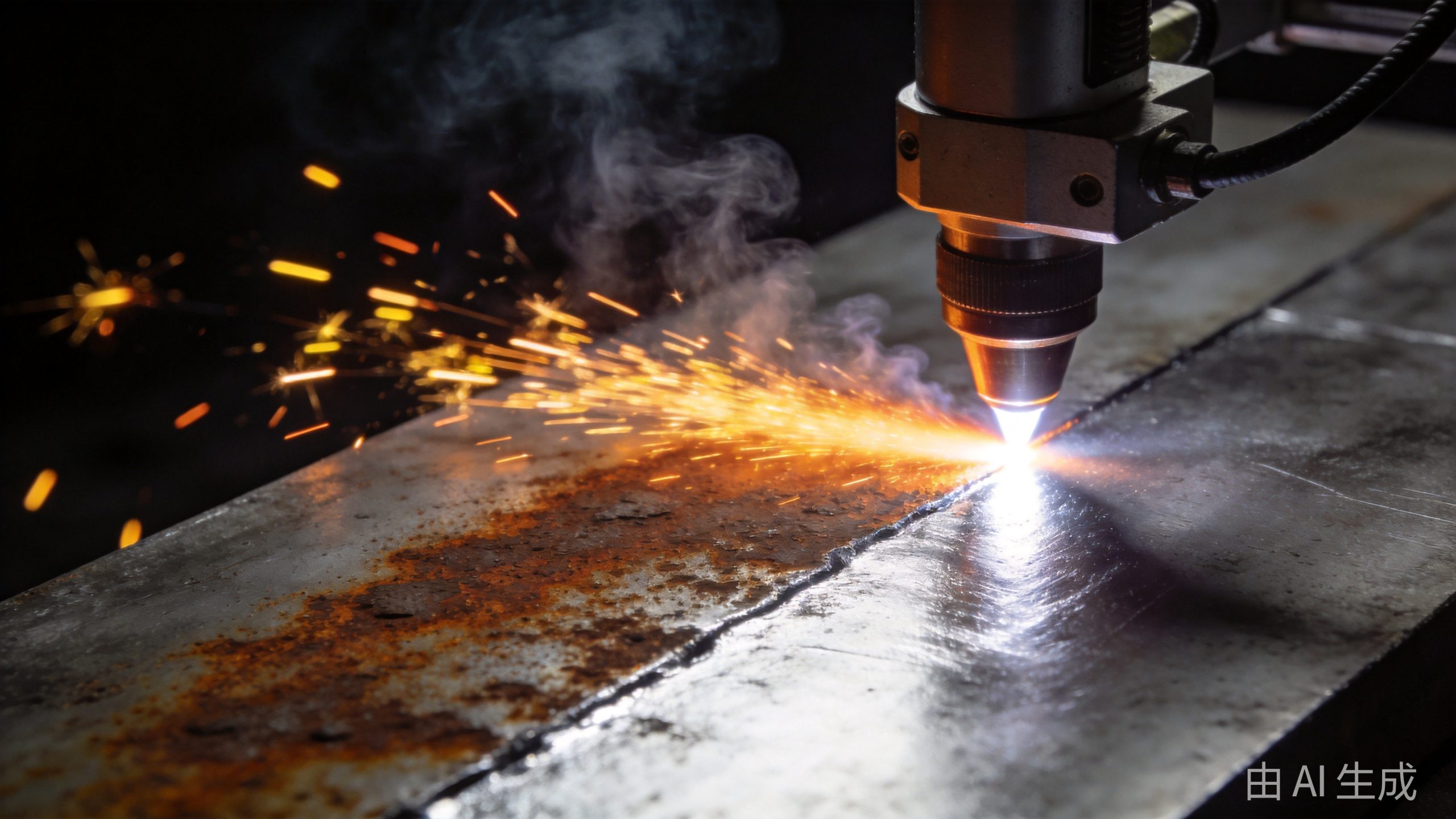
Laser cleaning is one of the most exciting advancements in surface treatment technology. It replaces harsh chemicals, abrasive blasting, and manual grinding with a precise, non-contact laser beam that removes contaminants without damaging the underlying material.
But how exactly does a laser cleaning machine work? In this guide, we break down the technology from the inside out — component by component, process by process. Whether you’re evaluating a purchase or just curious about how lasers clean surfaces, you’ll find everything you need here.
Quick Overview: What Is a Laser Cleaning Machine?
A laser cleaning machine uses a high-power laser beam to remove unwanted material — rust, paint, oil, oxide, coatings, and more — from the surface of a workpiece. The process is called laser ablation: the laser energy is absorbed by the contaminant, causing it to vaporize or sublimate (turn directly from solid to gas) without significantly heating the base material.
Key advantages over traditional cleaning methods:
– Non-contact and non-abrasive: No physical contact means no wear on tooling and no damage to delicate surfaces
– Precise: Can target specific areas with micron-level accuracy
– Environmentally friendly: No chemicals, no blasting media, no waste water — just vaporized contaminants (captured by a fume extractor)
– Low operating cost: No consumables (no sand, no chemicals, no brushes)
– Automation-friendly: Easy to integrate with robots or production lines
Interested in applications? See our article on 10 Industrial Applications of Laser Cleaning.
Core Components of a Laser Cleaning Machine
A laser cleaning system consists of several key components. Let’s go through each one.
1. Laser Source
The laser source generates the laser beam that does the cleaning. Most industrial laser cleaning machines use fiber lasers for their efficiency, reliability, and beam quality.
Inside the fiber laser source:
– Pump diodes: High-power laser diodes emit light at ~915–976 nm, which “pumps” energy into the active fiber
– Active fiber: Optical fiber doped with ytterbium (Yb) that amplifies light to ~1064 nm (near-infrared wavelength)
– Fiber Bragg Gratings (FBGs): Act as mirrors at each end of the active fiber, creating the optical cavity that builds up laser energy
The 1064 nm wavelength is ideal for laser cleaning because:
– It’s well-absorbed by most metals and many contaminants
– It can be delivered efficiently through fiber optic cables
– It’s in the near-infrared range, which is safe for operators when properly shielded
Common power levels for laser cleaning:
– 50–100W: Light-duty cleaning, precision applications, delicate surfaces
– 200–500W: Most popular, versatile for rust, paint, oil, oxide removal
– 1000W+: Heavy-duty, high-speed cleaning, thick coatings, large surface areas
2. Scanning Head (Galvo Scanner)
The scanning head — also called a galvanometer scanner or galvo head — is what makes laser cleaning practical and fast. Instead of moving the entire laser head across the surface, the galvo scanner uses moving mirrors to rapidly deflect the laser beam, creating a scanning pattern.
Inside the scanning head:
– X and Y galvanometer mirrors: Two small, lightweight mirrors mounted on precision motors. Each mirror tilts to deflect the beam along one axis
– F-theta lens: A special flat-field lens at the output that focuses the scanned beam onto a flat plane. Unlike a normal lens, the f-theta lens ensures the focal point stays at the same distance across the entire scan width
– Protective window: A sacrificial window that protects the expensive optics from dust and debris
The scanner oscillates the beam in a pattern — typically a line scan (back and forth along one axis) or a full 2D scan (both axes, creating a rectangular cleaning area). Scan speeds can reach hundreds or thousands of lines per second, creating the appearance of a continuous cleaning “brush.”
Scan width (the width of the cleaning path) typically ranges from 10 mm to 200+ mm, depending on the lens and application.
3. Fiber Optic Delivery Cable
The laser beam travels from the source to the scanning head through a fiber optic cable. This cable:
– Carries the high-power laser beam efficiently with minimal energy loss
– Provides flexibility, allowing the scanning head to be mounted on a robot arm, gantry, or handheld unit
– Contains a double-clad fiber design for reliable high-power transmission
– Is protected by a reinforced jacket for industrial environments
Cable lengths vary from a few meters (for integrated machines) to 10–20 meters (for robotic or remote installations).
4. Control System
The control system is the brain of the machine:
– Touchscreen interface: Operators set parameters like laser power, pulse frequency, scan speed, scan width, and cleaning pattern
– Cleaning presets: Pre-programmed recipes for different contaminants and materials — select the right one and go
– Real-time monitoring: Displays laser power, temperature, operating hours, and fault codes
– Parameter locking: Administrators can lock parameters to prevent untrained operators from making unsafe changes
Advanced features may include:
– Power modulation: Automatically adjusts laser power based on scan position for uniform cleaning
– Multi-mode operation: Different cleaning modes for different applications (light cleaning, heavy rust removal, precision cleaning)
– Pulse shaping: Controls the shape of individual laser pulses for optimal cleaning results
5. Chiller / Cooling System
High-power fiber lasers generate significant heat. A water chiller maintains stable operating temperature:
– Dual-circuit cooling: Separate loops for the laser source and the scanning head
– Temperature stability: Maintains temperature within ±0.5°C or better
– Flow monitoring: Alerts if cooling water flow drops below safe levels
– Filter system: Removes particles and prevents contamination
The chiller is usually built into the main cabinet for compact, all-in-one designs.
6. Fume Extraction System
When the laser ablates contaminants, it produces fumes and particulate matter. A fume extraction system captures and filters these byproducts:
– Extraction nozzle: Positioned near the cleaning area to capture fumes at the source
– Hepa filtration: HEPA filters remove particulate matter
– Activated carbon: Adsorbs gaseous contaminants and odors
– Flow control: Adjustable extraction power for different applications
Fume extraction is essential for both operator safety and maintaining clean optics inside the scanning head.
7. Motion System (Depending on Configuration)
Laser cleaning machines come in several form factors, each with different motion systems:
– Handheld: The operator holds the scanning head and moves it across the workpiece. No automated motion system needed.
– Gantry/XYZ: The scanning head moves on a 3-axis gantry over a fixed workpiece. Used for automated cleaning of flat or 3D parts.
– Robotic: The scanning head is mounted on a 6-axis industrial robot arm. Used for complex 3D parts and high-volume production.
– Conveyor: Parts pass under a fixed scanning head on a conveyor belt. Used for continuous production lines.
The Science: How Laser Ablation Works
At the heart of laser cleaning is laser ablation — the process of removing material by irradiating it with a laser beam. Here’s the science:
Step 1: Absorption
When the laser beam hits the surface, its energy is absorbed by the material. Different materials absorb different wavelengths differently — this is why the 1064 nm fiber laser wavelength works so well for metal cleaning:
– Metals (iron, steel, aluminum, copper): Highly absorbent at 1064 nm
– Rust and oxides: Also absorb well, often better than the base metal
– Organic contaminants (oil, grease, paint): Absorb laser energy and vaporize
– Some inorganic coatings: May require different wavelengths or higher power
The key principle of selective ablation is that the contaminant absorbs more laser energy than the base material. When the laser hits the surface, the contaminant heats up and vaporizes before the base material is significantly affected.
Step 2: Rapid Heating
The laser energy is absorbed in a very thin surface layer (microns thick) and heats it extremely rapidly — temperatures can rise thousands of degrees in microseconds.
This rapid heating causes:
– Vaporization: The contaminant turns directly from solid to vapor (sublimation) or melts and then vaporizes
– Shockwave generation: The sudden expansion creates micro-shockwaves that help dislodge particles
– Plasma formation: At very high intensities, a small plasma plume forms above the surface, which can also contribute to cleaning
Step 3: Material Removal
As the contaminant vaporizes, it’s carried away by:
– The fume extraction system (capturing vapor and particulate)
– The pressure of the expanding vapor and plasma
– The shockwaves that dislodge loosely bonded particles
The result is a clean surface with the base material intact.
Step 4: Scanning
The galvo scanner rapidly moves the laser beam across the surface in a controlled pattern. Each pulse or line cleans a small area, and the scanning motion covers the entire target surface.
The cleaning path looks like a rapidly moving line or rectangle of light sweeping across the surface — similar to how a scanner bar moves across a document.
Step-by-Step: How the Cleaning Process Works
Now let’s walk through a typical laser cleaning operation from start to finish.
Step 1: Setup & Preparation
The operator:
1. Positions the workpiece (or positions the cleaning head over the workpiece)
2. Ensures proper fume extraction is in place
3. Selects the appropriate cleaning preset on the control panel (e.g., “rust removal, steel, medium”)
4. Adjusts the working distance — the distance between the scanning head and the workpiece surface
5. Wears appropriate personal protective equipment (laser safety glasses, if needed)
Step 2: Focus Adjustment
The laser beam must be properly focused on the workpiece surface for optimal cleaning:
– The focal distance is determined by the f-theta lens
– At the focal plane, the beam is at its smallest and most intense
– Moving the workpiece closer or farther reduces intensity and cleaning effectiveness
Most machines have a marked working distance or a focus finder tool to help operators set the correct distance.
Step 3: Laser Activation
When the operator starts the cleaning process:
1. The laser source fires, producing a pulsed or continuous laser beam
2. The beam travels through the fiber optic cable to the scanning head
3. The galvo mirrors begin oscillating, scanning the beam across the target area
4. The f-theta lens focuses the scanned beam onto the workpiece surface
Step 4: Ablation
As the scanned laser beam sweeps across the surface:
– Each laser pulse delivers a burst of energy to a tiny spot
– The contaminant absorbs the energy, heats up, and vaporizes
– The rapid scanning creates a “cleaning path” that removes contaminants from the entire scanned area
– The fume extraction system pulls away the vaporized material and particulates
Step 5: Relative Motion
To clean a larger area, either:
– The operator moves the handheld head across the surface
– The gantry or robot moves the scanning head
– The workpiece moves under a fixed head (conveyor system)
The speed of this relative motion, combined with the scan rate and laser power, determines how quickly material is removed and how clean the surface becomes.
Step 6: Quality Inspection
After cleaning, the operator inspects the surface:
– Is the contaminant fully removed?
– Is the base material undamaged?
– Is the finish uniform across the cleaned area?
If needed, parameters can be adjusted and the area re-cleaned for better results.
Key Cleaning Parameters
Understanding these parameters helps achieve optimal cleaning results:
Laser Power
– Higher power = faster cleaning, thicker coatings can be removed
– Too much power = can damage the base material, especially on thin or delicate surfaces
– Too little power = incomplete cleaning, requires multiple passes
Pulse Frequency
– Pulse lasers are most common for cleaning (vs. continuous wave)
– Frequency (Hz) = number of laser pulses per second
– Higher frequency = more pulses per second, smoother and faster cleaning
– Lower frequency = more energy per pulse, better for heavy contamination
Pulse Duration (Pulse Width)
– How long each laser pulse lasts (typically nanoseconds for cleaning)
– Shorter pulses = higher peak power, less heat affected zone, better for delicate materials
– Longer pulses = more total energy per pulse, better for thick or stubborn contaminants
Scan Speed
– How fast the galvo scanner moves the beam across the surface
– Faster scan = wider coverage per unit time, but less energy per area
– Slower scan = more energy per area, more aggressive cleaning
Scan Width
– The width of the scanned area (determined by the f-theta lens)
– Wider scan = covers more area per pass, but lower energy density
– Narrower scan = higher energy density, more aggressive cleaning
Overlap
– How much each scan line overlaps with the previous one
– Higher overlap = more uniform cleaning, but slower
– Typical overlap: 20–50%
Working Distance
– Distance from the scanning head to the workpiece surface
– Must match the focal length of the f-theta lens for best results
– Small deviations are usually acceptable, but significant defocus reduces cleaning effectiveness
What Can Laser Cleaning Remove?
Laser cleaning is versatile and can remove many types of contaminants:
| Contaminant | Typical Application | Difficulty |
|---|---|---|
| Rust & corrosion | Steel parts, pipes, structures | Easy–Medium |
| Paint & coatings | Automotive, aerospace, refurbishment | Medium–Hard |
| Oil & grease | Machined parts, engine components | Easy |
| Oxide layers | Weld seams, heat-treated parts | Easy–Medium |
| Rubber residue | Tire molds, rubber molds | Medium |
| Carbon deposits | Engine parts, tooling | Medium |
| Adhesives & residues | Manufacturing, assembly | Medium |
| Plating & coatings | Electronics, precision parts | Medium–Hard |
| Mold release agents | Injection molds, die casting | Easy |
| Graffiti | Buildings, monuments, public art | Medium |
Types of Laser Cleaning Machines
Handheld Laser Cleaners
– Portable and flexible — take the cleaner to the workpiece
– Ideal for: Field maintenance, large structures, hard-to-reach areas
– Power range: 100–2000W
– Price range: $5,000–$30,000
Gantry/XYZ Laser Cleaners
– Automated 3-axis cleaning of flat or moderately 3D parts
– Ideal for: Production lines, batch processing, consistent parts
– Power range: 200–2000W
– Price range: $20,000–$100,000+
Robotic Laser Cleaners
– 6-axis robot arm for complex 3D geometries
– Ideal for: Automotive, aerospace, high-volume manufacturing
– Power range: 500–3000W
– Price range: $50,000–$200,000+
Conveyor/Inline Laser Cleaners
– Continuous cleaning of parts on a production line
– Ideal for: High-volume manufacturing, continuous strip or sheet processing
– Power range: 500–3000W
– Price range: $50,000–$150,000+
Safety Considerations
Laser cleaning machines are generally safe when used properly, but they do require attention to safety:
Laser Safety
– Most industrial laser cleaners are Class 4 lasers — direct exposure can cause eye and skin injury
– Proper laser safety eyewear matched to the 1064 nm wavelength is required for operators and bystanders
– Enclosed machines have interlocks that shut off the laser if doors are opened
– Handheld machines should have safety interlocks (trigger + contact sensor)
Fume Safety
– Laser ablation produces fumes and particulates that can be hazardous
– Always use the fume extraction system
– The specific hazard depends on the material being cleaned (e.g., zinc fumes from galvanized steel, lead from old paint)
– HEPA filtration and activated carbon are standard
Electrical Safety
– High-voltage components inside the laser source and power supply
– Only qualified technicians should service internal components
– Proper grounding is essential
Fire Safety
– Laser energy can ignite flammable materials
– Keep the work area clear of flammables
– Have appropriate fire suppression available
Maintenance Requirements
Laser cleaning machines are relatively low-maintenance. Here’s what’s typically needed:
| Component | Maintenance Frequency | What’s Done |
|---|---|---|
| Protective window | Daily–Weekly | Clean or replace if contaminated |
| Fume extraction filters | Per usage | Replace when full or flow drops |
| F-theta lens | Monthly–Quarterly | Inspect and clean |
| Fiber cable | Monthly | Inspect for damage, clean connectors |
| Chiller water filter | Monthly | Clean or replace |
| Chiller water | Every 3–6 months | Drain and refill with deionized water |
| Galvo scanner | Annually | Calibration and inspection |
| Laser source | 50,000+ hr life | No routine maintenance needed |
The fiber laser source has a typical lifetime of 50,000–100,000 hours — many years of normal operation.
How Laser Cleaning Compares to Other Methods
| Method | How It Works | Pros | Cons |
|---|---|---|---|
| Laser Cleaning | Laser beam vaporizes contaminants | Precise, non-contact, eco-friendly, low operating cost | Higher upfront cost, limited to line-of-sight |
| Sandblasting | Abrasive media blasted at surface | Fast, removes heavy contamination | Abrasive, messy, consumables cost, surface damage |
| Chemical Cleaning | Solvents or acids dissolve contaminants | Reaches complex geometries | Hazardous chemicals, waste disposal, environmental impact |
| Manual Grinding | Abrasive wheels or brushes | Low equipment cost | Labor-intensive, slow, inconsistent, dust |
| Dry Ice Blasting | Dry ice pellets blast surface | Non-abrasive, no secondary waste | Dry ice cost, noise, limited effectiveness on heavy rust |
| Ultrasonic Cleaning | Sound waves in liquid bath | Reaches complex geometries | Limited size, wet process, chemical additives needed |
For a detailed comparison, see our Laser Cleaning vs Sandblasting vs Chemical Cleaning article.
Conclusion
A laser cleaning machine works by generating a high-power fiber laser beam, delivering it through a fiber optic cable to a galvo scanning head, and focusing it onto the workpiece surface. The laser energy is absorbed by contaminants, causing rapid heating and vaporization (laser ablation), while the scanning motion covers the target area. A fume extraction system captures the removed material, and the base material remains undamaged.
The combination of precision, speed, environmental friendliness, and low operating cost makes laser cleaning a rapidly growing alternative to traditional surface treatment methods.
If you’re considering a laser cleaning machine for your business, explore Transon Laser’s laser cleaner lineup, check out our Laser Cleaning Machine Buyer’s Guide, or contact our team for a consultation.
Further Reading:
– How Much Does a Laser Cleaning Machine Cost?
– Laser Rust Removal: 7 Industrial Applications
– Laser Cleaning vs Sandblasting vs Chemical Cleaning
– 10 Industrial Applications of Laser Cleaning