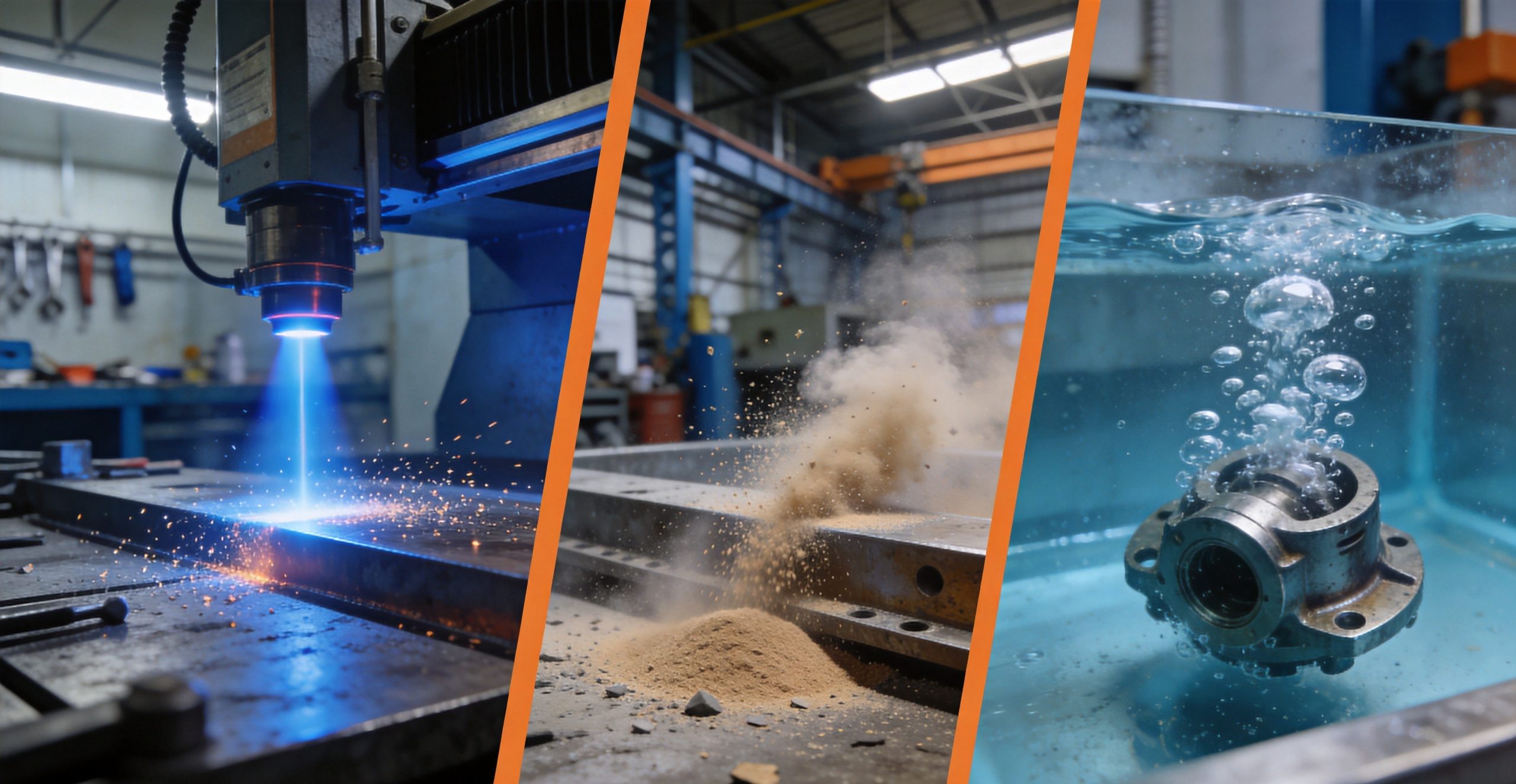
Industrial surface cleaning is a critical step in manufacturing, maintenance, and restoration. For decades, sandblasting and chemical cleaning have been the go-to methods. But in recent years, laser cleaning has emerged as a game-changing alternative — offering precision, efficiency, and environmental benefits that traditional methods can’t match.
But which cleaning method is right for your application? In this comprehensive guide, we compare laser cleaning, sandblasting, and chemical cleaning across 12 key factors: speed, cost, precision, environmental impact, material compatibility, operator safety, and more.
Whether you’re in automotive, aerospace, mold manufacturing, restoration, or general metal fabrication, this comparison will help you choose the best surface cleaning technology for your needs.
—
Quick Summary: Key Differences at a Glance
| Factor | Laser Cleaning | Sandblasting | Chemical Cleaning |
|---|---|---|---|
| Speed | Fast-Medium | Very Fast | Slow (dwell time) |
| Precision | Excellent (0.1mm) | Fair-Poor | Poor |
| Material Removal | Controlled (ablation) | Aggressive (abrasive) | Chemical etch |
| Substrate Damage | Minimal | High risk | Medium risk |
| Environmental Impact | Very Low | High (dust, waste) | Very High (toxic waste) |
| Consumables | None | High (abrasive media) | High (chemicals) |
| Operator Skill | Low-Medium | Medium | High (safety) |
| Equipment Cost | High ($8k–$50k) | Low-Medium ($1k–$10k) | Low-Medium |
| Automation Ready | Yes | Yes (limited) | Limited |
| Portability | Medium | Low-High | Low |
| Waste Generated | Minimal fumes/dust | Large volume of spent media | Hazardous liquid waste |
| Post-Cleaning | None required | Media recovery + cleanup | Rinse + neutralize + waste disposal |
—
1. Cleaning Speed & Productivity
Winner: Sandblasting (fastest for large areas)
When it comes to raw speed on large surfaces, sandblasting is the fastest. However, when you factor in setup, cleanup, and post-processing, laser cleaning often wins on total cycle time.
Speed Comparison
- Sandblasting: 5–50 m²/hour (depending on pressure and media)
- Laser cleaning: 1–20 m²/hour (depending on laser power and contamination)
- Chemical cleaning: 0.5–5 m²/hour (includes dwell time and rinsing)
Total Cycle Time Comparison
| Step | Laser Cleaning | Sandblasting | Chemical Cleaning |
|---|---|---|---|
| Setup | 5–10 min | 15–30 min (containment, media load) | 20–60 min (containment, mixing) |
| Cleaning | Fast (precision) | Very fast (large areas) | Slow (dwell time) |
| Cleanup | 5–10 min (fume extraction filter) | 30–120 min (media recovery, dust cleanup) | 60–240 min (rinse, neutralize, waste disposal) |
| Total cycle | 20–60 min | 60–180 min | 120–360 min |
Key insight: Sandblasting is faster during the actual cleaning step, but laser cleaning often has shorter total turnaround time because setup and cleanup are minimal. For precision cleaning of smaller parts, laser cleaning is dramatically faster overall.
—
2. Cleaning Quality & Precision
Winner: Laser Cleaning
Laser cleaning offers unmatched precision and quality control — it’s the only method that can selectively remove contaminants without affecting the base material.
Laser Cleaning Quality
- Micro-precision: Can target areas as small as 0.1mm
- Selective cleaning: Removes only the contaminant layer, not the substrate
- Non-contact: No physical force on the part
- Consistent results: Same quality every time with parameterized settings
- No media embedding: Nothing left behind on the surface
- Surface finish control: Can clean without altering surface roughness, or can texture if desired
Sandblasting Quality
- Aggressive: Removes material quickly but can damage the substrate
- Surface alteration: Always changes surface roughness (increases it)
- Media embedding: Abrasive particles can become embedded in soft materials
- Less precise: Difficult to control depth of material removal
- Edge effects: Can round edges and damage fine features
Chemical Cleaning Quality
- Uniform: Good for complex geometries with hard-to-reach areas
- Etching risk: Can etch or discolor the base material if not properly timed
- Residue risk: Chemical residue can remain if rinsing is incomplete
- Less controllable: Reaction rate varies with temperature, concentration, and time
—
3. Equipment Cost
Winner: Sandblasting (lowest initial cost)
| Method | Entry-Level | Industrial/Production |
|---|---|---|
| Laser Cleaning | $8,000–$15,000 (1000W handheld) | $20,000–$100,000+ (automated, high-power) |
| Sandblasting | $500–$3,000 (portable) | $5,000–$50,000 (cabinet, automated) |
| Chemical Cleaning | $200–$2,000 (tanks, spray) | $10,000–$100,000+ (automated lines) |
Laser cleaning cost breakdown:
- 1000W handheld fiber laser cleaner: $8,000–$12,000
- 1500W handheld fiber laser cleaner: $10,000–$18,000
- 2000W handheld fiber laser cleaner: $15,000–$25,000
- 3000W handheld/automated: $25,000–$50,000
- Robotic/automated laser cleaning cell: $50,000–$200,000+
ROI note: While laser cleaning has the highest upfront cost, consider the total cost of ownership:
- No consumables (no abrasive media, no chemicals)
- Minimal waste disposal cost
- Lower labor cost (easier to operate)
- No PPE replacement cost (less than sandblasting)
- No media replacement cost
—
4. Operating Cost & Consumables
Winner: Laser Cleaning (lowest ongoing cost)
| Method | Consumables | Approx. Cost per Hour |
|---|---|---|
| Laser Cleaning | Electricity only (fume extraction filter occasionally) | $1–$3 |
| Sandblasting | Abrasive media, nozzles, PPE, dust collector filters | $5–$25 |
| Chemical Cleaning | Chemicals, PPE, rinse water, waste disposal | $10–$50+ |
Laser Cleaning Operating Cost
- No consumables: The laser source lasts 100,000+ hours
- No media: No sand, grit, or beads to buy and replace
- No chemicals: No solvents, acids, or alkalis
- Low electricity: 1–5 kW depending on power level
- Minimal maintenance: Occasional lens cleaning, filter changes
Sandblasting Operating Cost
- Abrasive media: $0.10–$1.00 per kg (sand, glass bead, aluminum oxide, etc.)
- Nozzle wear: Nozzles wear out quickly (hours to days depending on media)
- PPE replacement: Respirators, gloves, suits wear out quickly
- Dust collection: Filters need regular replacement
- Media disposal: Spent media is often classified as hazardous waste
Chemical Cleaning Operating Cost
- Chemicals: Solvents, acids, alkalis — expensive and regulated
- PPE: Chemical-resistant suits, gloves, goggles, respirators
- Water: Large volumes of rinse water
- Waste disposal: Hazardous waste treatment is very expensive
- Regulatory compliance: Permits, reporting, training
—
5. Environmental Impact
Winner: Laser Cleaning (most eco-friendly)
| Environmental Factor | Laser Cleaning | Sandblasting | Chemical Cleaning |
|---|---|---|---|
| Waste volume | Very low (fumes/dust only) | Very high (spent media) | Very high (liquid waste) |
| Hazardous waste | Minimal | Often (contaminated media) | Yes (toxic chemicals) |
| Water usage | None | Low-Medium | Very high |
| Air emissions | Low (fume extractable) | Very high (dust) | Medium-High (fumes) |
| Chemical usage | None | None | Very high |
| Noise pollution | Low | Very high | Low |
Why Laser Cleaning is the Greenest Option
- Zero chemicals: No toxic solvents, acids, or alkalis
- Zero water: No water used in the process
- Minimal waste: Only the removed contaminant (collected by fume extraction)
- Low energy: Efficient fiber laser technology
- No waste transport: No drums of hazardous waste to haul away
- Regulatory compliance: Easier to meet EPA and OSHA standards
Environmental regulations are tightening worldwide. As governments crack down on hazardous waste, air emissions, and water pollution, laser cleaning is becoming not just the better technical choice — but the only compliant choice for many applications.
—
6. Material Compatibility
| Material/Contaminant | Laser Cleaning | Sandblasting | Chemical Cleaning |
|---|---|---|---|
| Rust removal | ✓ Excellent | ✓ Excellent | ✓ Good |
| Paint/coating removal | ✓ Excellent | ✓ Excellent | ✓ Good |
| Oil/grease removal | ✓ Excellent | ✗ Poor | ✓ Excellent |
| Oxide removal | ✓ Excellent | ✓ Good | ✓ Good |
| Mold cleaning | ✓ Excellent | ✗ Damages mold | △ Can etch |
| Weld cleaning | ✓ Excellent | △ Too aggressive | ✓ Good |
| Heritage/restoration | ✓ Excellent (precision) | ✗ Too damaging | ✗ Risk of damage |
| Rubber/plastic molds | ✓ Excellent | ✗ Damages surface | ✗ Can dissolve |
| Thin materials (<1mm) | ✓ Excellent | ✗ High risk | △ Etching risk |
| Complex geometries | ✓ Good (line-of-sight) | △ Fair | ✓ Excellent |
| Internal surfaces | △ Limited (line-of-sight) | △ Limited | ✓ Excellent |
Key takeaway: Laser cleaning excels at precision applications, delicate substrates, and heritage restoration where preserving the base material is critical. Sandblasting is best for heavy-duty cleaning of robust parts. Chemical cleaning is best for complex internal geometries and bulk degreasing.
—
7. Operator Safety
Winner: Laser Cleaning (safest with proper precautions)
All three methods have safety risks, but the nature and severity differ significantly:
Laser Cleaning Safety
- Laser radiation: Class 4 laser — can cause eye damage (requires laser safety glasses)
- Fumes: Metal oxide fumes from vaporized contaminants (requires fume extraction)
- Fire risk: Laser can ignite flammable contaminants
- Skin burns: Direct laser exposure can burn skin
- No abrasive rebound: No flying particles (unlike sandblasting)
- No chemical exposure: No skin contact with toxic chemicals
Sandblasting Safety
- Respiratory hazard: Silica dust causes silicosis (lung disease) — deadly
- Eye injury: Flying abrasive particles can blind
- Hearing damage: Very loud (100–115 dB) — hearing protection required
- Skin injury: Abrasive particles can cut and abrade skin
- Rebound hazard: Media bounces off surfaces at high speed
- Whole-body vibration: Can cause hand-arm vibration syndrome
Chemical Cleaning Safety
- Chemical burns: Acids and alkalis can cause severe burns
- Toxic fumes: Inhalation of solvent vapors or acid mists
- Skin absorption: Some chemicals are absorbed through skin
- Eye damage: Chemical splashes can cause blindness
- Fire/explosion: Some solvents are flammable or explosive
- Long-term health: Carcinogens, reproductive toxins, organ damage
Bottom line: Sandblasting has the highest immediate injury risk (flying particles, noise). Chemical cleaning has the highest long-term health risk (toxicity, carcinogens). Laser cleaning has manageable risks that are well-controlled with proper PPE and fume extraction.
—
8. Automation Capability
Winner: Laser Cleaning
| Method | Automation Level | Common Applications |
|---|---|---|
| Laser Cleaning | Fully automated (robotics, CNC, galvo scanning) | Automotive, aerospace, mold cleaning, production lines |
| Sandblasting | Semi-automated (robotic blast cells) | Foundries, auto parts, mass production |
| Chemical Cleaning | Limited automation (dip lines, spray lines) | Mass production degreasing, plating prep |
Laser cleaning automation advantages:
- Non-contact: No tool wear, no force on the part
- Precise and repeatable: Consistent quality 24/7
- Vision-guided: Can scan and adapt to part variations
- Flexible: Same machine can clean different parts with different programs
- Integratable: Easy to add to existing production lines
- Real-time monitoring: Can verify cleaning quality inline
—
9. Application Suitability
Best for Laser Cleaning
- Mold cleaning: Rubber, plastic, die-cast molds (no damage to mold surface)
- Heritage restoration: Art, monuments, historical artifacts (precision without damage)
- Weld cleaning: Removes oxides and discoloration from welds
- Aerospace: Precision parts, turbine blades, composite materials
- Automotive: Body panels, engine parts, brake components
- Electronics: PCB cleaning, connector cleaning
- Food industry: Mold cleaning, conveyor belt cleaning
- Marine: Rust and paint removal from ship components
Best for Sandblasting
- Heavy rust removal: Thick rust on steel structures
- Paint stripping: Heavy coatings on large surfaces
- Surface preparation: Before painting or coating (creates profile)
- Foundry: Sand removal from castings
- Stone/brick cleaning: Building facades (aggressive enough)
- Large structures: Bridges, ships, tanks
Best for Chemical Cleaning
- Bulk degreasing: Large quantities of small parts
- Complex internal geometries: Pipes, tubes, engine blocks
- Plating prep: Activating surfaces before electroplating
- Precision metal cleaning: Semiconductor, medical parts (with proper chemistry)
- Scale removal: Heavy oxide scale in hard-to-reach areas
—
10. When to Choose Each Method
Choose Laser Cleaning When:
- Precision matters — you need to clean without damaging the substrate
- Environmental compliance is a concern (zero chemicals, minimal waste)
- You’re cleaning molds, heritage items, or delicate parts
- You want to automate the cleaning process
- Labor and consumable costs are high in your area
- You need consistent, repeatable results
- Post-cleaning processing must be minimized
- Worker safety and health are top priorities
Choose Sandblasting When:
- You need maximum speed on large, robust surfaces
- You’re removing thick, heavy contaminants (thick rust, heavy paint)
- You need to create surface texture for coating adhesion
- Initial budget is very limited
- Parts are large and sturdy — not easily damaged
- You have proper containment and dust collection already
- Surface finish alteration is acceptable or desired
Choose Chemical Cleaning When:
- You need to clean complex internal geometries or blind holes
- Bulk processing of many small parts (dipping)
- Removing oil, grease, or organic contaminants at scale
- You have proper waste treatment facilities
- Parts are chemically compatible with the cleaning agent
- You need 100% coverage on irregular shapes
- Line-of-sight limitations make laser/sandblasting impractical
—
11. ROI Analysis: When Does Laser Cleaning Pay Off?
The biggest question: is a laser cleaning machine worth the investment?
Break-Even Calculation Example
Let’s compare laser cleaning vs. sandblasting for a mold cleaning operation:
| Factor | Sandblasting | Laser Cleaning |
|---|---|---|
| Equipment cost | $5,000 | $12,000 |
| Hourly labor cost | $25 | $20 |
| Consumables cost/hour | $10 (media, nozzles) | $1 (electricity) |
| Cleaning time per mold | 2 hours | 1 hour |
| Molds cleaned per week | 10 | 10 |
| Weekly cost | $700 (labor + media + equipment amortization) | $230 |
| Weekly savings with laser | $470 | — |
Additional investment: $7,000
Break-even point: ~15 weeks = 3.5 months
Factors That Speed Up Laser Cleaning ROI:
- High volume: More parts = more savings
- Currently using manual methods: Hand sanding, chemical dipping — biggest improvement
- High labor costs: Skilled workers are expensive
- High consumable costs: Expensive media or chemicals
- Quality rejects: Sandblasting damage causes scrap/rework
- Environmental fines: Chemical waste disposal costs are rising
- Multiple shifts: Higher machine utilization = faster payback
Factors That Slow Down ROI:
- Low volume: Occasional cleaning only
- Very heavy contamination: Thick rust, heavy paint — laser needs more passes
- Large surface areas: Sandblasting has speed advantage on big flat surfaces
- Tight budget: Can’t afford upfront investment
- Complex internal geometries: Laser can’t reach (line-of-sight limitation)
—
12. Future Outlook
The industrial cleaning landscape is changing rapidly:
Laser Cleaning: Growing Fast
- Technology improving: Higher power, lower cost, better beam quality
- Cost decreasing: Fiber laser prices continue to fall
- Adoption accelerating: Automotive, aerospace, and mold industries are switching rapidly
- Regulatory tailwind: Environmental and safety regulations favor laser over traditional methods
- AI integration: Smart laser cleaning with vision and machine learning is coming
Sandblasting: Declining in Many Applications
- Regulatory pressure: Silica sand is being banned in more regions (silicosis risk)
- Environmental concerns: Dust and waste issues
- Health costs: Rising workers’ compensation claims for silicosis and hearing loss
- Still dominant in: Heavy industry, large structures, surface profiling
Chemical Cleaning: Under Pressure
- Environmental regulations: Getting stricter every year
- Waste disposal costs: Rising rapidly
- Health concerns: Many common cleaning chemicals are carcinogens
- Being replaced by: Laser cleaning, aqueous cleaners, CO2 blasting
—
Final Recommendation
For precision cleaning, mold maintenance, heritage restoration, aerospace, automotive, and any application where quality, consistency, and environmental compliance matter — laser cleaning is the clear winner. It’s more precise, more eco-friendly, and has lower operating costs than both sandblasting and chemical cleaning.
For heavy-duty cleaning of large, robust structures — sandblasting still has its place. It’s the fastest and cheapest way to remove thick contaminants from big surfaces where surface finish isn’t critical.
For bulk cleaning of complex parts with internal geometries — chemical cleaning remains the most practical option, though it’s increasingly being replaced by alternative technologies as environmental regulations tighten.
The sweet spot for handheld laser cleaning:
- Industries: Mold manufacturing, automotive, aerospace, restoration, food & beverage
- Contaminants: Rust, paint, oil, grease, oxides, mold release agent
- Part size: Small to medium (handheld) or large (automated)
- Quality requirement: High (no substrate damage, consistent results)
If your business fits this profile, a 1000W or 1500W handheld fiber laser cleaner will likely pay for itself within 3–12 months.
—
Ready to explore laser cleaning for your business? [Browse our laser cleaning machines](https://www.transonlaser.com/product-category/laser-cleaner/) or [contact us](https://www.transonlaser.com/contact-us/) for a free consultation and cleaning test — send us your parts, we’ll clean them with laser and send back samples.
*Have questions about which cleaning method is right for your application? Drop a comment below or reach out to our engineering team — we’re happy to help.*
Further Reading
Explore our full range of laser cleaning machines from Transon Laser. Contact us today for a free quote on our handheld laser cleaning machine.
Further Reading: Wondering what laser cleaning is used for? See our guide to 10 Industrial Applications of Laser Cleaning across 10 industries.