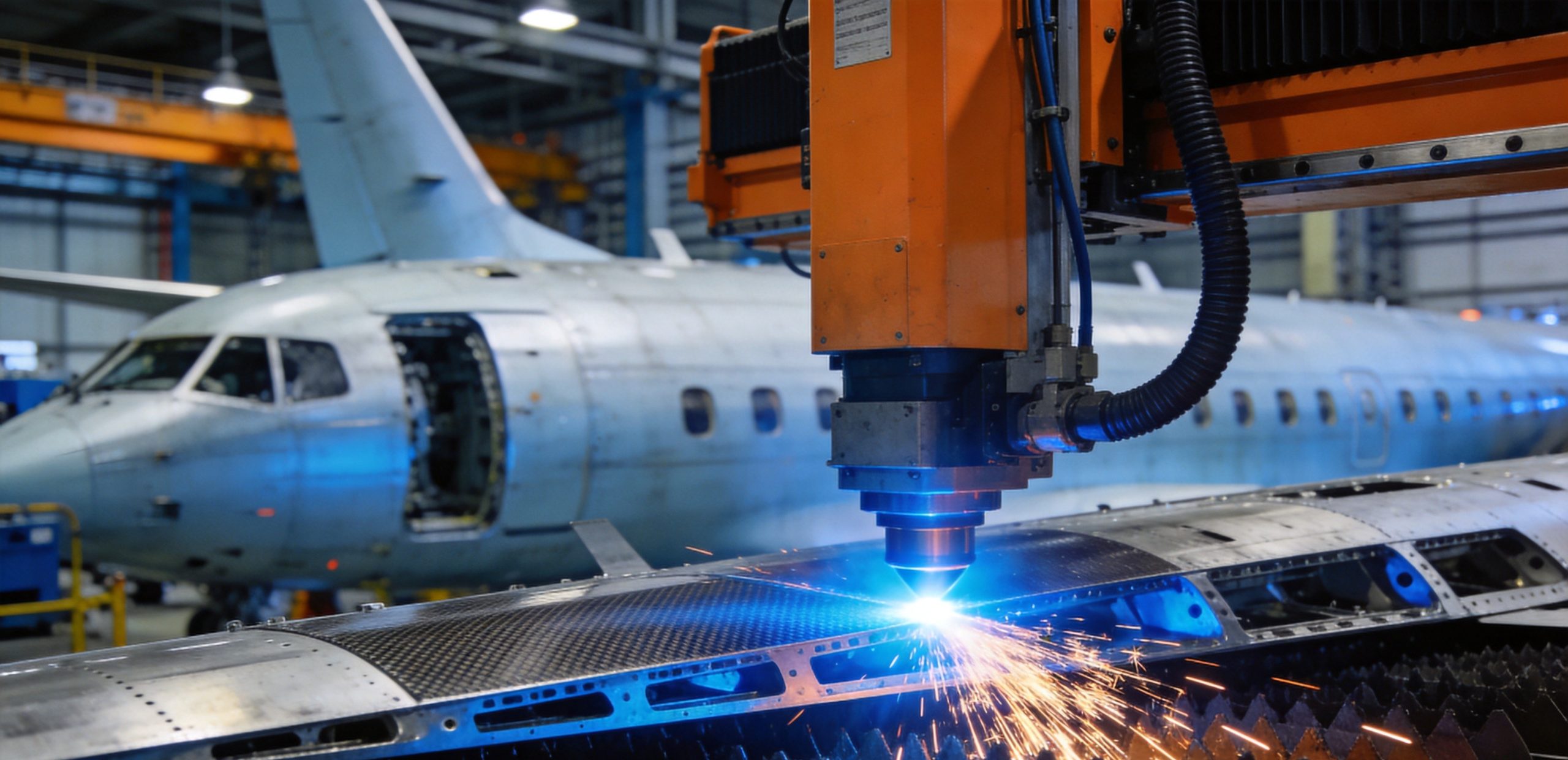
Aerospace manufacturing represents one of the most demanding production environments in the world. Every component—from the smallest fastener to the largest fuselage panel—must meet extraordinary standards for strength, precision, reliability, and regulatory compliance. In this high-stakes industry, laser technology has become an indispensable manufacturing tool, enabling capabilities that traditional methods simply cannot match.
This guide examines how lasers are used in aerospace manufacturing, the key applications driving adoption, the benefits they deliver, and the trends shaping the future of this critical industry.
Why Laser Technology Is Essential for Aerospace Manufacturing
Aerospace components operate under extreme conditions—high temperatures, intense vibration, massive structural loads, and corrosive environments. A single manufacturing defect can have catastrophic consequences. Laser technology addresses several core challenges that are uniquely pronounced in aerospace:
Precision at scale. Aerospace parts range from tiny turbine blade cooling holes measuring fractions of a millimeter to fuselage panels spanning several meters. Lasers deliver micron-level precision regardless of part size, and modern 5-axis laser systems can process complex 3D geometries with consistent accuracy across the entire workpiece.
Material versatility. Aerospace manufacturing uses an exceptionally wide range of materials, including aluminum alloys, titanium, Inconel and other superalloys, carbon fiber composites, ceramics, and specialty coatings. Laser systems can be configured to process all of these materials, often on the same machine with software-controlled parameter changes.
Reduced thermal distortion. Many aerospace components are large, thin-walled structures that are prone to warping during traditional welding. Laser welding concentrates heat in a very small area, minimizing the heat-affected zone and reducing distortion—critical for maintaining the tight dimensional tolerances required in aerospace assembly.
Non-contact processing. Lasers never touch the workpiece, eliminating tool wear, reducing contamination risk, and enabling processing of delicate or pre-finished surfaces without damage. This is particularly valuable for composite materials, which can delaminate under mechanical force.
Process repeatability and traceability. Modern laser systems operate under full CNC control, producing identical results across thousands of parts. This consistency is essential for meeting aerospace regulatory requirements from bodies like the FAA, EASA, and ISO 9001 / AS9100.
Key Laser Applications in Aerospace Manufacturing
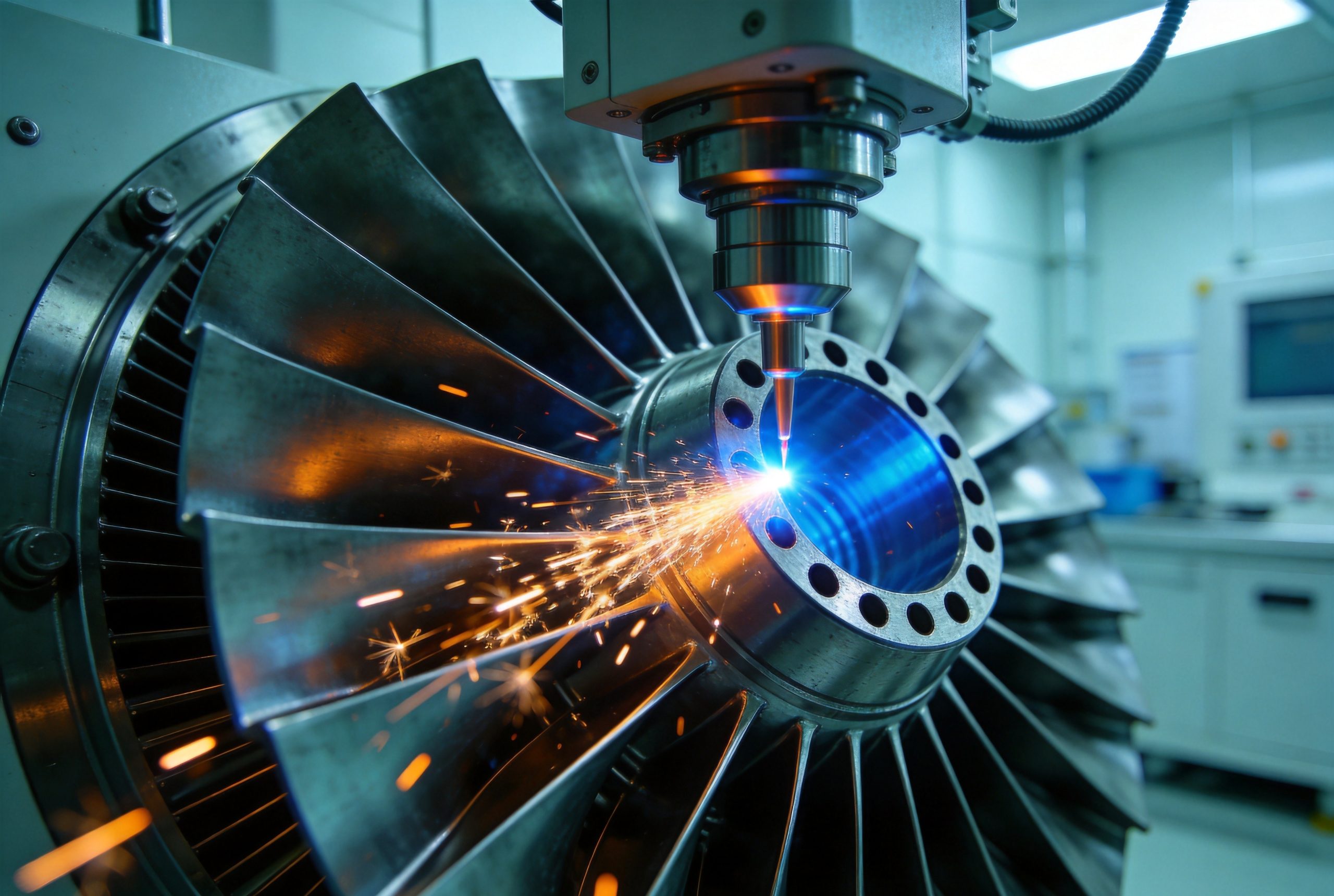
1. Laser Cutting
Laser cutting is one of the most established laser processes in aerospace manufacturing, used for everything from sheet metal components to intricate turbine parts.
Sheet metal fabrication for aircraft structures—including fuselage panels, wing ribs, brackets, and frame components—relies heavily on laser cutting. Fiber lasers cut aluminum, titanium, and steel sheets with clean edges, minimal dross, and high precision, reducing the need for secondary finishing operations. The ability to nest parts efficiently on the sheet also reduces material waste, a significant consideration when working with expensive aerospace alloys.
Turbine engine components, such as compressor blades, vanes, and heat shields, require extremely precise cutting of complex geometries in high-temperature superalloys like Inconel and Hastelloy. Laser cutting handles these difficult-to-machine materials efficiently, producing parts with tight tolerances and excellent surface quality.
Composite materials—carbon fiber reinforced polymer (CFRP) and other advanced composites that are increasingly used in modern aircraft—are well-suited to laser cutting. Unlike mechanical cutting tools, which can cause delamination, fraying, and fiber pull-out, lasers cut cleanly through composite materials when properly configured, preserving structural integrity.
Tube and profile cutting for hydraulic lines, fuel system components, and structural tubing uses 3D laser tube cutting machines to produce complex cutouts, angled ends, and precision holes in tubing of various diameters and materials.
2. Laser Welding
Laser welding has transformed how aerospace components are joined, offering significant advantages over traditional welding methods.
Fuselage and structure assembly is one of the most visible applications. Aircraft manufacturers use laser welding to join fuselage panels, stringers, and other structural components. The narrow heat-affected zone of laser welding reduces distortion compared to conventional welding, meaning less post-weld straightening and rework—a major cost and time saver in large-scale aircraft production.
Turbine engine component welding demands the highest levels of precision and quality. Laser welding is used to assemble turbine blades, vanes, combustor liners, and other hot-section components made from superalloys and single-crystal materials. The precise heat input of laser welding preserves the material properties of these high-performance alloys, which would be degraded by more aggressive welding processes.
Dissimilar material joining is increasingly important in aerospace, where designers combine different materials to optimize strength, weight, and heat resistance. Laser welding can join dissimilar metals—such as titanium to aluminum, or nickel-based superalloys to steel—that are difficult or impossible to join with traditional methods, opening new possibilities for lightweight design.
Hermetic sealing of sensors, avionics enclosures, and fuel system components relies on laser welding to create strong, leak-tight seals that can withstand the extreme pressure and temperature variations of flight.
3. Laser Drilling
Precision laser drilling creates small, accurately positioned holes in aerospace components, particularly in turbine engine parts.
Turbine blade cooling holes are perhaps the most critical laser drilling application in aerospace. Modern gas turbine blades operate at temperatures above the melting point of the blade material itself, made possible by an intricate network of tiny cooling holes that channel compressed air through the blade and over its surface. Laser drilling creates these holes—often hundreds per blade, with diameters as small as 0.3mm and at precise angles—with exceptional speed and consistency.
Combustor liner cooling holes and heat shield perforations also use laser drilling to create patterns of holes in superalloy sheets. The ability to drill thousands of holes quickly and accurately makes laser drilling the standard for these applications.
Fuel injector orifices require precisely sized and positioned holes to control fuel flow and spray patterns. Laser drilling produces these micro-holes with tight tolerances, ensuring consistent engine performance and emissions compliance.
De-icing system holes in aircraft wings and engine inlets use laser-drilled hole patterns for pneumatic de-icing systems, where uniform hole size is critical for consistent airflow.
4. Laser Marking and Engraving
Permanent, traceable marking is essential in aerospace manufacturing for part identification, traceability, and regulatory compliance.
Part identification and traceability—every aerospace component must be traceable from raw material to finished part and throughout its service life. Laser marking creates permanent, high-contrast marks containing part numbers, serial numbers, lot codes, date codes, and manufacturer information. These marks withstand extreme temperatures, chemical exposure, and mechanical wear, ensuring traceability throughout the component’s lifecycle.
Data matrix codes—2D barcodes that can store large amounts of information in a small space—are widely used in aerospace manufacturing. Laser-marked data matrix codes enable automated tracking of components through production, assembly, and maintenance, supporting digital manufacturing and Industry 4.0 initiatives.
Anti-counterfeiting is a growing concern in the aerospace supply chain. Laser marking can create micro-text, hidden marks, and other security features that help verify the authenticity of critical components and protect against counterfeit parts, which pose significant safety risks.
5. Laser Surface Treatment
Laser surface modification technologies enhance the performance and durability of aerospace components.
Laser hardening selectively hardens the surface of critical components—such as landing gear parts, turbine blades, and drive shafts—without affecting the bulk material properties. This improves wear resistance and extends service life, particularly for components that operate in high-stress environments.
Laser cladding deposits a layer of wear-resistant or corrosion-resistant material onto component surfaces. This is used for both manufacturing new components (applying protective coatings) and repairing worn parts in maintenance, repair, and overhaul (MRO) operations. Laser cladding can restore worn turbine blades, landing gear components, and other high-value parts to like-new condition, often at a fraction of the cost of replacement.
Laser cleaning removes contaminants, oxides, paint, and coatings from aerospace components prior to welding, bonding, or inspection. The non-contact nature of laser cleaning makes it ideal for delicate or precision parts, and it eliminates the need for chemical cleaning agents or abrasive blasting that can damage sensitive surfaces.
Laser peening (also known as laser shock peening) uses high-energy laser pulses to create compressive residual stresses in metal surfaces, dramatically improving fatigue resistance and damage tolerance. This technology is used on critical turbine engine components and structural parts to extend service life and improve safety.
Materials Processed with Lasers in Aerospace
The versatility of laser technology allows it to process virtually every material used in aerospace manufacturing:
Metals and alloys:
- Aluminum alloys (2024, 6061, 7075, and others used in airframes)
- Titanium and titanium alloys (Ti-6Al-4V, used in structures and engine components)
- Nickel-based superalloys (Inconel, Hastelloy, Waspaloy—used in turbine hot sections)
- Stainless steels (various grades for structural and system components)
- Cobalt-chrome alloys (used in wear-resistant applications)
- Copper and copper alloys (used in heat exchangers and electrical components)
Composite materials:
- Carbon fiber reinforced polymer (CFRP)—increasingly used in fuselages, wings, and control surfaces
- Glass fiber composites
- Aramid fiber composites (Kevlar)
- Honeycomb core materials
Specialty materials:
- Ceramics and ceramic matrix composites (CMCs)—used in the hottest sections of modern engines
- Thermal barrier coatings (TBCs)—applied to turbine components
- Various coatings and plating materials
Quality Control and Regulatory Considerations
Aerospace manufacturing operates under some of the strictest regulatory frameworks in any industry. Laser processes must be fully validated, controlled, and documented.
AS9100 compliance. AS9100 is the quality management standard for the aerospace industry. Laser manufacturing processes must be fully documented, controlled, and validated to meet this standard, including detailed work instructions, process parameters, and inspection records.
Nadcap accreditation. Many aerospace prime contractors require suppliers to hold Nadcap (National Aerospace and Defense Contractors Accreditation Program) accreditation for special processes including laser welding, laser cutting, and heat treatment. Obtaining and maintaining Nadcap accreditation requires rigorous process control, documentation, and periodic audits.
First Article Inspection (FAI). When a new part is introduced, manufacturers must perform a First Article Inspection to verify that the production process consistently produces parts that meet all specifications. Laser processes must be included in this validation, with documented parameters and inspection results.
Process control and monitoring. Modern laser systems for aerospace include extensive process monitoring capabilities—sensors that track laser power, beam position, weld penetration, and other parameters in real time. This data is logged and can be reviewed for quality assurance and continuous improvement.
Material traceability. Every aerospace component must be traceable back to its raw material source. Laser marking with unique identifiers is a key tool for achieving this traceability, and the laser marking process itself must be validated to ensure marks are permanent and legible throughout the component’s service life.
Benefits of Laser Technology for Aerospace Manufacturers
Improved product quality and reliability. The precision and consistency of laser processing result in higher-quality components with fewer defects, which is critical in an industry where reliability is paramount.
Reduced weight. Laser welding enables the use of lighter, thinner materials and more optimized designs, contributing to overall aircraft weight reduction—which directly translates to fuel savings and improved performance.
Lower production costs. While laser equipment represents a significant capital investment, the elimination of tool wear, reduced post-processing requirements, higher throughput, and lower scrap rates often result in lower per-unit production costs over time.
Faster production cycles. Laser processes are generally faster than traditional machining methods, and they can often complete multiple operations in a single setup. This reduces production lead times and enables faster response to customer demands.
Design freedom. Laser technology enables complex geometries, novel joint designs, and innovative material combinations that would be impossible or impractical with traditional manufacturing methods. This allows aerospace engineers to design more efficient, higher-performance aircraft.
Reduced environmental impact. Laser processing is generally more energy-efficient than traditional machining, produces less waste material, and eliminates the need for many chemical processing steps. This contributes to a smaller environmental footprint for aerospace manufacturing.
Emerging Trends in Aerospace Laser Manufacturing
1. Additive Manufacturing (3D Printing)
Laser-based additive manufacturing—including selective laser melting (SLM), direct metal laser sintering (DMLS), and laser metal deposition (LMD)—is revolutionizing aerospace component production. Complex geometries such as internal cooling channels in turbine blades, lattice structures for weight reduction, and integrated assemblies that would be impossible to machine conventionally are now possible with laser 3D printing. Aerospace companies are increasingly using additive manufacturing for both production parts and tooling, reducing lead times and enabling design optimization.
2. Remote Laser Welding
Remote laser welding uses scanning optics to rapidly position the laser beam over large work areas without moving the welding head. This enables extremely fast welding of large assemblies—such as fuselage panels and door structures—with cycle times that are a fraction of traditional spot welding. The technology is particularly valuable in high-volume aircraft production.
3. Ultrafast Laser Processing
Femtosecond and picosecond lasers deliver ultra-short pulse durations that minimize heat-affected zones, enabling extremely precise processing of delicate materials. These lasers are finding applications in aerospace for drilling cooling holes in ceramic matrix composites, processing thin-film sensors, and ablating coatings with micron-level precision. As ultrafast laser costs continue to decrease and power levels increase, their adoption in aerospace is accelerating.
4. AI-Powered Process Monitoring and Quality Control
Artificial intelligence and machine learning are being integrated into laser manufacturing systems for real-time process monitoring, defect detection, and adaptive control. Cameras, spectrometers, and other sensors feed data to AI algorithms that can detect anomalies during production, automatically adjust laser parameters, and provide detailed quality documentation. This improves yield, reduces scrap, and supports the digital transformation of aerospace manufacturing.
5. In-Space Manufacturing
As space exploration accelerates, the concept of manufacturing components in space rather than launching them from Earth is gaining traction. Laser technology—particularly laser-based additive manufacturing—is well-suited for in-space production, where precision, reliability, and automation are essential. Companies and space agencies are actively developing laser manufacturing systems that could one day produce satellite components, structural parts, and even habitats on orbit or on the lunar surface.
Comparing Laser Technologies for Aerospace Production
Different laser technologies serve different roles in aerospace manufacturing, and the right choice depends on the specific application, material, and production requirements.
Fiber lasers are the workhorse of modern aerospace manufacturing. They offer excellent beam quality, high reliability, and low operating costs, making them ideal for cutting, welding, and marking of metals. Fiber lasers are particularly well-suited for cutting aluminum, titanium, and steel sheet, as well as for welding structural components. Their compact size and air-cooled designs also make them easier to integrate into production lines and automation cells.
CO2 lasers remain important for certain aerospace applications, particularly for cutting thicker materials and processing non-metallic materials like composites and plastics. However, CO2 lasers are being gradually displaced by fiber lasers for most metal processing applications due to the higher efficiency and lower maintenance requirements of fiber technology.
Nd:YAG and pulsed solid-state lasers are the traditional choice for laser drilling of turbine blade cooling holes and other precision drilling applications. The pulsed output of these lasers enables high peak power drilling with minimal heat input, which is critical for drilling high-quality holes in superalloys without damaging the surrounding material.
Ultrafast lasers (femtosecond and picosecond) are the fastest-growing segment in aerospace laser processing. Their ultra-short pulse durations ablate material with virtually no heat-affected zone, enabling extremely precise processing of delicate materials like ceramic matrix composites, thin films, and thermal barrier coatings. As ultrafast laser costs decrease and average power increases, they are moving from specialty R&D applications into mainstream production.
Green and blue lasers are gaining traction for processing highly reflective materials like copper and gold, which are used in aerospace electrical systems and heat exchangers. The shorter wavelengths of green and blue lasers are absorbed much more efficiently by these materials than infrared wavelengths, enabling higher quality processing with less energy.
For most aerospace manufacturers, the practical approach is to start with fiber lasers for general cutting and welding applications, then add specialty laser technologies—such as pulsed Nd:YAG for drilling or ultrafast lasers for advanced materials—as product portfolios and production requirements evolve.
Selecting Laser Equipment for Aerospace Manufacturing
Choosing the right laser equipment for aerospace production requires careful consideration of multiple factors beyond just the machine specifications.
Application requirements. Start with a clear understanding of the specific applications the laser will be used for—cutting, welding, drilling, marking, surface treatment, or a combination. Different applications have different requirements for laser power, beam quality, pulse duration, and wavelength.
Material compatibility. Ensure the laser technology you choose is well-suited for the materials you work with. Fiber lasers work well for most metals, but if you process a lot of composites or ceramics, you may need UV or ultrafast lasers. For superalloy drilling, pulsed solid-state lasers are typically the standard.
Precision and quality requirements. Aerospace applications demand the highest levels of precision and quality. Look for laser systems with excellent beam quality, precise motion control, and comprehensive process monitoring capabilities. The ability to consistently meet tight tolerances is essential.
Production volume and throughput. Consider your current and projected production volumes. High-volume production may benefit from automated material handling, multi-station systems, or remote laser welding technology. Lower-volume or prototype work can use more flexible, manually-loaded systems.
Regulatory and quality requirements. Aerospace manufacturing operates under strict quality standards (AS9100, Nadcap, etc.). The laser equipment supplier should be able to provide the documentation and support needed for process validation, quality control, and regulatory compliance. Look for suppliers with experience in the aerospace industry.
Total cost of ownership. Beyond the initial purchase price, consider maintenance costs, consumables, operator training, energy consumption, and the cost of downtime. A machine with a lower upfront cost may end up being more expensive over its lifetime if it has high maintenance requirements or frequent downtime.
Service and support. In aerospace manufacturing, downtime is extremely costly. Evaluate the supplier’s service network, response time, spare parts availability, and technical support capabilities. A supplier with local service support and fast response times can significantly reduce the impact of any equipment issues.
Automation and integration capabilities. Most aerospace laser systems are integrated into larger production lines or automation cells. Ensure the laser system can be easily integrated with your existing equipment, PLCs, and manufacturing execution systems (MES). Open architecture and standard communication protocols make integration much easier.
Scalability and future-proofing. Consider whether the laser system can grow with your needs. Can it be upgraded with higher power, different wavelengths, or additional capabilities? A system that can adapt to future requirements will provide better long-term value.
Transon Laser works with aerospace and high-precision manufacturing customers to configure laser systems that meet their specific application and production requirements, with the process documentation and support capabilities that regulated industries demand.
The Future of Laser Technology in Aerospace
The role of laser technology in aerospace manufacturing will only continue to expand. Several key trends are driving this growth:
Lightweighting pressure. As fuel efficiency and emissions reduction become increasingly important, aircraft manufacturers are under constant pressure to reduce weight. Laser technology enables the use of lighter materials, thinner structures, and optimized designs that support this goal.
Advanced materials adoption. New materials—including ceramic matrix composites, additively manufactured superalloys, and advanced composites—are being introduced at an accelerating pace. Laser technology’s versatility makes it well-suited for processing these emerging materials.
Industry 4.0 and digital manufacturing. The integration of laser systems with digital manufacturing platforms, IoT sensors, and AI quality control will further improve efficiency, quality, and traceability in aerospace production.
Sustainable aviation. The push for more sustainable aviation—including electric propulsion, hydrogen fuel, and new aircraft configurations—will create new manufacturing challenges that laser technology is well-positioned to address.
Conclusion
Laser technology has become an essential tool in aerospace manufacturing, enabling the production of safer, more efficient, and more innovative aircraft and spacecraft. From cutting intricate turbine components to welding massive fuselage panels to drilling thousands of precision cooling holes, lasers deliver precision, consistency, and versatility that traditional manufacturing methods simply cannot match.
As the aerospace industry continues to evolve—with lighter materials, more complex geometries, and greater demands for efficiency and sustainability—the role of laser manufacturing will only grow. Aerospace manufacturers that invest in the right laser technology, process expertise, and quality systems will be well-positioned to meet the evolving demands of the industry.
For aerospace manufacturers seeking reliable laser solutions, working with experienced suppliers that understand the unique challenges of the aerospace industry—from regulatory compliance to process validation to material expertise—is critical to success. Companies like Transon Laser offer industrial-grade laser systems with the precision, reliability, and support capabilities that aerospace manufacturing demands.