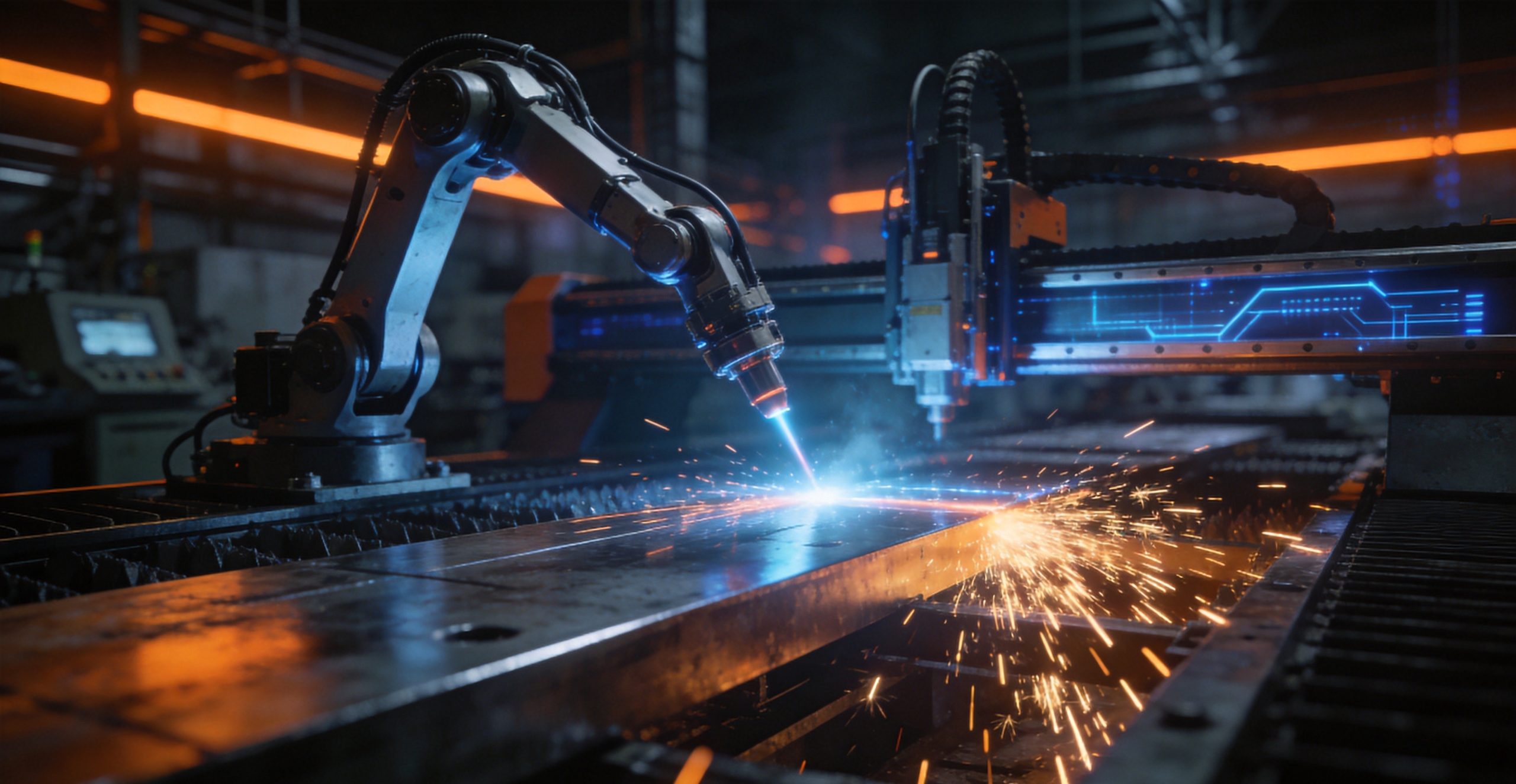
The industrial laser market is evolving faster than ever. What was once a niche tool for precision manufacturing has become a foundational technology across nearly every industry — from automotive to aerospace, from electronics to medical devices.
But what’s driving this rapid growth? And what trends should manufacturers, job shops, and investors be watching?
In this guide, we break down 7 major laser technology trends that are reshaping manufacturing in 2026 and beyond. From AI-powered quality control to new laser types that were impossible just a few years ago, these trends will define the future of industrial laser technology.
Whether you’re a manufacturer evaluating laser equipment, an investor tracking the market, or just curious about where laser technology is heading, this guide will give you a comprehensive overview of the most important trends.
—
Quick Overview: The State of Laser Technology in 2026
Before diving into specific trends, let’s set the stage:
- Global industrial laser market: ~$25 billion (2026), growing at 8–10% CAGR
- Fiber lasers: Now dominate the market (~60% share) thanks to falling costs and improving performance
- CO2 lasers: Still important for non-metals, but slowly losing share to fiber
- UV and green lasers: Fastest-growing segments, driven by electronics and battery manufacturing
- Handheld lasers: Explosive growth — bringing laser welding and cleaning to small businesses
The market is being pulled forward by three mega-trends:
- Electrification (EVs, batteries, solar)
- Automation (robots, AI, smart factories)
- Miniaturization (electronics, medical devices, semiconductors)
All three are driving demand for more, better, and cheaper laser technology.
—
Trend 1: AI and Machine Learning Integration
Impact: High — will transform quality control, process optimization, and predictive maintenance
Timeline: Already happening; will become standard by 2028
Artificial intelligence is coming to industrial lasers — and it’s going to change everything.
What’s Happening?
Laser manufacturers are adding AI and machine learning capabilities to their machines in three key areas:
1. Intelligent Process Control
- AI algorithms automatically adjust laser parameters (power, speed, focus) in real-time based on sensor feedback
- Compensates for variations in material thickness, surface condition, and part positioning
- Results in more consistent quality and fewer defects
2. Automated Quality Inspection
- Vision systems use AI to inspect welds, marks, and cuts immediately after processing
- Can detect defects that human inspectors would miss
- 100% inspection at production line speeds
- Automatically classifies defects and adjusts process parameters
3. Predictive Maintenance
- AI monitors laser source health, optics condition, and system performance
- Predicts when components will fail before they actually do
- Reduces unplanned downtime and extends equipment life
- Optimizes maintenance scheduling
Why It Matters
- Higher yield: Fewer defective parts = lower cost per part
- Less scrap: AI catches problems early, before material is wasted
- Reduced labor: AI systems can monitor and adjust processes without human intervention
- Better uptime: Predictive maintenance means fewer unexpected breakdowns
- Continuous improvement: AI learns from every part, getting better over time
Real-World Example
A major automotive supplier recently installed AI-powered laser welding cells for EV battery production. The result: defect rates dropped by 85%, and production yield increased from 92% to 99.2%. The system paid for itself in less than 6 months.
—
Trend 2: Blue and Green Lasers for Copper and Reflective Metals
Impact: Very High — game-changing for battery and electronics manufacturing
Timeline: Rapid adoption now; will be standard for copper welding by 2028
Copper is notoriously difficult to weld with infrared (IR) lasers. It reflects about 95% of IR light at room temperature, making it hard to get enough energy into the material. The result: spatter, porosity, and inconsistent weld quality.
But blue lasers (450nm) and green lasers (532nm) are changing that. Copper absorbs blue and green light 10–20x better than IR, making welding much easier and more consistent.
What’s Happening?
- Blue laser diodes: Power levels have increased from 100W to 1000W+ in just 3 years
- Green lasers: Frequency-doubled fiber lasers now available at 200–500W
- Hybrid approaches: Some systems use blue for initial heating and IR for deep penetration
- Falling prices: Blue laser costs have dropped 70% since 2022
Key Applications
- EV battery welding: Copper busbars, tabs, and terminals
- Electronics: Copper wires, connectors, and PCB components
- Electric motors: Stator and rotor welding
- Plumbing: Copper pipe and tube welding
- Jewelry: Gold and silver welding and soldering
Why It Matters
- Better copper welds: Less spatter, less porosity, more consistent quality
- Faster welding: 2–5x faster than IR for copper
- Lower cost: Less rework, less scrap, higher throughput
- Enables new applications: Makes copper welding practical for high-volume production
Market impact: The EV battery market alone could drive billions of dollars in blue/green laser demand over the next 5 years. Every EV has thousands of copper welds in its battery pack.
—
Trend 3: Ultrafast Lasers for Precision Micro-Manufacturing
Impact: High — enabling new levels of precision in electronics, medical, and semiconductor manufacturing
Timeline: Steady growth; will accelerate as costs come down
Ultrafast lasers (femtosecond and picosecond pulses) can process materials with unprecedented precision — removing material layer by layer, atom by atom, with virtually no heat-affected zone.
What’s Happening?
- Falling costs: Ultrafast laser prices have dropped 80% in the last decade
- Higher power: Average power has increased from watts to hundreds of watts
- New applications: Moving from R&D labs to production floors
- Compact form factors: Smaller, more robust designs for industrial environments
Key Applications
- Semiconductor manufacturing: Wafer dicing, via drilling, mask repair
- Medical devices: Stent cutting, catheter manufacturing, micro-machining
- Electronics: PCB micro-via drilling, flex circuit cutting, display manufacturing
- Solar: Thin-film solar cell patterning and edge isolation
- Watchmaking: Micro-components and gears
- Automotive: Fuel injector nozzles, sensor components
Why It Matters
- Unmatched precision: Can create features smaller than 1 micron
- No heat damage: “Cold” ablation process — no HAZ, no thermal stress
- Any material: Works on metals, ceramics, glass, polymers, even diamond
- Higher quality: Better surface finish, sharper edges, more consistent results
- Enables new products: Makes devices possible that couldn’t be made any other way
—
Trend 4: Handheld and Portable Laser Machines
Impact: Very High — democratizing laser technology for small businesses
Timeline: Explosive growth now; market will double by 2028
For decades, industrial lasers were big, expensive, stationary machines that only large manufacturers could afford. That’s all changing.
Handheld laser welders and cleaners have exploded in popularity, bringing laser technology to thousands of small and medium businesses that could never afford robotic systems.
What’s Happening?
- Falling prices: A 1500W handheld laser welder now costs $6,000–$12,000 — less than a good TIG welder + skilled operator
- Ease of use: Operators can be trained in days, not months
- Portability: Many models come on wheels or can be moved with a pallet jack
- Multiple functions: Some machines can weld, clean, and cut — all with one device
- Growing ecosystem: Accessories, nozzles, wire feeders, and safety equipment
Market Growth
- Handheld laser welders: ~500,000 units sold in 2025 (up from <50,000 in 2020)
- Handheld laser cleaners: ~300,000 units sold in 2025
- Fastest-growing markets: China, Southeast Asia, North America
- Key industries: Sheet metal fabrication, auto repair, jewelry, mold repair
Why It Matters
- Democratization: Brings laser technology to small businesses and job shops
- Labor savings: Replaces skilled TIG welders (who are in short supply)
- Productivity: 3–10x faster than traditional methods for many applications
- New markets: Creates use cases that didn’t exist before (on-site repair, mobile welding services)
- Competitive pressure: Forces traditional welding equipment manufacturers to adapt
Warning: The rapid growth of cheap handheld lasers has also raised safety concerns. Proper training and PPE are essential — Class 4 lasers can cause permanent eye damage and skin burns.
—
Trend 5: Integrated Multi-Process Laser Systems
Impact: Medium-High — changing how factories think about laser equipment
Timeline: Growing steadily; will be common in high-volume production by 2029
Why buy separate machines for cutting, welding, marking, and cleaning when one machine can do it all?
Multi-process laser systems — machines that can perform multiple laser processes with quick-change heads or software switching — are gaining popularity, especially in flexible manufacturing environments.
What’s Happening?
- Quick-change heads: Swap between welding, cutting, and cleaning heads in minutes
- Software switching: Some galvo-based systems can switch processes via software
- Modular design: Add processes as you need them
- Robotic integration: Robot cells with multiple tools for different operations
- All-in-one machines: Entry-level machines that weld, clean, and cut
Key Benefits
- Lower capital cost: One machine instead of 2–3
- Smaller footprint: Less floor space needed
- Flexibility: Can handle a wider variety of jobs
- Higher utilization: Machine is busy more of the time
- Easier training: Operators learn one system instead of several
Limitations
- Jack of all trades, master of none: May not be optimal for any single process
- Head change time: Switching heads takes time (reduces productivity for mixed jobs)
- Complexity: More parts = more things that can break
- Not for high volume: Best for job shops and low-to-medium volume, not mass production
—
Trend 6: Green Manufacturing and Sustainability
Impact: Medium-High — driven by regulation and corporate ESG goals
Timeline: Gradual but steady; will accelerate with carbon pricing
Manufacturers are increasingly looking for ways to reduce their environmental footprint. Laser technology is both part of the problem (energy use) and part of the solution (replacing more polluting processes).
What’s Happening?
1. Energy Efficiency Improvements
- Modern fiber lasers are ~40–50% wall-plug efficient (vs. 5–10% for CO2)
- New laser designs continue to improve efficiency
- Energy recovery systems capture and reuse waste heat
2. Replacing Polluting Processes
- Laser cleaning replaces sandblasting (dust, waste media) and chemical cleaning (toxic waste)
- Laser marking replaces inkjet printing (solvents, consumables)
- Laser cutting replaces die cutting (waste material, tool wear)
3. Circular Economy Enablement
- Laser welding enables lighter, stronger products that last longer
- Laser disassembly helps with recycling and remanufacturing
- Laser marking provides permanent identification for product lifecycle tracking
4. Regulatory Drivers
- EU Green Deal and CSRD regulations
- Carbon border adjustment mechanism (CBAM)
- EPA and OSHA tightening pollution and safety rules
- Corporate ESG targets from large manufacturers
Why It Matters
- Cost savings: Lower energy use = lower operating costs
- Compliance: Helps meet environmental regulations
- Marketing: “Green” manufacturing is a selling point for customers
- Risk management: Prepares companies for future carbon pricing and regulations
- Talent attraction: Younger workers prefer environmentally responsible employers
—
Trend 7: 3D Printing Additive Manufacturing with Lasers
Impact: High — transforming how complex metal parts are made
Timeline: Steady growth; will be mainstream for complex parts by 2030
Laser-based 3D printing (additive manufacturing) is revolutionizing how complex metal parts are designed and produced. What started as a prototyping tool is now a production technology for critical components.
What’s Happening?
- Growing adoption: Moving from prototyping to production
- Larger machines: Build volumes keep increasing
- Faster printing: Multi-laser systems (4, 6, even 12 lasers) speed up production
- More materials: New alloys and composites being qualified
- Better quality: Improved process monitoring and quality control
- Lower cost: Machine prices are falling, especially for entry-level systems
Key Technologies
- SLM (Selective Laser Melting): Full melting of metal powder — for strong, dense parts
- DMLS (Direct Metal Laser Sintering): Partial melting — for lower-stress applications
- SLA (Stereolithography): UV laser curing of resin — for high-detail plastic parts
- LMD (Laser Metal Deposition): Blown powder or wire — for large parts and repair
- WAAM (Wire Arc Additive Manufacturing): Not laser, but related — for very large parts
Key Applications
- Aerospace: Turbine blades, structural components, fuel nozzles
- Medical: Custom implants, surgical instruments, dental devices
- Automotive: Conformal cooling channels, lightweight structures, tooling
- Tooling: Conformal cooling for injection molds and die casting dies
- Energy: Turbine components, heat exchangers, nuclear parts
Why It Matters
- Design freedom: Can make parts impossible to manufacture any other way
- Reduced assembly: Combine multiple parts into one (faster, stronger, cheaper)
- Less waste: Additive process uses only the material needed (vs. 90% waste for machining)
- Mass customization: Each part can be unique without extra cost
- On-demand manufacturing: Print parts when and where you need them
—
Bonus Trend: Laser Safety and Regulation
As laser technology becomes more common and more powerful, safety and regulation are becoming increasingly important.
What’s Happening?
- Stricter safety standards: Updated IEC and ANSI laser safety standards
- Training requirements: More jurisdictions requiring formal laser safety training
- Enforcement: OSHA and similar agencies paying more attention to laser safety
- Handheld laser concerns: Rapid growth of cheap handheld lasers has raised safety alarms
- Laser safety officers: More companies appointing dedicated laser safety personnel
Key Safety Issues
- Eye protection: Class 4 lasers can cause permanent eye damage in milliseconds
- Skin burns: Direct or scattered laser exposure can burn skin
- Fumes and particulates: Laser processing generates potentially harmful fumes
- Fire hazard: Lasers can ignite flammable materials
- Reflections: Laser beams can reflect off shiny surfaces and hit unintended targets
Bottom line: As lasers become more powerful and more common, safety will become an even bigger concern. Proper training, PPE, and safety procedures are essential.
—
What This Means for Different Stakeholders
For Manufacturers
- Invest in automation and AI: The productivity gains are too big to ignore
- Consider multi-process systems: If you have varied needs, one machine may be more cost-effective
- Don’t ignore safety: More lasers = more safety risks — invest in training and protection
- Watch blue/green lasers: If you work with copper or EV batteries, this will affect you soon
For Job Shops and Small Businesses
- Handheld lasers are game-changers: Affordable, easy to use, and highly productive
- Start with one process: Welding or cleaning — whichever you need most
- Get training: Don’t skip safety training — it’s not worth the risk
- Add capabilities gradually: Start simple, then expand as you learn
For Investors
- Fiber lasers are the new baseline: Don’t bet against fiber laser technology
- Blue/green lasers are the next big thing: Especially for battery and electronics
- Ultrafast lasers have huge potential: But still early — watch for cost reductions
- AI integration is a differentiator: Manufacturers that get AI right will pull ahead
- Handheld laser market is booming: But watch for margin compression as competition increases
—
The Bottom Line
Laser technology is in a period of rapid innovation and adoption. Seven trends are driving this transformation:
- AI and machine learning — making lasers smarter and more productive
- Blue and green lasers — solving the copper welding challenge
- Ultrafast lasers — enabling unprecedented precision
- Handheld lasers — democratizing laser technology
- Multi-process systems — making lasers more flexible and affordable
- Green manufacturing — lasers as part of the sustainability solution
- 3D printing — transforming how complex parts are made
The common thread across all these trends is accessibility. Lasers are getting cheaper, easier to use, and more capable every year. What was once only available to large aerospace and automotive companies is now within reach of small job shops and even individual craftsmen.
If you’re in manufacturing, now is the time to learn about laser technology — because the companies that adopt these trends early will have a significant competitive advantage in the years ahead.
—
Ready to explore how laser technology can transform your manufacturing operation? [Browse our full range of laser machines](https://www.transonlaser.com/shop/) or [contact us](https://www.transonlaser.com/contact-us/) for a free consultation with our laser application specialists.
*Which laser technology trend do you think will have the biggest impact on manufacturing? Drop a comment below — we’d love to hear your thoughts.*