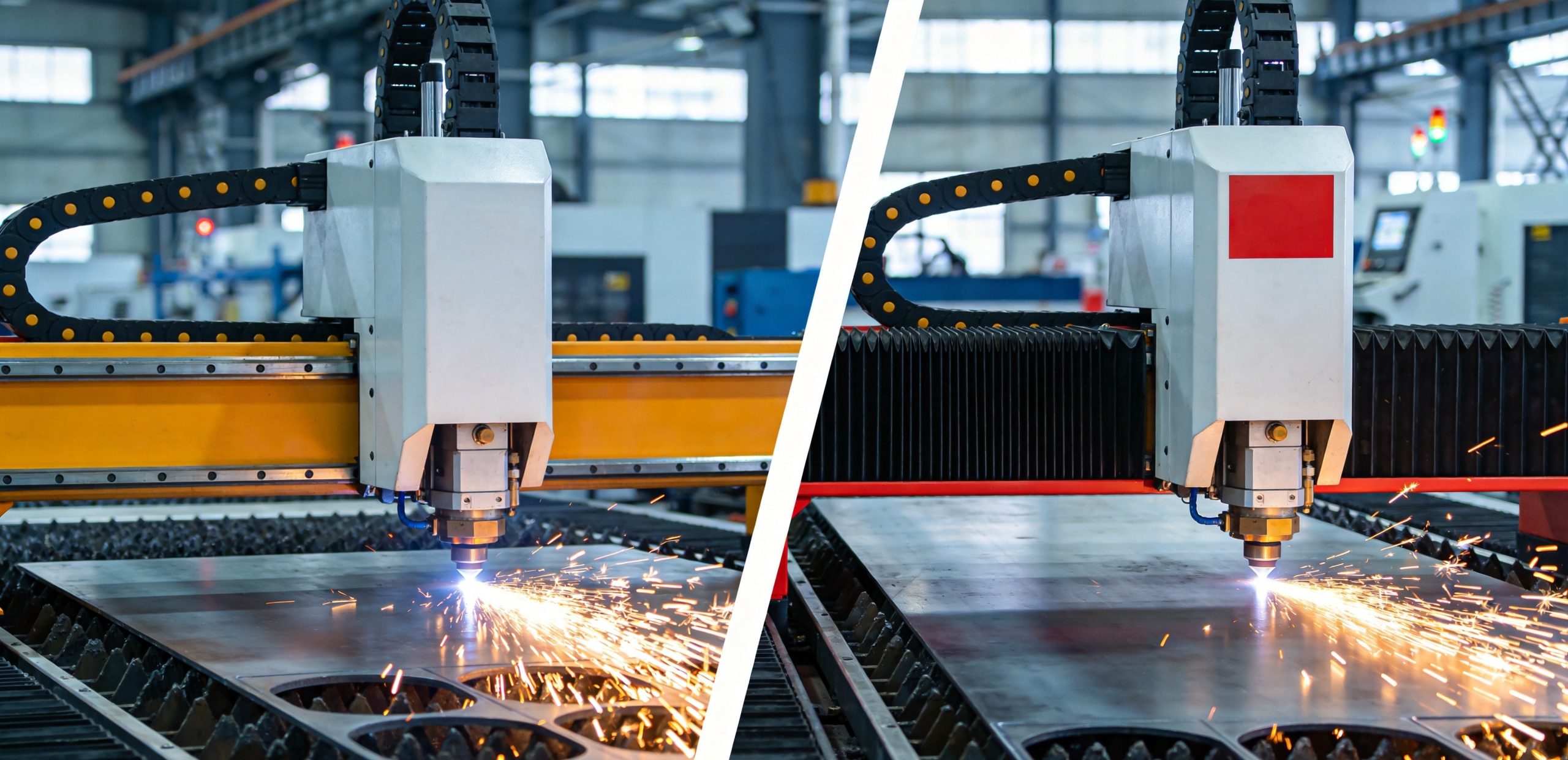
Fiber Laser vs CO2 Laser Cutting: What’s the Difference?
When it comes to industrial laser cutting, two technologies dominate the market: fiber laser cutting and CO2 laser cutting. Both produce precise cuts, but they work on fundamentally different principles and excel in different applications. Choosing the right technology can have a major impact on your production efficiency, operating costs, and product quality.
In this comprehensive guide, we’ll break down everything you need to know about fiber laser vs CO2 laser cutting — how they work, their strengths and weaknesses, cost comparisons, and which one is right for your business. Whether you’re setting up a new fabrication shop or upgrading your equipment, this comparison will help you make an informed decision.
How Each Technology Works
Fiber Laser Cutting
A fiber laser uses a bank of laser diodes to pump light into an optical fiber (usually doped with rare-earth elements like ytterbium). The light bounces back and forth along the fiber, amplifying as it goes, and emerges as a highly concentrated, single-mode laser beam. That beam is then delivered to the cutting head through a flexible fiber optic cable and focused onto the workpiece.
Key characteristics of fiber lasers:
- Wavelength: ~1.06 μm (near infrared, invisible to the naked eye)
- Beam delivery: Flexible fiber optic cable — no mirrors or complex beam paths
- Wall-plug efficiency: 30–40% (very efficient)
- Typical power range: 500W – 20kW+ for industrial cutting
- Operating cost: Low — no laser gas, minimal consumables
CO2 Laser Cutting
A CO2 laser generates its beam by exciting a mixture of gases (typically carbon dioxide, nitrogen, and helium) with an electrical discharge. The excited CO2 molecules emit photons at a wavelength of 10.6 μm (far infrared). The beam is guided through the machine by a series of mirrors and then focused onto the workpiece by a lens or curved mirror.
Key characteristics of CO2 lasers:
- Wavelength: 10.6 μm (far infrared, invisible)
- Beam delivery: Mirror-based beam path — requires precise alignment
- Wall-plug efficiency: 8–15% (relatively inefficient)
- Typical power range: 150W – 6kW for industrial cutting
- Operating cost: Higher — laser gas mixture, mirror replacement, more electricity
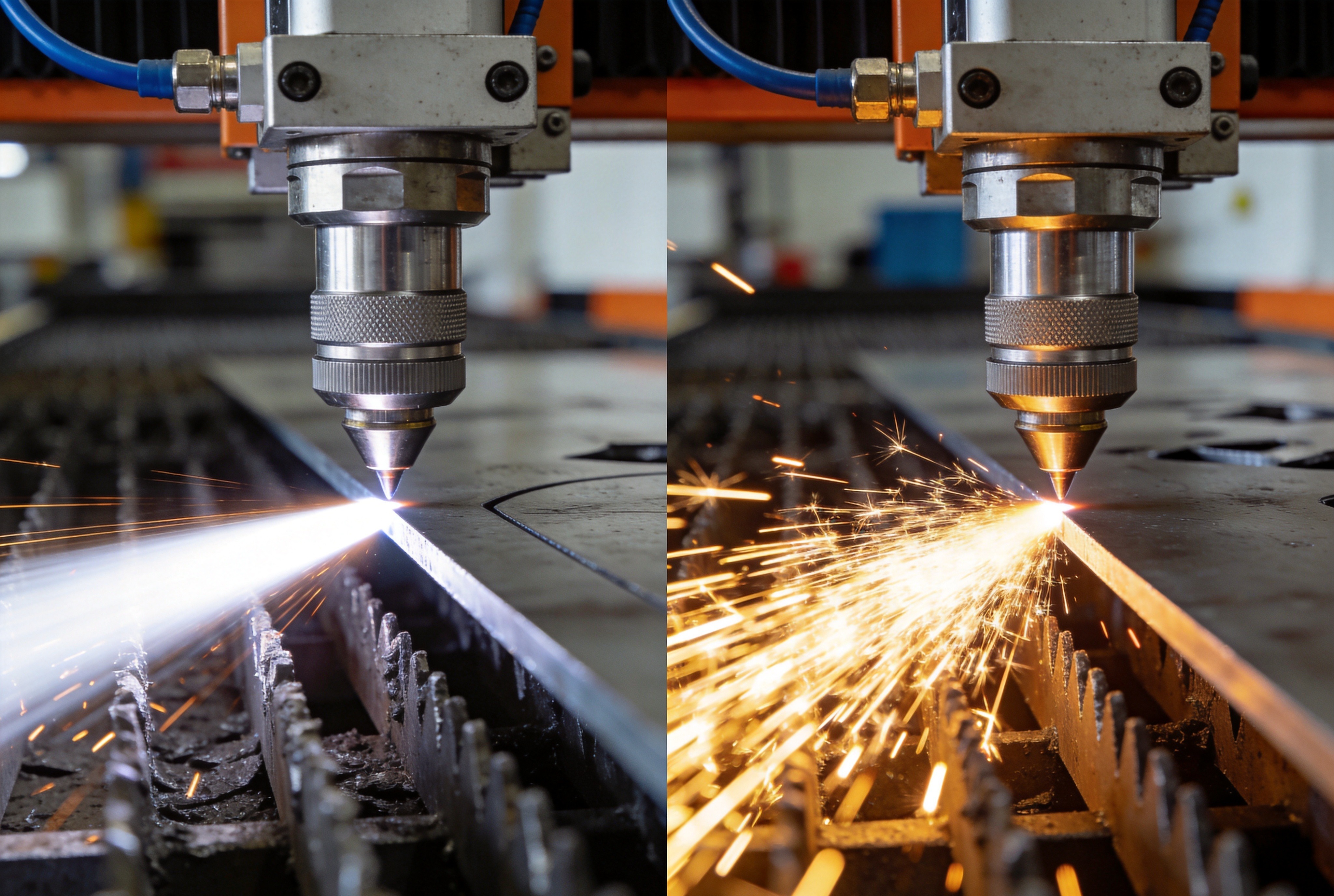
Side-by-Side Comparison
| Factor | Fiber Laser | CO2 Laser |
|---|---|---|
| Wavelength | ~1.06 μm (near IR) | 10.6 μm (far IR) |
| Wall-plug efficiency | 30–40% | 8–15% |
| Beam delivery | Fiber optic cable | Mirror system |
| Cutting speed (thin sheet) | Much faster (2–5x) | Slower |
| Cutting quality (thick plate) | Good, but CO2 edge is smoother | Excellent — smoother edge quality |
| Reflective metals (aluminum, copper, brass) | Excellent — high absorption | Poor — most light reflects off |
| Non-metals (acrylic, wood, fabric) | Limited — poor absorption | Excellent — widely used for non-metals |
| Operating cost per hour | Low ($2–$5/hr) | High ($8–$20/hr) |
| Maintenance requirements | Low — no mirrors, no laser gas | Higher — mirrors, optics, gas changes |
| Machine cost (equivalent power) | Generally lower | Generally higher |
| Expected laser source life | 100,000+ hours | 20,000–40,000 hours (before tube replacement) |
| Setup time | Fast — plug-and-play fiber | Slower — beam alignment needed |
Cutting Performance Comparison
Thin Sheet Metal (0.5–3mm)
This is where fiber lasers really shine. Because the 1.06 μm wavelength is highly absorbed by metals and the beam can be focused to a smaller spot size, fiber lasers cut thin materials significantly faster than CO2 lasers of the same power.
- 1mm stainless steel: A 1kW fiber laser can cut at ~15–20 m/min, while a 1kW CO2 manages ~6–8 m/min.
- 2mm mild steel: Fiber is roughly 2–3x faster than equivalent-power CO2.
- Edge quality: Both produce clean cuts, but fiber can sometimes leave a slightly rougher edge on very thin materials at maximum speed.
For high-volume production of thin sheet metal components, a fiber laser will almost always deliver higher throughput and lower cost per part.
Medium-Thickness Plate (3–10mm)
The speed gap narrows as material thickness increases. Both technologies perform well in this range, and the choice often comes down to material type and quality requirements.
- 6mm mild steel: A 2kW fiber and a 2kW CO2 are more comparable in speed, with fiber still having an edge of about 20–30%.
- Stainless steel: Fiber maintains a bigger advantage because the shorter wavelength absorbs better.
- Edge quality: CO2 generally produces a slightly smoother, more vertical cut edge in this thickness range. Fiber cut quality is very good but may show slightly more striation.
Thick Plate (10mm+)
For thicker materials, CO2 lasers have historically held an advantage in cut quality, but modern high-power fiber lasers have largely closed the gap.
- 12–25mm mild steel: High-power fiber lasers (3kW+) now cut thick steel very well. CO2 still has a slight edge in edge smoothness, but the difference is much smaller than it used to be.
- 25mm+: CO2 may still be preferred for the thickest applications where absolute edge quality is critical, but 6kW+ fiber lasers are increasingly competitive.
- Stainless steel thick plate: Fiber holds its own well, especially with nitrogen assist gas for oxide-free cuts.
It’s worth noting that high-power fiber lasers (6kW, 12kW, 20kW+) have dramatically changed the thick-plate cutting landscape in recent years. Machines like the Transon TS-F3015 6kW fiber laser can cut 25mm mild steel and 20mm stainless steel with excellent quality, at speeds that compete with and often exceed CO2 machines.
Material Compatibility
Where Fiber Lasers Excel
Fiber lasers are the clear winner for metal cutting, especially:
- Reflective metals: Aluminum, copper, brass, bronze, silver. The 1.06 μm wavelength absorbs much better into these materials than CO2’s 10.6 μm. With a CO2 laser, most of the beam reflects off reflective metals, making cutting slow or even dangerous (reflected light can damage optics). Fiber lasers handle them with ease.
- Stainless steel: Excellent cut quality and speed across all thicknesses.
- Mild steel / carbon steel: Very fast on thin to medium thickness.
- Galvanized steel: Good results, though zinc vaporization requires proper fume extraction.
- Brass and copper: Fiber is essentially the only practical laser choice for cutting these reflective metals.
Where CO2 Lasers Excel
CO2 lasers have broader material compatibility, especially for non-metallic materials:
- Acrylic / PMMA: CO2 lasers produce beautifully polished, flame-polished edges on acrylic — something fiber lasers cannot match (fiber doesn’t cut acrylic well at all).
- Wood and plywood: Excellent engraving and cutting results.
- Textiles and fabrics: Clean cuts with sealed edges.
- Paper, cardboard, leather, rubber, glass: All cut well with CO2.
- Plastics: Most plastics cut cleanly with CO2 (some may melt or discolor).
If your business cuts a mix of metals and non-metals, a CO2 laser might be the more versatile choice. If you primarily cut metals — especially reflective ones — fiber is almost certainly the better option.
Cost Comparison
Purchase Price
Let’s compare the approximate purchase prices for similarly capable machines:
| Machine Type | Power | Typical Price Range |
|---|---|---|
| Entry-level fiber laser | 1000W | $15,000 – $30,000 |
| Mid-range fiber laser | 3000W | $35,000 – $70,000 |
| High-power fiber laser | 6000W | $60,000 – $120,000 |
| Entry-level CO2 laser (metal-capable) | 150W | $8,000 – $20,000 |
| Industrial CO2 laser | 500W | $40,000 – $80,000 |
| High-power CO2 laser | 2000W | $80,000 – $150,000+ |
Note that these are rough ranges — actual pricing depends on brand, configuration, bed size, features, and supplier. Chinese manufacturers like Transon Laser typically offer significantly better value than European or Japanese brands, with comparable performance for most applications.
Operating Costs
This is where fiber lasers have a massive advantage:
- Electricity: With 3–4x higher wall-plug efficiency, fiber lasers use dramatically less power. A 2kW fiber laser might consume 6–8 kW of electricity, while a 2kW CO2 might draw 15–20 kW. Over thousands of operating hours, this adds up to substantial savings.
- Laser gas: CO2 lasers require a continuous supply of laser gas mixture (CO2 + N2 + He), which costs money and requires periodic replacement. Fiber lasers have no laser gas — zero cost.
- Optics maintenance: CO2 machines have multiple mirrors that need regular cleaning and periodic replacement. Fiber lasers deliver the beam through a sealed fiber cable — no mirrors to align or clean. The only consumable optic is the protective window at the cutting head.
- Consumables: Nozzles, protective windows, and assist gas are similar for both. But CO2 also has mirrors, output couplers, and rear mirrors that eventually need replacing.
Overall, fiber laser operating costs are typically 50–70% lower than equivalent CO2 machines. For a shop running one or two shifts per day, this can amount to tens of thousands of dollars in annual savings.
Total Cost of Ownership (TCO)
When you factor in purchase price, operating costs, maintenance, and expected lifespan, fiber lasers almost always come out ahead for metal cutting applications. The lower upfront cost (for equivalent metal-cutting capability), lower operating cost, and longer laser source life all contribute to a significantly lower TCO over the machine’s lifetime.
Maintenance and Reliability
Fiber Laser Maintenance
Fiber lasers are essentially “set it and forget it” compared to CO2:
- No beam alignment needed: The fiber cable delivers the beam directly to the cutting head — no mirrors to align or realign.
- No laser gas: No gas bottles to change, no gas lines to maintain.
- Long laser source life: 100,000+ hours is typical for quality fiber laser sources from reputable manufacturers. Many machines run for 10+ years without needing laser source replacement or refurbishment.
- Minimal daily maintenance: Clean the protective window, check the chiller, inspect the nozzle — that’s about it.
CO2 Laser Maintenance
CO2 machines require more ongoing attention:
- Mirror alignment: The beam path uses multiple mirrors that must stay perfectly aligned. Thermal expansion, vibration, and wear can all cause misalignment, leading to reduced cut quality and potential damage.
- Laser gas management: The laser gas mixture degrades over time and needs periodic replacement or replenishment.
- Shorter laser source life: CO2 laser tubes typically last 20,000–40,000 hours before needing replacement or recharging — and replacement is expensive.
- More optics to maintain: Mirrors, output couplers, rear mirrors, and focusing lenses all need regular inspection and cleaning.
For businesses without dedicated maintenance staff, the lower maintenance requirements of fiber lasers are a significant advantage.
Which One Should You Choose?
Choose Fiber Laser If…
- You primarily cut metal (steel, stainless steel, aluminum, copper, brass)
- You work with reflective metals like aluminum, copper, or brass — fiber is the only practical laser choice
- You need high production speed on thin to medium sheet metal
- You want low operating costs and minimal maintenance
- You value reliability and uptime
- You’re looking for the best long-term value and lowest total cost of ownership
For most metal fabrication businesses today, a fiber laser is the default choice. The technology has matured rapidly, prices have come down significantly, and the performance advantages over CO2 for metal cutting are undeniable.
Transon Laser’s TS-F3015 series fiber laser cutters offer an excellent balance of performance, reliability, and value. With power options from 1kW to 12kW and a range of bed sizes, there’s a configuration for every shop size and production need.
Choose CO2 Laser If…
- You cut a lot of non-metallic materials (acrylic, wood, fabric, leather, paper)
- You need the absolute smoothest edge quality on thick metal plate
- You do a lot of laser engraving on a variety of materials
- Your budget is very tight and you only need to cut thin materials at low volume
CO2 lasers still have their place, especially for shops that work with diverse materials including non-metals. But for pure metal cutting, fiber has become the dominant technology — and for good reason.
The Hybrid Option: Combo Machines
Some manufacturers offer “hybrid” or “combo” machines that have both a fiber laser head and a CO2 laser head, or that can switch between the two. These can be a good solution for shops that need to cut both metals and non-metals regularly.
However, hybrid machines also have drawbacks:
- Higher purchase price than a single-technology machine
- More complex — more things to maintain and potentially break
- Switching between heads takes time
- Each laser may have lower power than a dedicated machine
For most shops, it’s usually more cost-effective to buy one dedicated machine that handles your primary application, and outsource the occasional jobs that require the other technology — or add a second machine later if demand justifies it.
Industry Trends: The Shift to Fiber
Over the past decade, fiber lasers have rapidly taken market share from CO2 lasers in the metal cutting industry. Several factors are driving this shift:
- Falling fiber laser prices: As the technology has matured and production volumes have increased, prices have dropped dramatically. What cost $500k ten years ago might cost $50k today.
- Higher power options: Early fiber lasers were limited to lower powers. Today, 6kW, 12kW, and even 20kW+ fiber lasers are readily available, making them competitive with CO2 for thick-plate cutting.
- Better cut quality: Advancements in beam shaping, cutting heads, and process parameters have narrowed the quality gap that CO2 once held on thick materials.
- Lower operating costs: As energy costs rise, the efficiency advantage of fiber lasers becomes increasingly important.
- Chinese manufacturers: Companies like Transon Laser have brought high-quality, affordable fiber laser machines to the global market, accelerating adoption.
Most industry analysts expect fiber lasers to continue gaining market share, though CO2 will remain relevant for specific applications like acrylic cutting and certain non-metal industries.
Frequently Asked Questions
Can a fiber laser cut acrylic?
Not well. The 1.06 μm wavelength of fiber lasers doesn’t absorb well into acrylic and other clear plastics. You’ll get melting and burning rather than the clean, polished edge that CO2 lasers produce. For acrylic cutting, CO2 is the way to go.
Can a CO2 laser cut aluminum?
Poorly. Aluminum reflects about 95% of CO2 laser light, making it very inefficient and potentially dangerous (reflected light can damage the laser). While it’s technically possible with high-power CO2 machines and special settings, fiber lasers are far better suited for cutting aluminum and other reflective metals.
Which is better for a small job shop?
It depends on what you cut. If you mostly cut metal, go with fiber — the lower operating cost and higher productivity will pay for itself quickly. If you do a mix of metal and non-metal work, a CO2 might be more versatile, or consider getting both (start with your primary application). For many small shops, a 1–3kW fiber laser from a value-focused supplier like Transon Laser offers the best combination of capability and affordability.
How long does a fiber laser source last?
Quality fiber laser sources from reputable manufacturers are typically rated for 100,000 hours or more of operation. With proper cooling and maintenance, many machines last 10+ years before the laser source needs any major service. This is roughly 2–5x the lifespan of a typical CO2 laser tube.
Is fiber laser cutting more dangerous than CO2?
Both require proper safety precautions, but they have different hazards. Fiber laser light (1.06 μm) can be more dangerous because it’s invisible and can pass through the cornea of the eye, potentially damaging the retina — so proper laser safety glasses are essential. CO2 laser light (10.6 μm) is absorbed by the cornea and doesn’t reach the retina, but it can still cause corneal burns and skin injuries. Both require proper enclosure, fume extraction, and safety training.
Conclusion
In the fiber laser vs CO2 laser cutting debate, there’s no universal winner — the right choice depends on your specific applications, materials, production volume, and budget. However, for most metal fabrication businesses, fiber laser is the clear choice in 2026. It’s faster, more efficient, cheaper to operate, requires less maintenance, and handles a wider range of metals — including reflective materials that CO2 struggles with.
CO2 lasers still have their place, particularly for non-metal cutting and engraving applications where their longer wavelength produces superior results. But as fiber laser technology continues to improve and prices keep falling, the gap keeps narrowing.
If you’re in the market for a laser cutting machine and primarily work with metal, we recommend starting with a fiber laser. Transon Laser offers a range of fiber laser cutters at competitive prices, with power options from 1kW to 12kW and bed sizes to match any production need. Contact our team today for a free consultation and quote — we’ll help you find the right machine for your specific requirements.
For more laser technology comparisons and buying guides, check out these related articles:
- Fiber Laser Cutting Machine Maintenance Guide
- Laser Welding vs TIG vs MIG: Complete Comparison
- Laser Rust Removal: The Complete Guide
When you’re ready to move from technology comparison to purchase, our fiber laser cutting machine buyer’s guide explains the key specifications, machine configurations, and what to ask suppliers before you buy.
When you are ready to move from technology comparison to machine specification, our fiber laser cutting machine parameters guide explains power levels, beam quality, motion systems, bed sizes, and how to match them to your production needs.