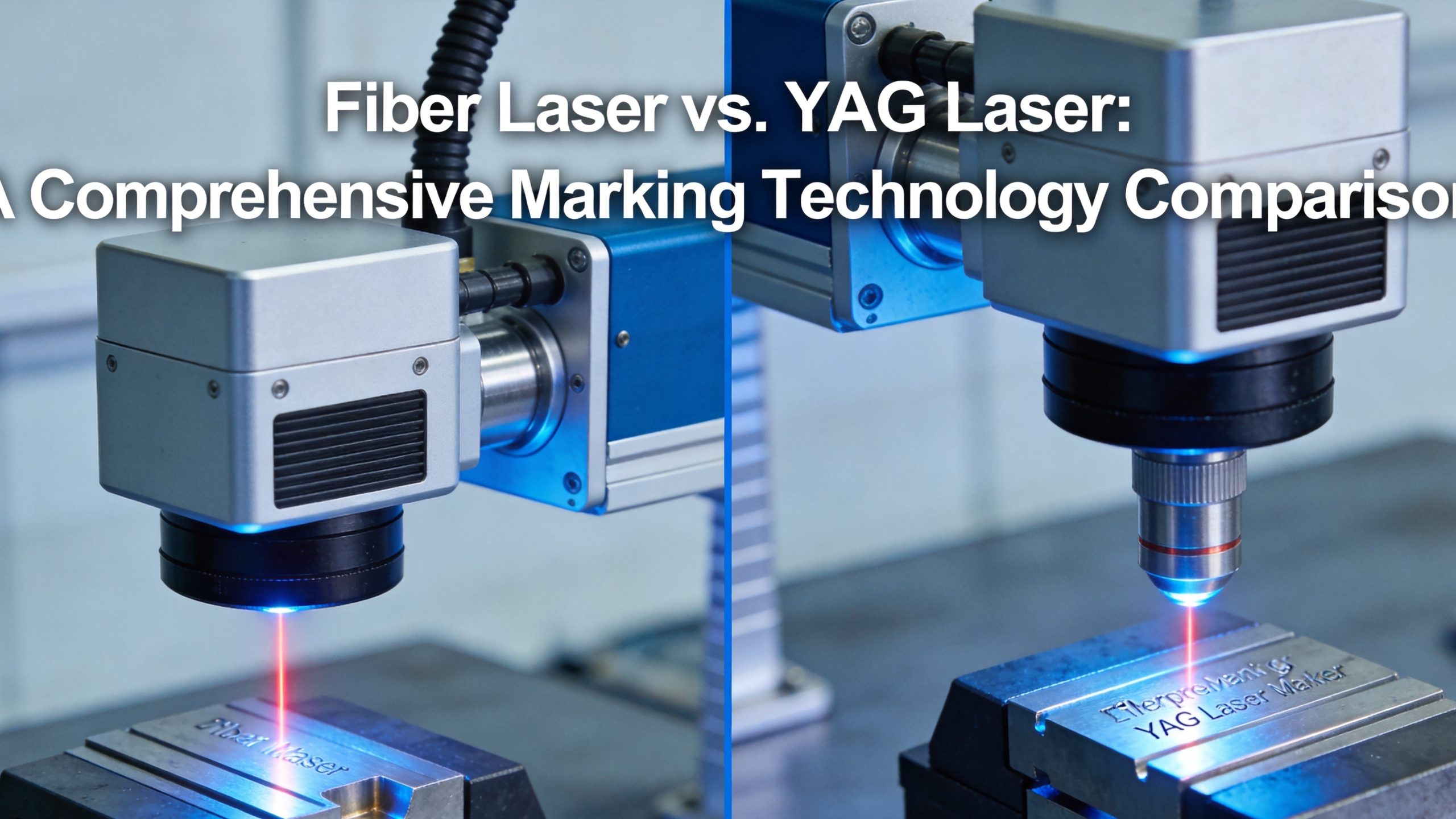
Quick Comparison Summary
| Factor | Fiber Laser Marking | YAG Laser Marking |
|---|---|---|
| Laser source | Fiber optic + diode pumped | Nd:YAG crystal + lamp/diode pumped |
| Typical power | 20W – 100W | 50W – 200W |
| Wavelength | 1064 nm (near infrared) | 1064 nm (near infrared) |
| Beam quality | Excellent (M² < 1.5) | Good (M² ~ 2–6) |
| Marking speed | Fastest (up to 10,000 mm/s) | Moderate (up to 5,000 mm/s) |
| Energy efficiency | 30–40% wall-plug | 2–5% (lamp pumped) / 10–15% (diode pumped) |
| Maintenance | Low (100k+ hours MTBF) | High (lamp replacement every 400–1,000 hrs) |
| Operating cost | Low | High (electricity + consumables) |
| Initial cost | $2,000 – $15,000 | $5,000 – $25,000 |
| Best for | High-volume production, fine detail, 24/7 operation | Deep engraving, thick materials, legacy systems |
What Is Fiber Laser Marking?
Fiber laser marking uses a fiber laser source — a laser beam generated inside an optical fiber doped with rare-earth elements (typically ytterbium). The laser is pumped by multiple laser diodes, and the fiber itself acts as both the gain medium and the beam delivery system.
Fiber lasers are a relatively newer technology that has rapidly gained market share since the 2010s. Today, they are the dominant laser marking technology for most industrial applications.
Key characteristics of fiber laser marking:
– Excellent beam quality (M² < 1.5), producing very fine, sharp marks
– High energy efficiency (30–40% wall-plug efficiency)
– Long maintenance intervals (100,000+ hours mean time between failures)
– Fast marking speed thanks to high-quality beam and galvo scanners
– Compact size and air-cooled design (for lower powers)
– Suitable for 24/7 production environments
What Is YAG Laser Marking?
YAG laser marking uses an Nd:YAG laser source — a solid-state laser where the gain medium is a synthetic yttrium aluminum garnet (YAG) crystal doped with neodymium ions. The crystal is pumped either by a flashlamp (lamp-pumped YAG) or by laser diodes (diode-pumped YAG, or DPSS). For more on keeping your machine in top condition, see our Fiber Laser Marking Machine Maintenance Guide.
YAG lasers were the dominant industrial marking technology before fiber lasers became mainstream. Many older production lines still use YAG markers, and they remain preferred for certain deep-engraving applications.
Key characteristics of YAG laser marking:
– Good beam quality (but generally lower than fiber lasers)
– Can produce high pulse energies for deep engraving
– Lamp-pumped models have low energy efficiency and frequent maintenance
– Diode-pumped models are more efficient but more expensive
– Proven technology with decades of industrial use
– Generally larger and water-cooled
Side-by-Side Comparison
1. Marking Speed
Winner: Fiber laser
Fiber lasers mark significantly faster than YAG lasers, thanks to their superior beam quality and higher pulse repetition rates. A typical 20W fiber laser can mark at speeds of 5,000–10,000 mm/s, while a comparable YAG laser typically maxes out at 2,000–5,000 mm/s.
For high-volume production lines, this speed difference directly translates to higher throughput. A fiber laser can often mark 2–3 times as many parts per hour as a YAG laser with the same average power.
Example: Marking a 20mm x 20mm logo + serial number on metal parts:
– Fiber laser (30W): ~1.5 seconds per part
– YAG laser (50W): ~3–4 seconds per part
2. Marking Quality and Resolution
Winner: Fiber laser
Fiber lasers produce a higher quality beam (lower M² value) than most YAG lasers. This means the laser can be focused to a smaller spot size, enabling:
– Finer detail and higher resolution marks
– Sharper text and graphics
– Better consistency across the marking field
– Smaller minimum line width (~0.01mm vs ~0.02mm for YAG)
For applications requiring very fine marks — such as microelectronics, medical devices, or high-density 2D codes — fiber lasers generally produce better results.
That said, YAG lasers can still produce high-quality marks, especially diode-pumped YAG (DPSS) systems with good beam quality. The difference is most noticeable at very small mark sizes or when comparing lower-end YAG systems.
3. Deep Engraving Capability
Winner: YAG laser (for very deep engraving)
When it comes to deep engraving (0.2mm or deeper), YAG lasers — especially lamp-pumped models with high pulse energy — have a traditional advantage. Their higher pulse energy can remove material more aggressively per pulse.
However, this gap has narrowed significantly in recent years. Modern 50W+ fiber lasers with optimized pulse parameters can achieve engraving depths of 0.3–0.5mm on steel, which covers the vast majority of industrial engraving applications.
Rule of thumb:
– < 0.2mm depth: Fiber laser is faster and better quality
– 0.2–0.5mm depth: Both can work; fiber may be faster, YAG may have higher quality at max depth
– > 0.5mm depth: YAG laser (or high-power 100W+ fiber laser)
For most industrial marking and light engraving applications, fiber lasers are more than sufficient.
4. Material Compatibility
Winner: Tie (slight edge to YAG for some materials)
Both fiber and YAG lasers operate at roughly the same wavelength (1064 nm near infrared), so they can mark similar materials:
– All metals (steel, stainless steel, aluminum, copper, brass, titanium, gold, silver)
– Most engineering plastics (ABS, PC, PA, POM, etc.)
– Ceramics and coated materials
YAG lasers with higher pulse energy can sometimes mark certain materials — like thick copper or highly reflective metals — more easily. But fiber lasers with proper parameter tuning can also handle these materials effectively.
For plastics, the difference is minimal. Both technologies can produce clean, legible marks on most common engineering plastics.
Note: Neither fiber nor YAG lasers are ideal for marking glass or transparent materials. For those applications, UV lasers or CO2 lasers are typically better choices.
5. Energy Efficiency and Operating Cost
Winner: Fiber laser (by a large margin)
This is where fiber lasers really shine. Fiber lasers are dramatically more energy efficient than YAG lasers:
| Laser Type | Wall-Plug Efficiency | Electricity Cost (8 hrs/day) |
|---|---|---|
| Lamp-pumped YAG | 2–5% | $3–$8/day |
| Diode-pumped YAG (DPSS) | 10–15% | $1.50–$3/day |
| Fiber laser | 30–40% | $0.50–$1.50/day |
Over a year of 8-hour daily operation, the electricity savings alone can be $500–$2,000 per machine. For factories running 24/7, the savings are even larger.
Beyond electricity, fiber lasers have lower consumable costs:
– No lamp replacement (lamp-pumped YAG needs new lamps every 400–1,000 hours, at $100–$300 each)
– Lower cooling requirements (air-cooled for <50W, vs water-cooled for most YAG systems)
– Fewer replacement parts (simpler design with fewer moving parts)
6. Maintenance Requirements
Winner: Fiber laser
Fiber lasers have significantly lower maintenance requirements:
– Laser source MTBF: 100,000+ hours (essentially no maintenance for the laser source itself)
– No lamp changes (unlike lamp-pumped YAG)
– Air-cooled design (for most marking-power systems) means no chiller maintenance
– Cleaning the lens and mirrors is the main periodic maintenance task
YAG laser maintenance:
– Lamp replacement every 400–1,000 hours (lamp-pumped models)
– Water cooling system needs regular maintenance (filter changes, water treatment)
– Optics alignment may need periodic adjustment
– More moving parts = more potential failure points
Diode-pumped YAG (DPSS) systems have lower maintenance than lamp-pumped YAG, but still generally require more upkeep than fiber lasers.
7. Total Cost of Ownership (TCO)
Winner: Fiber laser
When you factor in purchase price, electricity, consumables, maintenance, and downtime, fiber lasers almost always have a lower total cost of ownership:
| Cost Factor | Fiber Laser (30W) | YAG Laser (50W lamp-pumped) |
|---|---|---|
| Initial purchase | $3,000 – $7,000 | $5,000 – $12,000 |
| Electricity (year) | $200 – $500 | $1,000 – $2,500 |
| Consumables (year) | $50 – $200 (lenses) | $500 – $1,500 (lamps + parts) |
| Maintenance labor | Minimal | Regular |
| 5-year TCO | $4,000 – $10,000 | $10,000 – $25,000 |
The gap is even larger for 24/7 production environments, where the electricity and consumable savings compound.
8. Reliability and Uptime
Winner: Fiber laser
Fiber lasers are inherently more reliable than YAG lasers because:
– The laser source has no moving parts or consumables
– The fiber design is robust and resistant to misalignment
– Air-cooled systems eliminate water cooling as a failure point
– Mean time between failures (MTBF) of 100,000+ hours
YAG lasers — especially lamp-pumped models — have more components that can fail:
– Flashlamps burn out periodically
– Water cooling systems can leak or develop problems
– Optics can drift out of alignment
– More complex power supplies
For production environments where downtime is expensive, fiber lasers offer significantly higher uptime.
9. Size and Footprint
Winner: Fiber laser
Fiber laser marking machines are generally more compact than YAG systems:
– The laser source is smaller
– Air-cooled design eliminates the need for a bulky chiller
– Integrated all-in-one designs are common
This makes fiber lasers easier to integrate into existing production lines, work cells, or benchtop setups where space is limited.
10. Technology Outlook
Winner: Fiber laser
Fiber laser is the faster-growing technology with more active R&D investment:
– Prices continue to fall as production volumes increase
– New applications and capabilities are constantly being developed
– Most new laser marking machines sold today are fiber-based
– Replacement parts and technical expertise are increasingly available
YAG laser technology is mature but relatively stagnant. While YAG systems will continue to be used for specialized applications, the market is clearly moving toward fiber lasers for the vast majority of marking needs.
When to Choose Fiber Laser Marking
Fiber laser marking is the better choice for most applications:
✅ Choose fiber laser if:
– You need high marking speed and throughput
– Fine detail and high-quality marks are important
– You want low operating costs and minimal maintenance
– The machine will run 8+ hours per day
– You have limited floor space
– You want a future-proof technology
– You’re marking metals, plastics, or ceramics for general industrial use
For businesses like metal fabrication shops, hardware manufacturers, electronics assemblers, and promotional product companies, a fiber laser marking machine from a reputable manufacturer like Transon Laser offers the best balance of performance, reliability, and value.
When to Choose YAG Laser Marking
YAG laser marking still makes sense in specific situations:
✅ Choose YAG laser if:
– You need very deep engraving (>0.5mm) on hard metals
– You have an existing production line already using YAG systems
– You need to match existing YAG marking parameters or specifications
– You have specialized applications that specifically require YAG pulse characteristics
– You found a great deal on a used YAG system for low-volume use
For most new installations, however, fiber laser is the better investment.
Can a Fiber Laser Replace My Existing YAG Marker?
In most cases, yes. A modern 30W or 50W fiber laser can replace a 50W or even 100W lamp-pumped YAG marker for the vast majority of applications.
Before making the switch, consider:
1. Marking quality: Test samples on your actual materials to ensure the fiber laser meets your quality requirements
2. Process parameters: You’ll need to develop new marking parameters (speed, power, frequency) for the fiber laser
3. Tooling and fixtures: Existing fixtures may or may not be compatible
4. Software: Fiber laser marking software is generally more modern and user-friendly, but there will be a learning curve
5. Integration: If the marker is integrated into an automated line, check compatibility with your PLC/control system
Many companies have successfully replaced aging YAG markers with fiber lasers and seen improvements in speed, quality, and operating cost.
Final Verdict
For the vast majority of industrial laser marking applications, fiber laser is the clear winner over YAG laser. It’s faster, produces higher quality marks, uses less electricity, requires less maintenance, has a lower total cost of ownership, and is more reliable.
YAG lasers still have a place for very deep engraving and legacy applications, but the technology is mature and declining. Fiber laser is the present and future of industrial laser marking.
If you’re in the market for a laser marking machine, we recommend starting with a fiber laser from a reputable manufacturer. Transon Laser offers a range of fiber laser marking machines — from 20W desktop models to 100W heavy-duty systems — with reliable Raycus or Maxphotonics laser sources, responsive after-sales support, and competitive pricing.
Further Reading:
– Fiber Laser Marking Machine: Complete Buyer’s Guide
– How Much Does a Fiber Laser Marking Machine Cost?
– Fiber vs CO2 vs UV vs Diode Laser Marking: Full Comparison
– Fiber Laser Marking Machine Parameters: Complete Technical Reference
– 12 Industrial Applications of Laser Marking
– How Does a Fiber Laser Marking Machine Work?
Related Reading: For more details on how fiber lasers perform on various metal materials — including stainless steel, aluminum, copper, and titanium — see our complete guide to laser marking on metal.