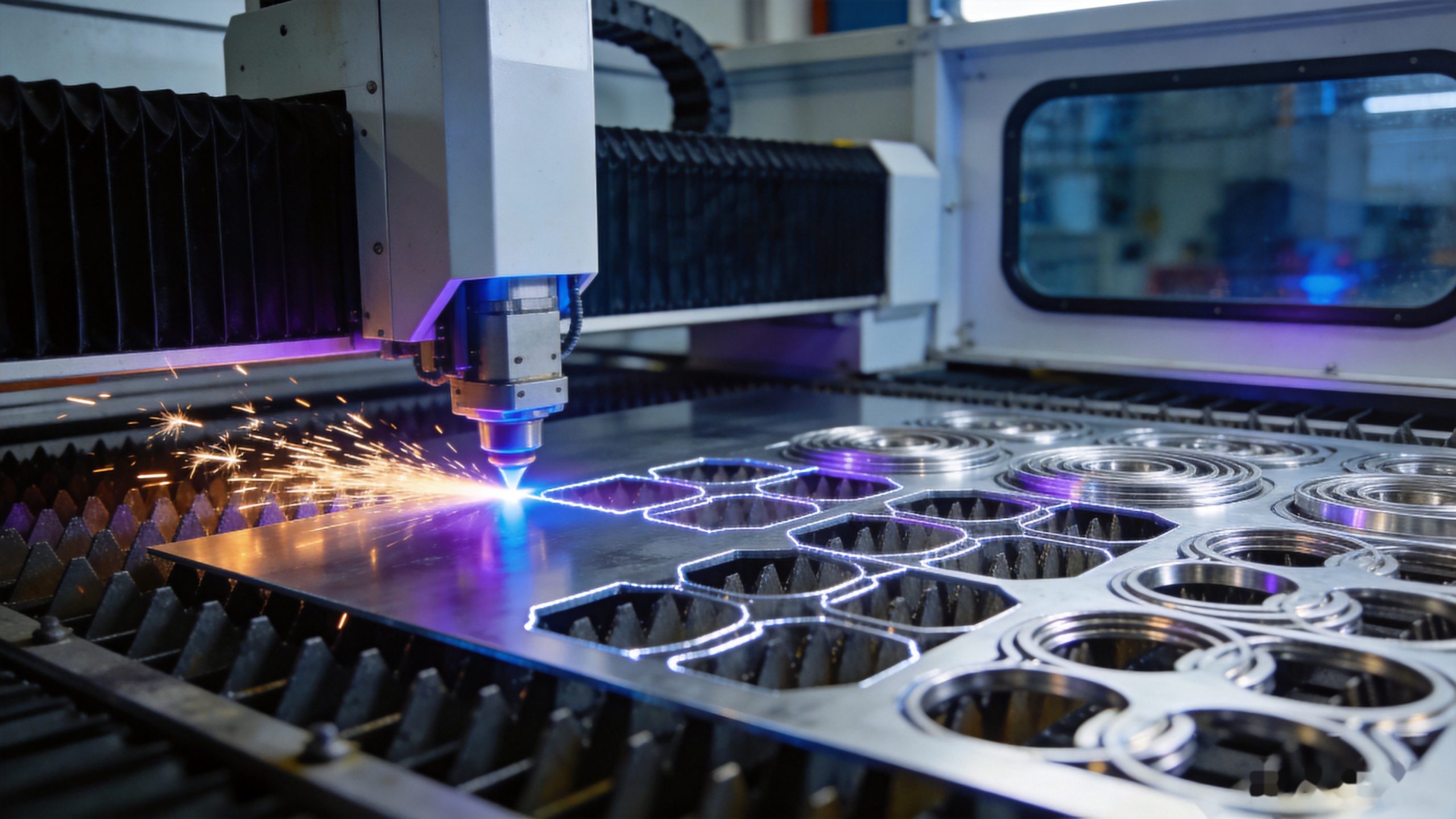
Stainless steel is the material that separates a good laser cutting setup from a mediocre one. The same machine that flies through 2mm mild steel at 22 m/min will slow to a crawl on 8mm stainless — and if the gas is wrong, it won’t produce a sellable edge at all. For more on keeping your machine in top condition, see our Fiber Laser Cutting Machine Maintenance Guide.
That’s because stainless steel is not just “steel that doesn’t rust.” It behaves fundamentally differently under a laser beam: it reflects more energy, it conducts heat poorly, and it has no exothermic reaction to help the cut along. Every parameter that works well on carbon steel has to be reconsidered.
This guide covers what actually matters in production: why stainless behaves the way it does, the assist gas decision that determines your edge quality and your operating cost, real cutting speeds across thickness and power levels, how to diagnose dross and discoloration, the cost math on nitrogen, how different stainless grades cut, and how to specify a machine that handles stainless well.
Why Stainless Steel Cuts Differently
Four material properties drive everything:
1. High reflectivity at 1064nm. Austenitic stainless (304, 316) reflects a large share of the near-infrared beam at room temperature. Fiber lasers handle this far better than CO2 lasers ever did, and modern sources include anti-reflection protection, but the practical effect is still reduced coupling efficiency — especially on thin sheet where the beam transit time is short.
2. Low thermal conductivity. Stainless conducts heat roughly a third as well as carbon steel. That sounds like it should help, and it partly does — heat stays in the cut zone. But it also means heat concentrates at the kerf walls, which drives dross attachment and heat tint on thin material.
3. No exothermic assist. Cut carbon steel with oxygen and the oxidation reaction itself releases energy, adding effective cutting power for free. Stainless doesn’t offer that. With nitrogen you’re cutting with laser energy alone, which is why stainless speeds sit well below carbon steel speeds at equal power.
4. A tenacious chromium oxide layer. The passive layer that makes stainless corrosion-resistant also resists the cut at the top surface. It has a higher melting point than the base metal and needs enough energy density to be broken through cleanly.
The practical consequence: stainless cutting is a gas and energy-density problem, not a raw-wattage problem. Throwing more power at it without fixing gas, focus, and nozzle geometry mostly buys you more heat, not more speed.
The Assist Gas Decision: Nitrogen vs Oxygen vs Compressed Air
This single choice determines edge quality, cutting speed, and — often — the largest line item in your operating cost. Get it right before you tune anything else.
Nitrogen: The Default for Stainless
Nitrogen is inert. It doesn’t react with the molten metal, so the cut edge stays bright, oxide-free, and weldable. It also shields the kerf from atmosphere, which suppresses oxidation on the cut face.
- Edge quality: bright, silver-white, oxide-free
- Weldability: cut edges can be welded directly without grinding
- Speed: high on thin sheet with high pressure; relatively slower on thick plate
- Cost: the highest of the three options — high purity nitrogen is expensive and consumption is heavy
- Pressure: roughly 10–15 bar on thin material, 15–25 bar on thicker plate
For most stainless work that ends up visible, welded, or in a food/medical environment, nitrogen is the only acceptable answer.
Oxygen: Fast but Compromising
Oxygen works on stainless, but the exothermic reaction leaves an oxidized, dark grey-to-black edge with a distinct heat-affected zone. That edge must be mechanically cleaned or pickled before welding, and it can’t pass cosmetic inspection.
Oxygen does have legitimate uses on stainless:
– Thick plate where nitrogen pressure can’t penetrate cleanly
– Non-cosmetic internal parts that will be painted or coated
– Situations where nitrogen supply is unavailable
Its gas cost is low and its speed on thick plate can exceed nitrogen, but the downstream cleaning labor usually eats the savings.
Compressed Air: The Cost Play
Compressed air sits between the two — cheaper than nitrogen by a wide margin, cleaner than oxygen, but with enough oxygen content (roughly 21%) to leave a light oxide tint and a slightly rougher edge.
It’s a reasonable choice on:
– Thin stainless sheet (up to roughly 3mm) where the part will be painted or hidden
– Prototype and short-run work where gas cost dominates
– Shops without nitrogen supply on site
It is not a reasonable choice for visible architectural work, food-contact surfaces, or anything that will be TIG-welded without post-cleaning.
Quick decision rule: if the cut edge will be seen, welded, or exposed to moisture in service, use nitrogen. If it won’t be, price out oxygen and compressed air before defaulting to nitrogen.
Stainless Steel Cutting Speed Chart
The table below gives production-quality speeds — clean, dross-free cuts with acceptable edge finish — on nitrogen assist gas. These are practical values, not theoretical maximums.
| Thickness | 1000W | 2000W | 3000W | 6000W | 12000W |
|---|---|---|---|---|---|
| 1 mm | 18 m/min | 30 m/min | 36 m/min | — | — |
| 2 mm | 10 m/min | 18 m/min | 25 m/min | 35 m/min | — |
| 3 mm | 6 m/min | 12 m/min | 18 m/min | 28 m/min | 35 m/min |
| 5 mm | 2.5 m/min | 6 m/min | 10 m/min | 18 m/min | 25 m/min |
| 8 mm | 0.8 m/min | 2.5 m/min | 4.5 m/min | 10 m/min | 16 m/min |
| 10 mm | — | 1.2 m/min | 2.5 m/min | 6 m/min | 12 m/min |
| 12 mm | — | 0.6 m/min | 1.5 m/min | 4 m/min | 8 m/min |
| 16 mm | — | — | 0.6 m/min | 2 m/min | 5 m/min |
| 20 mm | — | — | — | 1 m/min | 3 m/min |
Assist gas: nitrogen, 10–15 bar thin / 15–25 bar thick. Speeds vary with machine dynamics, beam quality, material tolerance, and required edge finish.
Maximum practical cutting thickness by power: 1000W ≈ 5mm, 2000W ≈ 8mm, 3000W ≈ 12mm, 6000W ≈ 20mm, 12000W ≈ 30mm, 20000W ≈ 40mm.
What the Numbers Tell You
Read the chart by column, not by row. Going from 1000W to 2000W roughly doubles speed at every thickness. Going from 2000W to 3000W adds about 40% more on thin sheet but only 25% on 8mm. Going from 3000W to 6000W barely changes 1–3mm speed — machine acceleration is already the limit — but more than doubles throughput at 8–10mm.
That’s the real lesson: on stainless, power upgrades pay off at medium thickness, not thin sheet. A shop cutting nothing but 1–2mm stainless gets little from a 6000W machine beyond flexibility. A shop cutting 6–10mm stainless gets a step change.
Choosing Laser Power for Stainless
| Your dominant stainless work | Recommended power | Why |
|---|---|---|
| 1–3mm sheet, high volume (enclosures, panels, trim) | 1500W–3000W | Acceleration-limited; higher power adds little |
| Mixed 1–6mm, general job shop | 3000W | Best coverage per dollar; handles most work |
| 5–12mm plate (kitchen equipment, tanks, structural) | 6000W | Real throughput gain above 6mm |
| 10–25mm heavy plate | 12000W | Nitrogen penetration and speed both require it |
| 25mm+ | 20000W | Only path to productive thick stainless |
If your work is genuinely mixed across a wide thickness range, go one step above your calculated need. The marginal machine cost is usually small compared with the cost of turning down jobs or running slow on your heaviest recurring part.
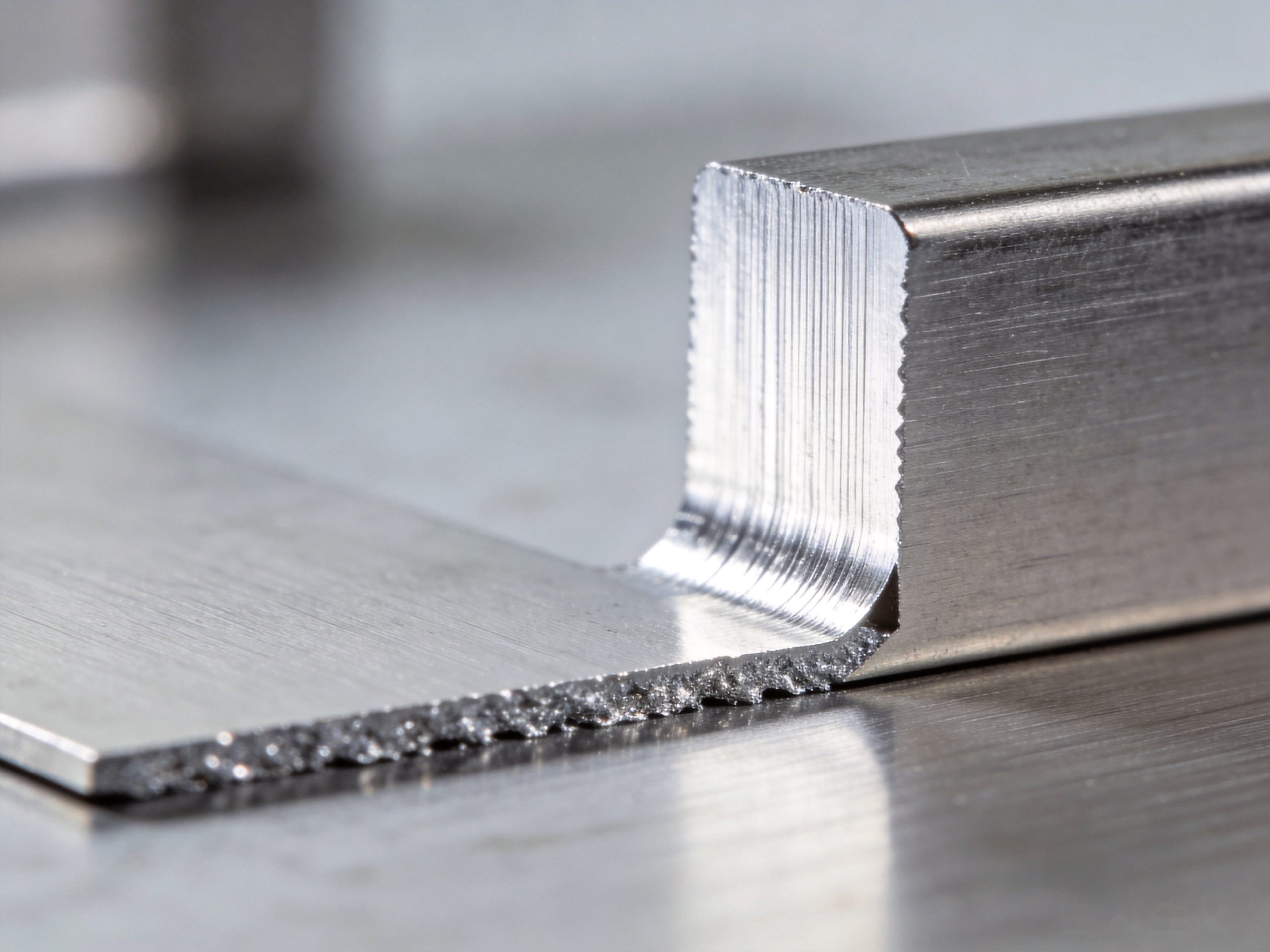
A laser-cut stainless steel edge: uniform striations and a clean bottom edge indicate correct gas pressure and focus. Bottom dross points to insufficient pressure or focus set too high.
Diagnosing Cut Quality Problems
Most stainless cutting complaints fall into four categories. Here’s how to identify and fix each.
Dross (Bottom Adhesion)
Dross is resolidified metal clinging to the bottom of the kerf. On stainless it usually indicates insufficient energy density at the bottom of the cut, or gas that has lost pressure and velocity before exiting.
| Dross type | Cause | Fix |
|---|---|---|
| Soft, easily removed | Slightly low speed or low gas pressure | Increase speed 5–10%, raise nitrogen pressure 1–2 bar |
| Hard, stubborn | Focus too high, or power too low for thickness | Lower focus position, increase power |
| Heavy on one side of contour | Gas flow misalignment or damaged nozzle | Inspect and replace nozzle, check centering |
| Present only on corners | Acceleration limits at direction changes | Reduce speed at corners via controller settings |
Burrs and Rough Edges
A rough, sandpaper-like edge on stainless almost always means the cut is running with too little gas energy or too much heat.
- Increase nitrogen pressure before touching power. Pressure is the usual culprit below 15 bar.
- Verify nozzle condition. A partially clogged or worn nozzle delivers an asymmetric jet — this is far more common than operators expect.
- Check focus. On thin stainless, focus slightly above or at the surface; on thick plate, move it below.
- Confirm gas purity. Nitrogen below 99.99% introduces enough oxygen to roughen the edge. Below 99.9% the effect is obvious.
Heat Tint and Discoloration
Straw-yellow to blue-grey discoloration along the cut edge is oxidation, which means oxygen reached the kerf while it was still hot.
- Gas purity first. 99.999% nitrogen is standard for cosmetic stainless; 99.99% is acceptable for most industrial work.
- Check for leaks between the gas supply and the cutting head — fittings, hose, and regulator.
- Reduce heat input on thin sheet by raising speed and lowering power together rather than running slow and hot.
- Pierce settings matter more than people think: a hot, slow pierce leaves a discolored halo that shows after the cut.
Taper and Kerf Width Variation
A cut that’s wider at the top than the bottom means the beam is losing focus through the material.
- On thick stainless, lower the focus progressively with thickness.
- Increase gas pressure with thickness to clear molten material faster.
- Verify beam quality. High BPP on a cheap source produces visible taper on thick plate no setting will fix.
- Check lens condition — a thermally degraded lens focus-shifts under load.
Nitrogen Consumption and Cost Math
Nitrogen is usually the biggest operating cost in stainless cutting, and most shops underestimate it. Here’s how to reason about it honestly.
Consumption scales with:
– Pressure: doubling pressure roughly doubles mass flow
– Nozzle diameter: flow scales with the square of diameter — a 2.0mm nozzle passes roughly 1.8× the gas of a 1.5mm nozzle
– Duty cycle: piercing and slow thick-plate contouring consume far more than high-speed thin-sheet work
Two supply routes, with very different economics:
| Supply method | Rough cost basis | Best fit |
|---|---|---|
| Cylinder / bundle | Highest per-unit cost, highest handling labor | Low consumption, intermittent use |
| Liquid nitrogen (LN2) tank + evaporator | Much lower per-unit cost, requires tank and evaporator capex | Continuous production, medium-to-high consumption |
| On-site PSA generator | Lowest per-unit cost, but purity typically 99.5–99.9% and notable electricity draw | High consumption; non-cosmetic work |
The decision threshold is consumption, not conviction. Below roughly a few hundred Nm³ per month, cylinders win on capital. Above it, LN2 almost always wins — the per-unit savings overwhelm the tank lease and evaporator cost within months. PSA generators are attractive at high volume but the lower purity limits them to work where a light tint is acceptable.
Two practical ways to cut gas cost without touching quality:
- Match nozzle to thickness. Running a 2.5mm nozzle on 1.5mm sheet wastes gas for no quality benefit. Smaller nozzle, higher pressure, same or better cut.
- Don’t use nitrogen where it doesn’t matter. If a stainless part is going to be painted, powder-coated, or fully machined after cutting, the oxide-free edge is irrelevant. Oxygen or compressed air on those parts can be a real saving.
How Different Stainless Grades Cut
Not all stainless cuts the same. Grade selection affects cuttability measurably.
304 / 304L (austenitic, the workhorse). Cuts well across the full power range. The reference material for all the speed data above. Low carbon (L) grades behave nearly identically under the laser.
316 / 316L (austenitic, molybdenum-bearing). Slightly harder to cut than 304 — expect roughly 5–10% slower speeds at equal thickness and power, with a greater tendency to dross on thick plate. The molybdenum content raises hot strength. Usually still cut with nitrogen at standard pressures, but thick-section work may need a small pressure increase.
430 / 420 (ferritic and martensitic). Higher carbon content and different thermal behavior. Cuts faster than austenitic grades in thin sections but with a greater susceptibility to hardening at the cut edge. Martensitic grades can develop a hardened zone that complicates subsequent machining — worth flagging to downstream operations.
Duplex and super-duplex (2205, 2507). Higher strength and alloy content. Cutting is feasible but slower, and thick sections demand high power and generous nitrogen pressure. Treat duplex as a step harder than 316 when quoting.
Mirror-finish and polished sheet. Surface reflectivity is higher, coupling is worse, and any dross or scratch shows immediately. These materials reward good gas purity and clean optics more than raw power.
Where Stainless Laser Cutting Pays Off
Stainless is one of the highest-value laser cutting applications because the alternative processes struggle with it.
Food processing and commercial kitchen equipment. Hobs, sinks, prep tables, ventilation hoods. Nitrogen-cut edges are directly weldable and hygienic — no grinding step between cut and weld.
Medical and laboratory equipment. Clean, burr-free edges matter for both cleanability and operator safety. Thin-wall 304 and 316 work is routine.
Architectural and decorative metalwork. Balustrades, cladding, signage, and feature panels where the cut edge is visible and must be uniform. Heat tint is a rejection criterion here, which puts gas purity front and center.
Chemical and pharmaceutical processing. Tanks, vessels, piping, and skids in 316L where corrosion resistance at the weld line depends on an oxide-free cut face.
Automotive and EV. Battery trays, exhaust components, structural brackets — mixed thickness work where throughput and edge consistency both count.
Appliance and HVAC. Panels, housings, and ductwork in volume production, often thin gauge where machine dynamics matter more than wattage.
In almost every case, the economic argument is the same: laser cutting replaces a cut-grind-weld sequence with cut-weld, and removes a finishing labor step. That labor is the saving, not the machine speed.
Practical Tips for Better Stainless Cutting
1. Clean the sheet before cutting. Oil, fingerprints, and adhesive residue change absorption and produce inconsistent edges. A wipe-down costs seconds; a scrapped nest costs far more.
2. Pierce correctly. Stainless needs a controlled pierce — usually a slower, lower-power pierce with a dwell, or a ramp pierce. Piercing at full power creates a spatter burst that damages the lens and leaves a discolored halo.
3. Keep optics clean. On stainless, a contaminated protective lens shows up as dross and tint before it shows up as a power drop. Inspect on a schedule, not on a symptom.
4. Set corner and small-feature speeds separately. Acceleration limits, not power, cause dross and burn-through at corners and small radii on thin stainless. Controller-level corner rules do more for quality than any parameter tweak.
5. Verify material tolerance. Stainless sheet often runs thick of nominal. A nominal 3mm sheet at 3.2mm cuts noticeably slower — quote from measured thickness, not the label.
6. Do sample cuts on new material lots. Alloy and surface condition vary between suppliers. A five-minute test cut on a new lot prevents a full-nest rejection.
7. Match the machine’s dynamic performance to your thickness mix. For thin stainless, acceleration and positioning speed determine throughput more than laser power. For thick plate, power and gas delivery dominate. Buying for the wrong end of the range is the most common specification mistake.
A machine that is well matched to the work makes all of the above easier — stable gas delivery, reliable focus control, and a rigid frame that holds alignment through long runs. This is where equipment choice matters most: shops cutting stainless in production should prioritize gas system design and motion dynamics over headline wattage. Transon’s TSF1530 series, for example, is configured around exactly this tradeoff — the platform supports 1.5–3kW sources for thin-sheet stainless work with the acceleration to match, while the same frame handles higher-power configurations for shops moving into thicker plate. Sizing the machine to your actual thickness distribution, rather than to a single impressive spec sheet number, is what keeps stainless cutting profitable.
Machine Selection Checklist for Stainless Work
Before signing a purchase order for a machine that will cut stainless, confirm:
- Laser source quality and BPP. Ask for the beam parameter product, not just wattage. Low BPP is what produces clean thick-section cuts.
- Anti-reflection protection. Essential for stainless and aluminum; verify it’s specified.
- Gas delivery design. Can the machine sustain 20–25 bar at the nozzle through the whole program? Undersized regulators and hoses are a common hidden limitation.
- Focus control resolution. Thick stainless needs precise focus positioning; confirm the adjustment range and repeatability.
- Nozzle and lens consumables supply. Stainless consumes nozzles faster than carbon steel. Confirm availability and cost.
- Acceleration and positioning speed. For thin sheet this is your throughput ceiling.
- Controller corner and pierce control. Ask specifically how it handles corner deceleration and pierce ramping.
- Demonstration on your material. Insist on a cut test on your own stainless grade and thickness, at your required edge quality, before committing.
Frequently Asked Questions
Can a 1000W fiber laser cut stainless steel?
Yes — up to roughly 5mm, at production speeds. 1mm cuts at about 18 m/min on nitrogen. Beyond 5mm, expect either very slow cutting or the need for more power.
Is nitrogen required for laser cutting stainless steel?
Not required, but strongly recommended for any edge that will be seen or welded. Oxygen and compressed air both work and cost less, but both leave oxidation that requires downstream cleaning.
What nitrogen purity do I need?
99.999% for cosmetic and weld-critical edges. 99.99% is acceptable for most industrial stainless work. Below 99.9%, edge roughness and tint become obvious.
What pressure should I run for stainless?
Roughly 10–15 bar on thin material and 15–25 bar on thicker plate. If you’re seeing dross on thick sections, pressure is usually the first thing to check.
How thick can a fiber laser cut stainless steel?
Practically: about 5mm at 1000W, 8mm at 2000W, 12mm at 3000W, 20mm at 6000W, 30mm at 12000W, and 40mm at 20000W. These are production values — theoretical limits run somewhat higher with perfect conditions.
Why is stainless slower to cut than carbon steel?
Three reasons: no exothermic assist-gas reaction to add energy, higher reflectivity reducing beam coupling, and lower thermal conductivity concentrating heat at the kerf rather than distributing it.
Can I weld stainless parts directly after laser cutting?
Yes, if cut with nitrogen at good purity. Oxygen-cut edges carry an oxide layer that must be ground or pickled first, or the weld will be porous and poorly fused.
Does 316 cut slower than 304?
Yes, typically 5–10% slower at equal thickness and power, with a greater tendency toward dross on thick plate. Quote 316 work with that allowance built in. Not sure which laser technology is right for you? Read our complete fiber laser vs CO2 laser comparison to help you decide.
Final Thoughts
Stainless steel rewards a properly specified setup and punishes a generically specified one. The machine that cuts carbon steel beautifully will cut stainless acceptably only if the gas system, the optics, and the parameter discipline are right.
The three decisions that matter most, in order: gas type and purity (this determines whether your edge is sellable), power matched to your real thickness distribution (this determines throughput and machine payback), and parameter discipline on pierce, focus, and corner control (this determines your scrap rate).
Get those right and stainless becomes one of the most profitable materials you cut — a single operation replacing a cut-grind-weld sequence, with an edge that goes straight to the next process.
If you’re working through a stainless application and want a concrete recommendation — power level, assist gas, expected speed at your thickness, and consumable cost — send us your material grade, thickness range, and required edge quality. We’ll run the numbers against real cutting data and, if useful, cut a sample on our machines and send you the results.
Related Reading:
- Fiber Laser Cutting Thickness & Speed Chart: 1kW to 20kW Complete Guide
- Fiber Laser Cutting for Sheet Metal Fabrication: The Complete Guide
- How to Choose the Right Laser Power for Your Fiber Laser Cutting Machine
- Fiber Laser Cutting Machine Parameters: A Complete Technical Reference
- Fiber Laser vs CO2 Laser Cutting Machine: Which One Should You Choose?
- How Much Does a Fiber Laser Cutting Machine Cost in 2026?
If you’re in the market for a machine, our fiber laser cutting machine buyer’s guide walks through the key specifications, safety features, and supplier evaluation criteria to help you choose confidently.
For a full technical breakdown of machine specifications and how to choose the right configuration for your stainless steel cutting work, see our fiber laser cutting machine parameters guide.