Introduction
The global electric vehicle (EV) revolution is reshaping manufacturing at every level, and nowhere is this more evident than in battery production. As demand for longer-range, faster-charging, and safer batteries accelerates, manufacturers are turning to advanced fabrication technologies to meet increasingly stringent quality, precision, and throughput requirements. Among these technologies, laser processing has emerged as a cornerstone of modern EV battery manufacturing.
From electrode cutting and tab welding to surface cleaning and traceability marking, lasers offer unmatched precision, speed, and flexibility compared to traditional mechanical and chemical methods. As battery designs evolve—with larger formats, higher energy densities, and new chemistries—the role of laser technology continues to expand.
This article explores how laser cutting, welding, cleaning, and marking technologies are transforming EV battery production, the key advantages they deliver, and what manufacturers should consider when integrating laser equipment into battery lines.
Why Laser Technology Matters for EV Battery Manufacturing
EV battery production demands an unusual combination of requirements that few manufacturing technologies can satisfy simultaneously:
- Micron-level precision. Battery components—especially electrodes and separators—are extremely thin (often 100–200 µm) and require clean, burr-free cuts to prevent internal short circuits.
- High throughput. Gigafactories produce millions of cells per day. Equipment must keep pace without sacrificing quality.
- Non-contact processing. Mechanical tools wear out, generate contamination, and risk damaging delicate materials. Lasers eliminate physical contact entirely.
- Material versatility. Battery assemblies join dissimilar metals—copper, aluminum, nickel, and their alloys—each with different thermal properties.
- Consistency and repeatability. A single defective cell can compromise an entire module. Laser processing delivers uniform results at scale.
- Automation readiness. Lasers integrate seamlessly with robotic arms, vision systems, and in-line quality monitoring.
Traditional methods like mechanical stamping, ultrasonic welding, and chemical etching struggle to meet all these criteria at once. Laser technology, by contrast, addresses them in a single platform, making it the default choice for modern battery manufacturing lines.
Laser Cutting in Battery Production
Laser cutting is one of the most established laser applications in battery manufacturing, used across multiple stages of electrode and component preparation.
Electrode Cutting
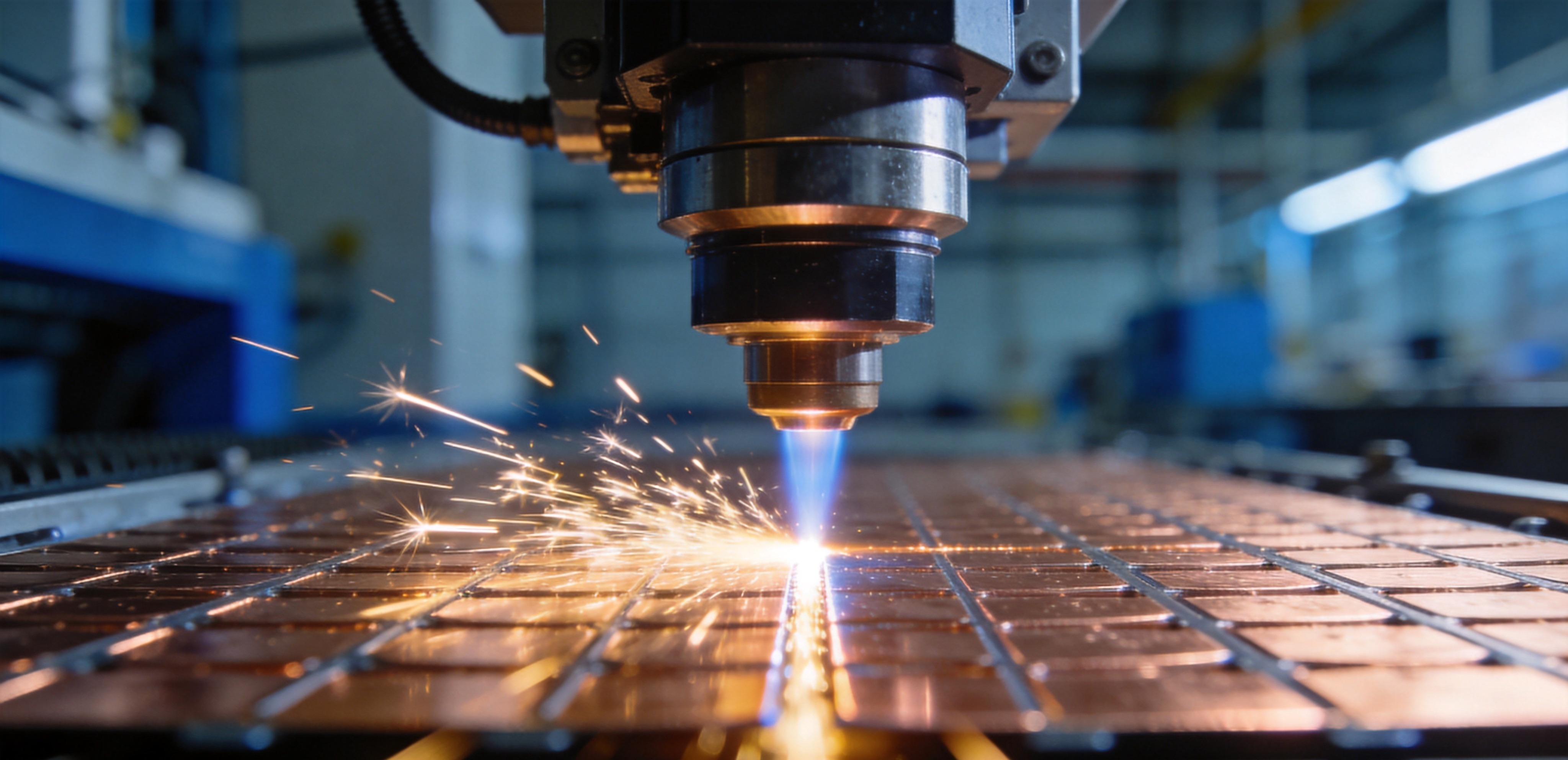
The electrodes—anode (copper foil coated with graphite) and cathode (aluminum foil coated with active materials like NMC, LFP, or NCA)—are manufactured in large continuous rolls (mother rolls) that must be cut into precise smaller formats before cell assembly.
Why laser cutting excels here:
- No tool wear. Mechanical blades dull over time, producing burrs and particulate contamination that can cause internal shorts. Lasers maintain consistent cut quality indefinitely.
- Clean, burr-free edges. Modern fiber and green lasers produce narrow kerfs and minimal heat-affected zones (HAZ), critical for preventing delamination of electrode coatings.
- Flexible geometries. Laser cutting handles straight slitting, tab shaping, and complex contour cuts without tooling changes, enabling rapid changeovers between cell formats.
- High speed. Multi-kilowatt fiber lasers can cut electrode foils at tens of meters per minute, matching the throughput of high-volume coating lines.
Key considerations:
- Green or blue lasers are often preferred for cutting copper foils, as these wavelengths are absorbed more efficiently than infrared, reducing heat input and HAZ.
- Dust extraction and fume filtration systems are essential to remove particulate generated during laser cutting.
- In-line vision inspection can verify cut quality and detect delamination in real time.
Separator Cutting
The separator—a thin microporous polymer film (typically 10–30 µm thick of polyethylene or polypropylene)—prevents direct contact between anode and cathode while allowing ion flow. Cutting separators demands extreme precision, as even minor damage can cause internal short circuits.
Laser cutting provides non-contact, clean edges without the mechanical stress that can tear or deform delicate separator films. UV lasers are particularly well-suited for this application, as their short wavelength enables cold ablation with minimal thermal impact on the polymer.
Tab Cutting and Forming
Battery tabs—thin metal strips that connect the electrode foils to the cell terminals—are often cut and shaped directly from the electrode foil using lasers. This integrated approach eliminates a separate tab-welding step, reducing material cost and potential failure points. Laser-cut tabs feature smooth edges that improve weld quality in downstream processes.
Laser Welding in Battery Assembly
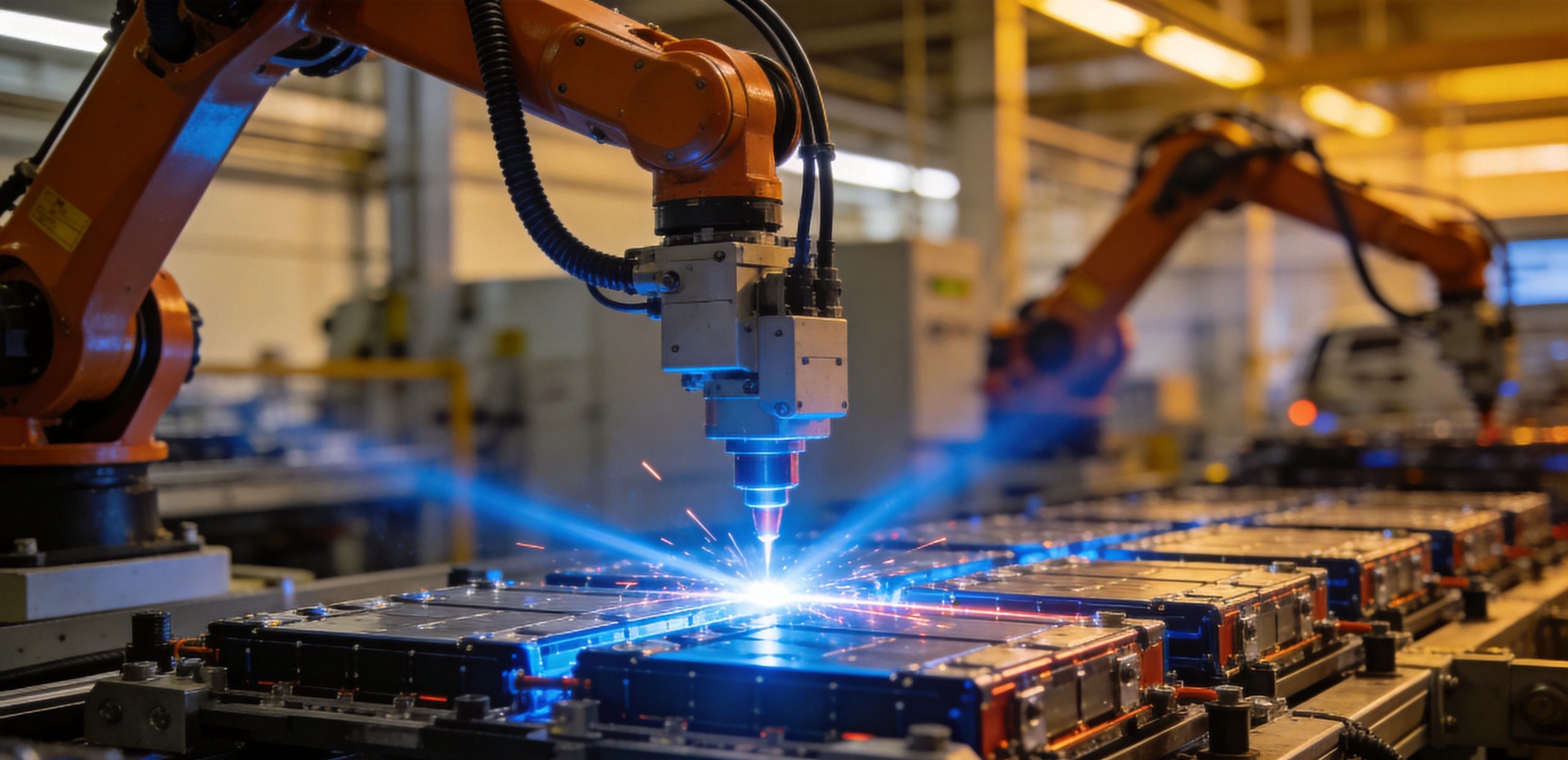
Laser welding is arguably the most critical laser application in EV battery manufacturing, as weld quality directly impacts battery performance, safety, and lifespan.
The Welding Challenge in Batteries
Battery welding is uniquely challenging because it routinely involves joining dissimilar materials—most commonly copper to aluminum, copper to nickel, and aluminum to steel. These materials have different melting points, thermal conductivities, and reflectivity, making consistent welds difficult with traditional methods.
Additionally, battery welds must:
- Have low electrical resistance to minimize heat generation and energy loss
- Be mechanically robust to withstand vibration and thermal cycling
- Be hermetically sealed (for prismatic and cylindrical cell cans) to prevent electrolyte leakage
- Be free of defects like porosity, cracks, and spatter that could cause performance degradation or safety issues
Key Laser Welding Applications
Tab-to-Busbar Welding
In module assembly, individual cell tabs are welded to busbars that connect cells in series or parallel. Laser welding provides fast, consistent, low-resistance joints between dissimilar metal combinations like copper-to-aluminum and nickel-to-copper.
Advantages:
- Precise heat input control minimizes the risk of heat damage to cell internals
- High welding speed supports automated module assembly lines
- Consistent weld quality reduces resistance variation across the module
- Non-contact process eliminates electrode wear and contamination
Cell-to-Cell and Cell-to-Cooling-Plate Welding
Many modern battery pack designs—particularly cell-to-pack (CTP) and cell-to-body (CTB) architectures—require welding cells directly to cooling plates or structural components. Laser welding, especially with galvanometer scanning optics (wobble welding), can produce long, continuous weld seams with excellent penetration control.
Prismatic Cell Can Sealing
Prismatic battery cells have aluminum or steel cans that must be hermetically sealed after electrolyte filling. Laser welding provides a leak-tight seal that withstands the internal pressures generated during charging and discharging. The weld must be free of porosity and cracks to prevent electrolyte leakage and moisture ingress.
Cylindrical Cell Welding
In cylindrical cell production (like the 4680 format), laser welding is used for several applications, including tab welding to the can and cap, and can sealing. The high speed and precision of laser welding align well with the high-volume nature of cylindrical cell manufacturing.
Wobble Welding: A Game-Changer for Battery Applications
Wobble welding—where the laser beam oscillates in a controlled pattern (typically circular or figure-eight) during welding—has become increasingly popular in battery manufacturing. This technique:
- Widens the weld pool, improving gap tolerance between parts
- Produces larger, more consistent weld nuggets
- Reduces porosity and spatter
- Improves weld strength and electrical conductivity
- Is especially effective for welding dissimilar metals
Laser Cleaning in Battery Manufacturing
While less widely discussed than cutting and welding, laser cleaning plays a vital role in ensuring battery quality and reliability.
Surface Preparation Before Welding
Before any welding operation, the surfaces to be joined must be clean and free of contaminants like oils, greases, oxides, and residual electrode coatings. Even small amounts of contamination can cause weld porosity, increased resistance, or mechanical weakness.
Laser cleaning advantages:
- Dry, chemical-free process. No solvents, no waste disposal, no chemical residues
- Precise and selective. Cleans only the targeted area without affecting surrounding materials
- Fast and consistent. Automated laser cleaning stations can keep pace with high-speed production lines
- Improves weld quality. Clean surfaces produce stronger, more conductive, more reliable welds
Removing Electrode Coatings for Tab Connections
In some battery designs, a small area of the electrode coating must be removed to create a clean metal surface for tab attachment. Laser ablation precisely removes the active material coating from the foil substrate without damaging the underlying copper or aluminum—something mechanical methods struggle to do consistently.
Cleaning Before Adhesive Application
Battery modules and packs use structural adhesives for bonding cells to cooling plates and pack structures. Laser cleaning improves surface energy and removes release agents or contaminants from cell surfaces, significantly improving adhesive bond strength and long-term reliability.
Laser Marking for Traceability
As battery regulations tighten and warranty periods extend, traceability throughout the battery lifecycle has become essential. Laser marking provides permanent, high-contrast marks on battery cells, modules, and components that withstand harsh operating environments.
Common marking applications:
- Data matrix codes and QR codes on individual cells for full traceability from manufacturing to recycling
- Serial numbers, date codes, and batch numbers for quality control and warranty tracking
- Brand logos and specification markings on cell cans and module housings
Laser marking is preferred over ink-based methods because it:
- Produces permanent marks that won’t fade, rub off, or dissolve in electrolyte
- Requires no consumables (no ink, no labels)
- Is fast and easily integrated into automated lines
- Can mark a wide range of materials including aluminum, steel, and plastics
Key Advantages of Laser Technology in Battery Production
Summing up across all applications, laser technology delivers seven core benefits that explain its growing dominance in EV battery manufacturing:
1. Unmatched precision. Lasers can focus energy to spots as small as a few microns, enabling processing of the thinnest and most delicate battery components.
2. Non-contact processing. No tool wear, no mechanical stress, no contamination from physical contact.
3. Material versatility. A single laser system can process metals, polymers, and composites—critical in a battery supply chain that spans many material types.
4. High speed and throughput. Modern multi-kilowatt lasers operate at speeds that match or exceed the fastest battery production lines.
5. Consistent quality. Laser processing delivers repeatable results 24/7, reducing scrap rates and improving overall yield.
6. Automation and integration. Lasers work seamlessly with robotics, vision systems, and AI-powered quality inspection, supporting fully automated production lines.
7. Lower total cost of ownership. While initial investment is higher than mechanical alternatives, lasers have lower consumable costs, less downtime, and longer service life.
Considerations When Choosing Laser Equipment for Battery Lines
Selecting the right laser equipment for battery manufacturing requires careful evaluation of several factors:
1. Wavelength Matters
Different materials absorb different laser wavelengths with varying efficiency:
- Infrared (1064 nm) fiber lasers: Most versatile, good for cutting and welding most metals
- Green lasers (532 nm): Better absorption by copper and gold, ideal for copper welding and thin copper cutting
- Blue lasers (450 nm): Excellent absorption by copper, emerging technology for high-speed copper welding
- UV lasers (355 nm): Cold ablation of polymers, ideal for separator cutting and delicate marking
2. Power and Pulse Configuration
- Continuous wave (CW) lasers for high-speed cutting and deep-penetration welding
- Pulsed lasers for precision applications with tight heat control
- Average power determines throughput; higher power generally means faster processing
3. Beam Delivery and Optics
- Galvanometer scanners (galvo scanners) enable fast beam positioning for welding and marking
- Fixed optics with moving stages for high-precision cutting
- Fiber delivery for flexibility in machine design and integration with robotic arms
4. Automation and Integration Capabilities
Look for systems that support:
- Industrial communication protocols (PROFINET, EtherCAT, Modbus)
- Integration with vision systems for part alignment and quality inspection
- Compatibility with robotic handling systems
- Data collection for process monitoring and traceability
5. Safety and Environmental Systems
Laser systems require:
- Proper enclosures and interlocks for operator safety
- Fume extraction and dust collection systems
- Cooling systems (water chillers for high-power lasers)
- Compliance with relevant safety standards (IEC 60825, etc.)
Laser Welding vs. Other Joining Methods in Battery Production
Laser welding is not the only option for joining battery components. To understand why it has become the dominant choice, it helps to compare it against the alternatives battery manufacturers have historically used.
vs. Ultrasonic Welding
Ultrasonic welding was long the industry default for foil-to-foil and tab-to-busbar connections, because it delivers fast, low-resistance joints at very low cost. However, ultrasonic welding requires consistent electrode pressure and material thickness, and it degrades as electrodes wear. In busbar and structural applications where joint integrity is critical, ultrasonic’s limits become apparent — particularly with thicker, more variable materials.
Laser welding offers a wider process window, cleaner joint geometry, and the ability to weld dissimilar metals reliably, at the cost of higher capital investment.
vs. Resistance Spot Welding
Resistance spot welding (RSW) is excellent for joining thicker sheet metal and remains standard in automotive body-in-white assembly. For thin foils and delicate battery structures, however, RSW creates excessive heat input relative to the material thickness — risking burn-through, electrode marking, and damage to active coating layers.
Laser welding concentrates energy far more precisely, protecting adjacent thin and heat-sensitive materials while still achieving strong, low-resistance joints.
vs. Chemical Bonding and Adhesives
Adhesive bonding is common for structural attachments, but it provides no electrical conductivity and cures slowly. In applications requiring both mechanical attachment and electrical connection — cell tabs, current collectors, and busbars — adhesives cannot substitute for a welded joint.
When Each Method Still Makes Sense
Honest engineering guidance favors the right tool for each job. Ultrasonic welding remains highly competitive for very thin foil laminations where cost per joint dominates. Resistance spot welding retains advantages for thick structural assemblies. Adhesives serve well for purely mechanical bonds with no electrical path. Laser welding earns its place wherever precision, dissimilar-metal capability, low heat input, and long-term joint reliability matter most — which in EV battery manufacturing covers an expanding share of the production line.
Cost Considerations and ROI for Laser Battery Lines
Laser equipment represents a meaningful capital investment, so it deserves a clear-eyed business case.
Where the Costs Sit
- Equipment acquisition: The laser source, optical head, motion system, and safety enclosure
- Integration: Fixtures, loading/unloading, machine vision, MES/ERP connectivity, and line balancing
- Consumables: Optics protection windows, lenses, nozzles, and fume filtration replacement
- Maintenance: Optics inspection, chiller service, beam alignment checks, and preventive maintenance contracts
Where the Savings Come From
- Eliminated consumable cost. No electrodes, blades, or tooling wear means no consumable spend on replacements and no scheduled tooling changeovers.
- Reduced scrap. Consistent, non-contact processing produces fewer out-of-spec parts — a meaningful advantage when a scrapped cell represents the cost of several days of coating and formation time.
- Lower labor and maintenance intensity. Automated laser processes need fewer operators per shift and carry lower routine maintenance burden than blade-based or mechanical systems.
- Faster changeovers. Programmable optics and tool-free format changes reduce downtime when moving between cell designs.
- Quality and warranty gains. Fewer field failures translate directly into lower warranty and service costs — increasingly significant as battery warranties extend to 8 years or more.
The Practical Break-Even Question
For a high-volume gigafactory line running continuously, laser processing typically pays for itself through scrap reduction and consumable savings alone well before volume targets are reached. For lower-volume or prototype operations, the calculation shifts — and in some cases, leasing models or shared production capacity make more sense than ownership. Manufacturers at the pilot stage should evaluate total cost per good part rather than unit price alone.
Transon Laser Solutions for Battery Manufacturing
As the EV battery industry continues its rapid growth, manufacturers need equipment partners who understand both laser technology and the unique demands of battery production. Transon Laser offers a range of fiber laser solutions designed to meet the precision, speed, and reliability requirements of battery manufacturing applications.
For battery component cutting: Transon’s high-precision fiber laser cutting machines deliver clean, burr-free cuts on electrode foils, tabs, and busbar materials. Available in a range of power levels and formats, these systems support both roll-to-roll and sheet-fed processing configurations.
For battery welding applications: Transon laser welding systems—including galvanometer-based wobble welding configurations—provide consistent, high-quality welds for tab-to-busbar, can-sealing, and module assembly applications. With precise power control and real-time monitoring capabilities, these systems help manufacturers maintain the highest quality standards.
For surface preparation and cleaning: Transon laser cleaning systems offer a dry, chemical-free solution for removing oxides, oils, and contaminants from battery components prior to welding or adhesive bonding.
What sets Transon apart is not just the equipment itself, but the engineering support behind it. The company works closely with battery manufacturers to optimize process parameters, integrate with existing production lines, and ensure reliable performance at production scale. For manufacturers scaling up battery capacity, having a trusted equipment partner who can respond quickly to process challenges and evolving product designs is invaluable.
Future Outlook
Several trends point to an even larger role for laser technology in battery manufacturing:
1. Larger cell formats. The shift toward larger cylindrical cells (like the 4680) and bigger prismatic cells increases both the amount of welding per cell and the quality requirements—trends that favor laser technology.
2. Solid-state batteries. Next-generation solid-state batteries will introduce new materials and joining challenges. Lasers, with their ability to process a wide range of materials with precision, are well-positioned to adapt.
3. AI and machine learning integration. Real-time process monitoring combined with AI analytics will enable closed-loop quality control, where the laser system automatically adjusts parameters to maintain optimal weld or cut quality.
4. Ultrafast lasers. Femtosecond and picosecond lasers, with their extremely short pulse durations and minimal HAZ, will find growing use in processing the thinnest and most sensitive battery components.
5. Battery recycling. As the first generation of EV batteries reaches end-of-life, laser technology will play a role in battery recycling—from laser disassembly of packs to laser-based material separation and recovery.
Conclusion
Laser technology has become indispensable in modern EV battery manufacturing. From the initial cutting of electrode foils to the final marking of finished cells, lasers deliver the precision, speed, consistency, and flexibility that battery production demands. As battery designs continue to evolve and production volumes scale exponentially, the role of laser technology will only grow.
For battery manufacturers, investing in high-quality laser equipment—and partnering with suppliers who understand both the technology and the application—isn’t just about keeping up with current production needs. It’s about building the manufacturing foundation for the next generation of electric vehicles.
Whether you’re setting up a new battery production line or upgrading existing equipment, evaluating laser technology solutions should be a priority. The quality, efficiency, and reliability gains are simply too significant to ignore.
Beyond EV battery production, laser technology plays an equally critical role in aerospace manufacturing, where precision and reliability requirements are even more demanding—see our laser technology in aerospace manufacturing for a detailed look.