Introduction
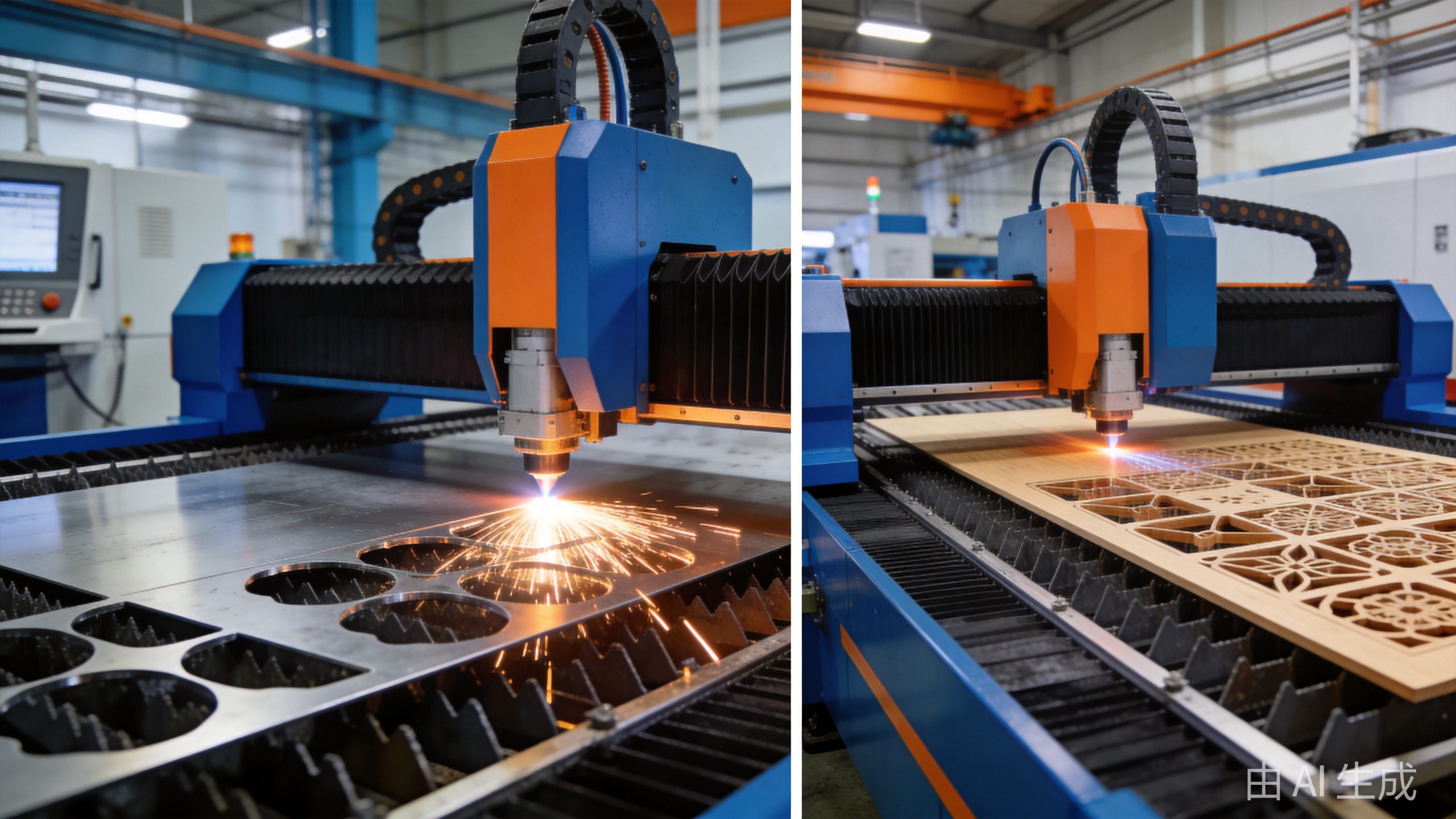
When it comes to laser cutting machines, the two most common technologies are fiber laser and CO2 laser. Both have been around for decades, both can cut a wide range of materials, and both are widely used in manufacturing and fabrication shops worldwide.
But which one is right for your business? The answer depends on what materials you cut, how thick they are, your production volume, and your budget.
In this comprehensive comparison, we break down the key differences between fiber laser and CO2 laser cutting machines across every dimension that matters — from cutting speed and material capability to operating cost, maintenance requirements, and return on investment.
Quick Summary
| Factor | Fiber Laser | CO2 Laser |
|---|---|---|
| Best for | Metal cutting (thin to medium thickness) | Non-metals + thick metal |
| Typical power range | 1000W – 12000W+ | 150W – 6000W |
| Cutting speed (thin metal) | 3–10x faster | Slower |
| Cutting quality | Excellent edge quality, smooth cuts | Good, but more dross on thin metal |
| Material versatility | Metals + some plastics | Metals, wood, acrylic, fabric, leather, glass |
| Operating cost | Lower (higher efficiency, less maintenance) | Higher (more consumables, more maintenance) |
| Upfront cost | Higher | Lower |
| Beam wavelength | 1064 nm (near infrared) | 10,600 nm (far infrared) |
| Maintenance | Minimal (no mirrors, sealed fiber) | Regular (mirror alignment, tube replacement) |
1. How They Work: The Core Difference
Fiber Laser Cutting
A fiber laser uses optical fiber doped with rare-earth elements (like erbium, ytterbium, or neodymium) as the gain medium. The laser beam is generated inside the fiber and delivered through a flexible fiber optic cable to the cutting head.
- Wavelength: ~1064 nm (near infrared)
- Beam delivery: Flexible fiber optic cable — no mirrors to align
- Efficiency: 25–40% wall-plug efficiency
- Spot size: Very small (0.05–0.2mm typical) — excellent for fine detail
CO2 Laser Cutting
A CO2 laser uses a gas mixture (primarily carbon dioxide, nitrogen, and helium) as the gain medium, excited by electrical discharge. The beam is delivered through a series of mirrors to the cutting head.
- Wavelength: 10,600 nm (far infrared)
- Beam delivery: Mirrors and beam path — requires alignment
- Efficiency: 8–15% wall-plug efficiency
- Spot size: Larger (0.1–0.3mm typical) — good for thicker materials
2. Cutting Speed Comparison
Cutting speed is where fiber lasers have the biggest advantage — especially on thin to medium metal sheets.
Mild Steel Cutting Speed (approximate)
| Thickness | Fiber Laser (1500W) | CO2 Laser (1500W) | Fiber Advantage |
|---|---|---|---|
| 1 mm | ~12 m/min | ~3 m/min | 4x faster |
| 3 mm | ~6 m/min | ~2 m/min | 3x faster |
| 5 mm | ~3 m/min | ~1.5 m/min | 2x faster |
| 10 mm | ~1.2 m/min | ~0.8 m/min | 1.5x faster |
| 20 mm | ~0.4 m/min | ~0.35 m/min | Roughly equal |
Key Takeaway:
- On thin metal (≤5mm): Fiber lasers are dramatically faster — often 3–10x the speed of equivalent-power CO2 lasers
- On medium metal (5–12mm): Fiber is still faster, but the gap narrows
- On thick metal (>15mm): CO2 lasers can match or slightly exceed fiber laser cut quality, though speed is similar
- The thinner the material, the bigger the fiber laser speed advantage
This speed difference translates directly to production capacity. A 1500W fiber laser can produce 2–4x more parts per day than a 1500W CO2 laser on typical sheet metal work.
3. Material Capability
What Fiber Lasers Cut Best:
Metals (excellent results):
- Mild steel / carbon steel (up to 25–50mm depending on power)
- Stainless steel (up to 20–40mm)
- Aluminum (up to 15–30mm)
- Copper and brass (up to 8–15mm — reflective but manageable)
- Galvanized steel
Other materials (limited):
- Some plastics and polymers
- Thin wood and paper (can burn edges)
- Not ideal for acrylic (melts rather than cuts cleanly)
What CO2 Lasers Cut Best:
Non-metals (excellent results):
- Acrylic / PMMA (polished edge quality)
- Wood, plywood, MDF
- Fabric, leather, textiles
- Paper, cardboard
- Glass (engraving and some cutting)
- Rubber, foam
Metals (good results):
- Mild steel (up to 25–50mm)
- Stainless steel (up to 15–30mm)
- Aluminum (up to 10–20mm)
- Copper and brass (limited — highly reflective at CO2 wavelength)
Key Takeaway:
- If you cut mostly or only metal: Fiber laser is the clear choice
- If you cut mostly non-metals (acrylic, wood, fabric): CO2 laser is better
- If you cut both metal and non-metal: You may need both, or choose based on your primary material
4. Cut Quality Comparison
Fiber Laser Cut Quality
- Smoother edges on thin metal — less dross, cleaner finish
- Narrower kerf (cut width) — less material waste, finer detail capability
- Better precision — smaller spot size = more accurate cuts
- Less taper — more perpendicular cut edges, especially on thin material
- Excellent for fine features — small holes, narrow slots, intricate patterns
CO2 Laser Cut Quality
- Smoother on thick metal — CO2 often produces a smoother edge on steel >15mm
- Polished edge on acrylic — CO2 wavelength is ideal for acrylic, producing a flame-polished edge
- Wider kerf — more material removed per cut
- Good for engraving — CO2 lasers excel at engraving on wood, acrylic, and other non-metals
Key Takeaway:
For metal cutting, especially thin sheet metal, fiber lasers generally produce better edge quality with less post-processing needed. For acrylic and other non-metals, CO2 lasers produce superior results.
5. Operating Cost Comparison
Electricity Consumption
Fiber lasers are significantly more energy-efficient:
- Fiber laser: 25–40% wall-plug efficiency
- CO2 laser: 8–15% wall-plug efficiency
This means a fiber laser uses roughly 50–70% less electricity per watt of laser output. For a 3000W machine running 8 hours a day, this can add up to thousands of dollars per year in electricity savings.
Consumables
| Consumable | Fiber Laser | CO2 Laser |
|---|---|---|
| Laser source lifespan | 70,000–100,000 hours | 2,000–8,000 hours (tube) |
| Optics replacement | Rare (sealed fiber) | Regular (mirrors, lenses) |
| Nozzles | Yes (every 1–3 months) | Yes (every 1–3 months) |
| Protective windows | Yes (periodic) | Yes (periodic) |
| Gas (laser gas) | None | Yes (CO2 gas mixture, periodic refill) |
| Assist gas | Yes (nitrogen/oxygen/air) | Yes (nitrogen/oxygen/air) |
Maintenance Requirements
Fiber laser maintenance:
- Daily: Check nozzle, clean protective window
- Monthly: Clean optics, check alignment (minimal)
- Annual: Professional inspection, filter replacement
- No mirror alignment needed — fiber delivery is permanently aligned
CO2 laser maintenance:
- Daily: Check nozzle, clean lens
- Weekly: Mirror alignment check and cleaning
- Monthly: Full optics service, beam alignment
- Every 2–8 years: Laser tube replacement (major cost)
- Gas refill as needed
Key Takeaway:
Fiber lasers have significantly lower operating and maintenance costs. The sealed fiber delivery system eliminates the need for mirror alignment, and the laser source lasts 10–20x longer than a CO2 laser tube.
6. Upfront Cost
Fiber laser cutting machines generally cost more upfront than CO2 lasers with similar power output.
| Machine Type | Typical Price Range (1500W) |
|---|---|
| Fiber laser cutter (entry-level) | $20,000 – $40,000 |
| Fiber laser cutter (industrial) | $40,000 – $100,000+ |
| CO2 laser cutter (entry-level) | $5,000 – $15,000 |
| CO2 laser cutter (industrial) | $20,000 – $60,000 |
However, this comparison can be misleading because:
1. A 1500W fiber laser cuts much faster than a 1500W CO2 laser
2. Fiber lasers have lower operating costs
3. Fiber lasers require less maintenance and downtime
The real comparison should be based on cost per part or return on investment, not just purchase price.
7. Return on Investment (ROI)
Despite higher upfront costs, fiber lasers often deliver faster ROI for metal cutting businesses.
ROI Factors for Fiber vs. CO2:
| Factor | Fiber Laser Impact | CO2 Laser Impact |
|---|---|---|
| Production speed | 2–5x more parts per day | Baseline |
| Labor cost | Similar per hour, but fewer hours per part | More hours per part |
| Electricity | 50–70% lower | Baseline |
| Maintenance | Lower cost, less downtime | Higher cost, more downtime |
| Consumables | Lower (no tube replacement) | Higher (tube replacement every few years) |
| Cut quality | Less post-processing (deburring, grinding) | More post-processing |
Typical ROI Timeline:
- High-volume metal fabrication: Fiber laser ROI in 1–2 years
- Medium-volume job shop: Fiber laser ROI in 2–3 years
- Low-volume / mixed materials: CO2 laser may have better short-term ROI
When Fiber Makes Financial Sense:
- You cut metal for 20+ hours per week
- Most of your work is on sheet metal ≤10mm thick
- You’re currently outsourcing laser cutting or using older technology
- Production speed directly affects your revenue
8. Other Important Factors
Floor Space
Both types of machines have similar footprint requirements based on bed size. Fiber lasers may require slightly less auxiliary equipment (no laser gas system), but the difference is minimal.
Operator Skill
Both machines require trained operators. Fiber lasers are generally considered easier to set up and maintain because there’s no mirror alignment to worry about. Modern CNC control systems for both types are similarly user-friendly.
Resale Value
Fiber laser machines generally hold their value better than CO2 lasers because:
- Laser source lasts much longer
- Technology is newer and in higher demand
- Lower maintenance requirements mean more predictable condition
Future-Proofing
Fiber laser technology has been advancing rapidly, with power levels increasing and costs decreasing every year. CO2 technology is more mature and stable, with slower innovation. For a long-term investment, fiber lasers are generally considered more future-proof for metal cutting applications.
9. Which One Is Right for You?
Choose a Fiber Laser If:
- ✅ You primarily cut metal (steel, stainless, aluminum)
- ✅ Most of your material is ≤12mm thick
- ✅ Production speed is important to your business
- ✅ You want low maintenance and operating costs
- ✅ You’re looking for a long-term investment
- ✅ Fine detail and precision are important
Choose a CO2 Laser If:
- ✅ You primarily cut non-metals (acrylic, wood, fabric, leather)
- ✅ You need to cut a wide variety of materials
- ✅ You have a limited budget
- ✅ You cut thick metal (>15mm) regularly
- ✅ Engraving is a significant part of your business
Consider Both If:
- You cut both metal and non-metals in significant volume
- You have enough work to justify two machines
- You want the best quality for each material type
Hybrid Machines: Do They Work?
Some manufacturers offer “hybrid” machines that combine both fiber and CO2 lasers in one system. While these sound appealing, there are trade-offs:
- Pros: One machine cuts both metal and non-metal, saves floor space
- Cons: Higher cost, more complex maintenance, often compromises on both technologies, slower to switch between modes
For most businesses, two dedicated machines (one fiber, one CO2) will deliver better performance and reliability than a single hybrid machine — unless space is extremely limited.
Further Reading
Ready to dive deeper into fiber laser technology? Read our complete guide on how to choose a fiber laser cutting machine for a detailed breakdown of power levels, bed sizes, and key specifications.
Conclusion
The fiber laser vs. CO2 laser decision ultimately comes down to what materials you cut and how much you cut them.
For metal fabrication businesses, fiber laser cutting machines are almost always the better choice today. The higher upfront cost is offset by dramatically faster cutting speeds, lower operating costs, and less maintenance — typically delivering ROI in 1–3 years for active shops.
For businesses that primarily cut non-metals like acrylic, wood, or fabric, CO2 lasers remain the gold standard, delivering excellent cut quality at a lower price point.
Before making a decision, always request cutting samples on your actual materials from potential suppliers. Seeing real results on your parts is the best way to make an informed choice.
Still not sure which laser cutting technology is right for you? Contact our experts for a free consultation — we’ll help you compare options based on your specific materials and production needs.