Laser Welding in Automotive Manufacturing: Applications, Benefits & Trends
The automotive industry has always been at the forefront of manufacturing technology adoption, and laser welding is no exception. From body-in-white assembly to battery manufacturing for electric vehicles, laser welding has become an indispensable process in modern automotive production. Its combination of speed, precision, and automation-friendliness makes it ideal for the high-volume, high-quality demands of the auto industry.
In this comprehensive guide, we’ll explore how laser welding is used in automotive manufacturing, the key applications and benefits, current trends shaping the market, and what to consider when implementing laser welding in automotive production. Whether you’re an automotive engineer, a production manager, or a supplier looking to understand this technology, this guide covers everything you need to know.
Why Laser Welding for Automotive?
Automotive manufacturing demands the highest standards of quality, consistency, and efficiency. Laser welding delivers on all these fronts and more. Here’s why automakers have embraced it so widely:
Unmatched Speed and Productivity
Laser welding is significantly faster than traditional welding methods like MIG, TIG, or resistance spot welding. A fiber laser can weld at speeds of several meters per minute, and with remote scanning optics, it can jump between weld locations in milliseconds. This translates directly into higher production throughput — critical for an industry that produces millions of vehicles per year.
Superior Weld Quality and Strength
The focused laser beam produces deep, narrow welds with excellent penetration-to-width ratios. This means stronger welds with less heat input and distortion compared to conventional methods. For automotive applications where structural integrity and crash safety are paramount, laser welding provides consistent, high-quality results that are easy to validate.
Precision and Versatility
Laser welding can produce extremely precise welds in a wide range of materials and thicknesses. It can weld thin sheet metal without burn-through, and it can also handle thick structural components. The ability to precisely control heat input makes it suitable for joining dissimilar materials and for welding near heat-sensitive components.
Automation and Integration
Laser welding systems integrate seamlessly with robotics and automation — a perfect fit for highly automated automotive production lines. Robotic laser welding cells can operate 24/7 with minimal supervision, delivering consistent quality and predictable cycle times. Combined with vision systems and quality monitoring, they create a highly reliable manufacturing process.
Cost Efficiency
While the initial investment in laser welding equipment is higher than traditional welding methods, the total cost of ownership is often lower. Higher speeds mean fewer machines and less floor space. Lower consumable costs (no electrodes, no filler wire in many cases) and reduced rework further contribute to savings. Over the life of a production line, laser welding typically delivers a strong return on investment.
Key Applications in Automotive Manufacturing
Laser welding is used throughout the vehicle manufacturing process. Here are the most important applications:
1. Body-in-White (BIW) Assembly
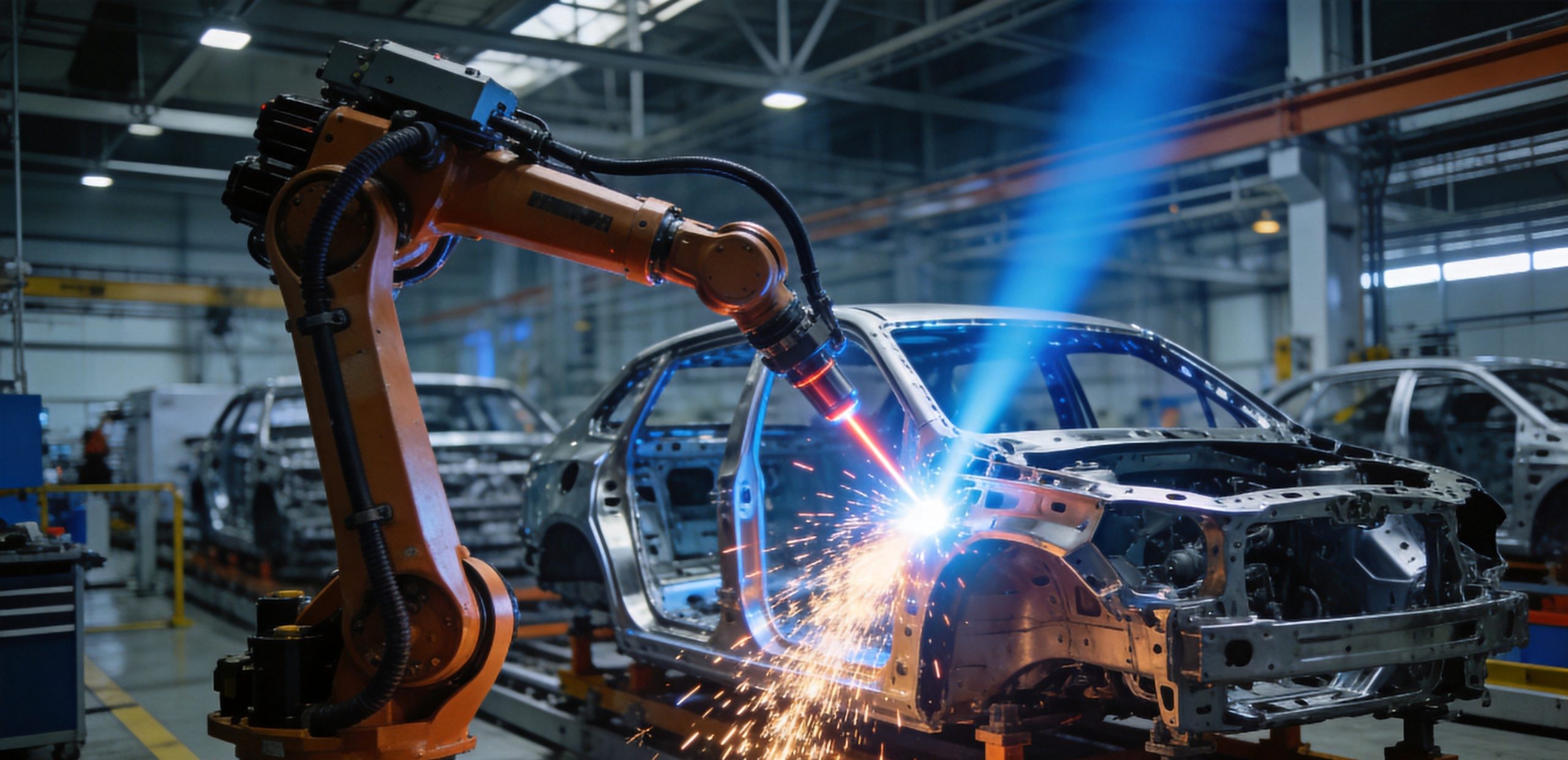
This is the largest application area for laser welding in automotive manufacturing. Body-in-white refers to the stage where the car’s metal body structure is assembled before painting.
- Laser brazing: Widely used for joining roof panels to side frames, trunk lids, and door frames. Laser brazing produces a smooth, clean joint that requires minimal finishing before painting — a major advantage for visible body panels.
- Laser welding of structural components: Used for frame rails, pillars, crossmembers, and other structural parts where strength and precision are critical.
- Tailored welded blanks (TWBs): Sheets of different thicknesses or materials are laser-welded together before stamping. This allows manufacturers to use material only where it’s needed, reducing weight and cost while maintaining strength in critical areas.
- Remote laser welding (RLW): Uses a scanning optic to rapidly move the laser beam between weld points. Ideal for welding dozens of spots on a body panel in seconds, much faster than resistance spot welding.
Major automakers like Volkswagen, BMW, Mercedes-Benz, and Tesla have invested heavily in laser welding for body assembly, with some vehicles featuring hundreds of laser welds per body.
2. Powertrain Components
Laser welding plays a crucial role in manufacturing engine and transmission components:
- Engine components: Cylinder heads, valve seats, piston rings, and exhaust manifolds are commonly laser welded. The precision of laser welding is essential for these high-temperature, high-stress components.
- Transmission parts: Gears, shafts, clutch components, and torque converters all benefit from laser welding’s ability to produce strong, distortion-free joints in hardened steels.
- Exhaust systems: Laser welding provides leak-tight joints in stainless steel exhaust components, with minimal heat distortion and excellent corrosion resistance.
3. Electric Vehicle (EV) Battery Manufacturing
The rapid growth of electric vehicles has created a huge new demand for laser welding. Battery manufacturing requires precise, reliable welding of thin, conductive materials — exactly what fiber lasers excel at.
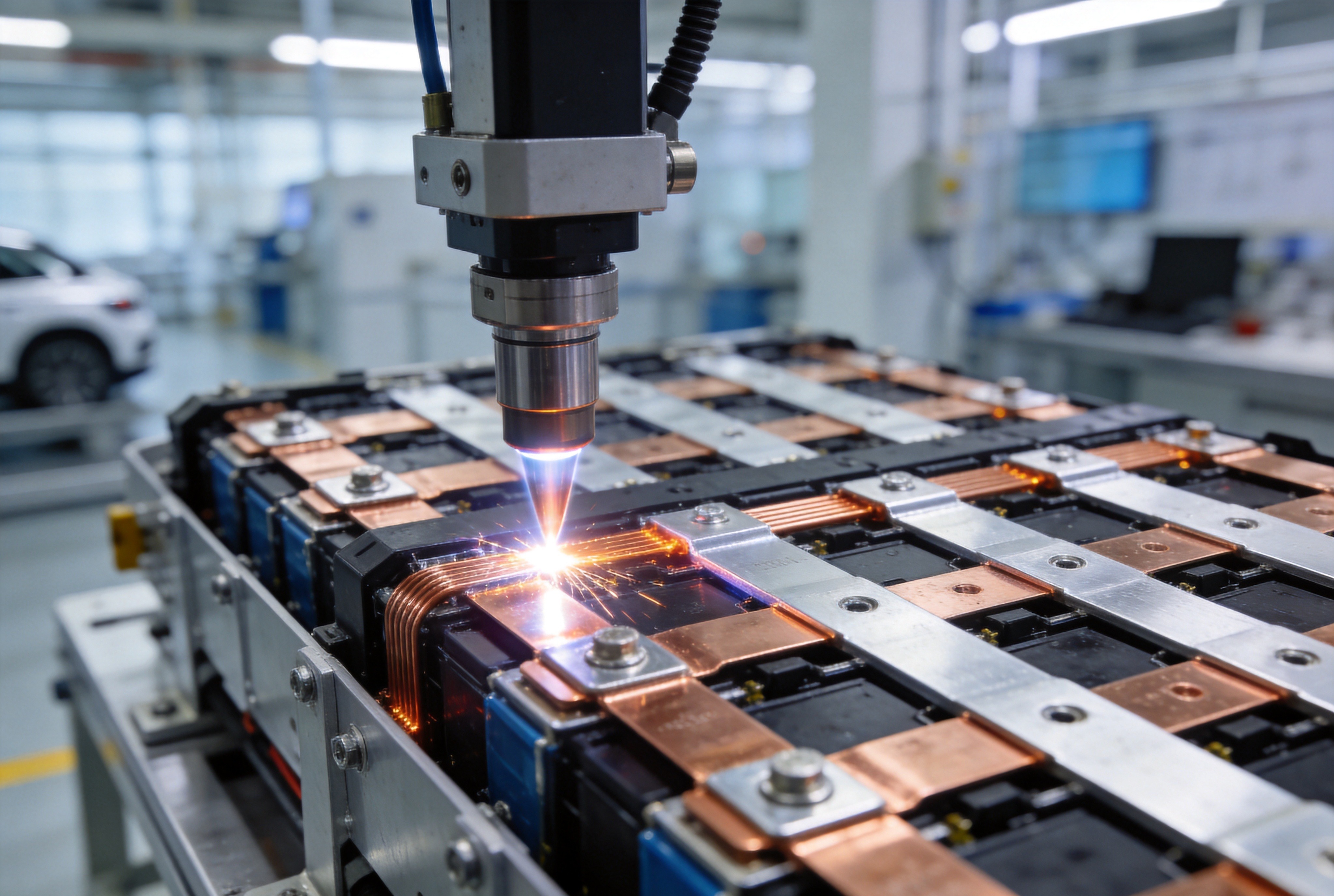
- Battery cell assembly: Laser welding is used to join battery tabs, busbars, and cell cans. The ability to weld thin copper and aluminum foils without damaging the delicate cell components is critical.
- Battery module and pack assembly: Welding busbars, cooling plates, and structural components in battery modules and packs. High-speed, high-quality welds are essential for electrical conductivity and thermal management.
- Battery enclosure welding: Hermetic sealing of battery packs and modules to protect against moisture and contaminants. Laser welding provides a reliable, leak-tight seal.
- Tab-to-busbar welding: One of the most critical and challenging applications, joining thin copper or aluminum tabs to thicker busbars. Laser welding handles this with precision and speed.
As EV production volumes continue to grow, battery laser welding is becoming one of the fastest-growing application areas. Companies like Transon Laser are developing specialized laser welding systems optimized for battery manufacturing applications.
4. Chassis and Suspension Components
- Hydroformed components: Laser welding is used to join hydroformed tubes and structures, where access is limited and precision is essential.
- Aluminum chassis parts: As automakers use more aluminum to reduce weight, laser welding has become the preferred joining method due to its ability to produce high-quality aluminum welds.
- Subframes and control arms: Lightweight, high-strength chassis components benefit from laser welding’s combination of speed and structural integrity.
5. Interior and Trim Components
- Instrument panel components: Laser welding of plastic components using through-transmission laser welding (TTLW).
- Door panels and trim: Joining plastic interior components with clean, strong welds that don’t require adhesives or fasteners.
- Lighting components: Hermetic sealing of headlight and taillight assemblies using laser welding of clear and colored plastics.
Key Benefits for Automotive Manufacturers
Weight Reduction
Every kilogram of weight saved improves fuel efficiency (or extends EV range). Laser welding enables weight reduction in several ways:
- Tailored welded blanks allow variable thickness — only using material where strength is needed
- Laser welding works well with lightweight materials like aluminum and magnesium
- Strong, reliable welds mean designers can optimize part geometry for minimum weight
- Overlap joints can be replaced with butt joints, reducing material overlap
Automakers using laser welding have achieved body-in-white weight reductions of 10–20% compared to traditional construction methods.
Improved Structural Integrity and Safety
Laser welds are typically stronger and more consistent than resistance spot welds or MIG welds. The deep penetration characteristic of laser welding creates a strong bond through the full material thickness, which is especially important for crash safety structures. Modern vehicles with laser-welded bodies consistently achieve top safety ratings.
Better Surface Quality
Laser brazing produces smooth, aesthetically pleasing joints on visible body panels. Unlike spot welding, there are no dimples or indentations to fill and smooth before painting. This reduces rework and improves overall build quality.
Flexibility and Adaptability
Laser welding systems can be quickly reprogrammed for different parts and models. This is increasingly important as automakers move toward more flexible production lines that can build multiple vehicle models on the same line. With robotic laser welding, changing from one model to another is just a software update away.
Lower Operating Costs
While the capital investment is significant, laser welding reduces operating costs through:
- Lower consumable costs (no electrodes, less filler wire)
- Less rework and scrap due to higher first-pass quality
- Higher throughput means fewer production lines needed
- Reduced labor requirements in fully automated cells
- Lower energy consumption compared to resistance welding for equivalent work
Current Trends and Developments
1. The EV Revolution
Electric vehicles are driving massive growth in automotive laser welding. Battery manufacturing alone has created an entirely new market for laser welding equipment. Key challenges in this area include:
- Welding thin, highly reflective materials like copper and aluminum
- Ensuring consistent electrical conductivity of welds
- Welding dissimilar materials (copper to aluminum, steel to aluminum)
- High-volume production demands (millions of welds per year)
- Quality assurance — every weld must be perfect for safety and reliability
Blue lasers and green lasers are emerging as alternatives to infrared fiber lasers for copper welding, as they are absorbed much better by copper. However, infrared fiber lasers with advanced beam shaping are still the dominant technology due to their maturity, reliability, and cost-effectiveness.
2. Remote Laser Welding (RLW)
Remote laser welding uses a scanning optic (galvo scanner) to move the laser beam rapidly over the workpiece, rather than moving the entire robot arm. This allows welds to be placed in milliseconds, dramatically increasing productivity. A single RLW station can replace multiple resistance spot welding robots.
Recent advancements in scanner technology and higher laser powers are making RLW even more capable, with larger working areas and faster positioning speeds.
3. Aluminum and Multi-Material Joining
As automakers pursue lightweighting goals, they’re increasingly using aluminum and multi-material construction. Laser welding of aluminum presents challenges (high reflectivity, high thermal conductivity, hot cracking), but modern fiber lasers with optimized parameters and advanced beam shaping handle it well.
Laser welding of dissimilar materials (steel to aluminum, copper to aluminum) is an active area of research and development. While challenges remain, techniques like laser brazing, friction stir welding hybrid processes, and advanced beam control are making it increasingly practical.
4. Quality Monitoring and AI
Modern laser welding systems are increasingly equipped with advanced monitoring systems that track weld quality in real time. These systems use cameras, spectrometers, and photodiodes to monitor the weld pool and detect defects. Artificial intelligence and machine learning algorithms are being applied to analyze this data and automatically identify quality issues.
This is especially important for battery manufacturing, where a single bad weld can cause a safety hazard. In-line quality monitoring reduces the need for destructive testing and ensures that every weld meets specifications.
5. Higher Power Lasers
Laser power levels in automotive manufacturing continue to increase. Where 2–4 kW was once standard, 6–10 kW systems are now common, and 15–20 kW systems are entering production. Higher power means faster welding speeds and the ability to weld thicker materials in a single pass.
Challenges and Considerations
While laser welding offers many advantages, it’s not without challenges. Here’s what automotive manufacturers need to consider:
Initial Investment Cost
Laser welding systems require a significant upfront investment — typically several hundred thousand dollars per cell for a robotic system, and millions for a complete production line. However, the productivity and quality gains usually justify the investment for high-volume production.
Precise Fixturing Required
Laser welding requires very precise part positioning and fixturing. Because the laser beam is focused to a small spot, even small gaps or misalignment can cause weld defects. This means tooling and fixturing must be designed and built to tight tolerances, which adds to the upfront cost.
Safety Considerations
High-power industrial lasers are Class 4 laser products and require proper safety measures. Enclosures, interlocks, and personal protective equipment are necessary. Automated laser welding cells must be properly guarded to prevent accidental exposure.
Operator Skill and Training
Operating and maintaining laser welding systems requires specialized knowledge and training. While the actual welding is automated, setting up parameters, maintaining the system, and troubleshooting problems demand skilled technicians.
Material and Joint Design
Not all materials and joint designs are suitable for laser welding. Materials that are highly reflective (copper, silver) or prone to hot cracking (certain aluminum alloys) require special techniques. Joint design must account for the laser’s deep, narrow weld profile.
For manufacturers working with suppliers like Transon Laser, these challenges can be addressed through proper application engineering and process development. A good supplier will work with you to optimize parameters, design fixtures, and train your team.
The Future of Laser Welding in Automotive
The role of laser welding in automotive manufacturing will only grow in the coming years. Here’s what we can expect:
- EV production growth will continue to drive demand for laser welding equipment, especially for battery applications. The global EV laser welding market is projected to grow at double-digit rates through the rest of the decade.
- Higher levels of automation with more integrated quality monitoring, predictive maintenance, and self-optimizing process parameters.
- New laser technologies like blue and green lasers will find niches in copper welding, while infrared fiber lasers will continue to dominate most applications due to their maturity and cost-effectiveness.
- Digitalization and Industry 4.0 integration — laser welding cells will be fully connected, with real-time data collection, remote monitoring, and cloud-based analytics.
- More materials and applications — as laser technology advances, it will be applied to an even wider range of materials and components, including more plastic welding, additive manufacturing hybrid processes, and in-situ repair.
For automakers and suppliers, staying competitive means investing in laser welding capability now. The technology is mature, reliable, and proven in the most demanding production environments. Companies that master laser welding will have a significant advantage in quality, cost, and innovation.
How Transon Laser Supports the Automotive Industry
Transon Laser is a leading supplier of laser welding equipment for automotive applications. Our machines are used by automotive parts manufacturers, Tier 1 suppliers, and custom fabrication shops around the world.
Our automotive solutions include:
- Handheld laser welders (TS-FW series): Ideal for low-volume production, prototyping, repair work, and job shops serving the automotive industry. Available in 1000W, 1500W, 2000W, and 3000W configurations.
- Automatic laser welding cells: Custom-engineered welding systems with rotary tables, fixtures, and robotic integration for medium to high-volume production.
- Battery welding solutions: Specialized systems for battery tab welding, busbar welding, and battery pack assembly.
- Application development support: Our engineering team works with customers to develop optimal welding parameters and process solutions for specific automotive applications.
- Global service and support: With customers in over 50 countries, we provide installation, training, and ongoing technical support worldwide.
Whether you’re setting up a new production line, upgrading an existing one, or just exploring what laser welding can do for your automotive applications, contact the Transon Laser team for expert advice and a free consultation.
Frequently Asked Questions
How fast is laser welding compared to resistance spot welding?
Laser welding is typically 2–5x faster than resistance spot welding for equivalent applications. With remote laser welding (scanning optics), it can be even faster because the beam moves between weld points in milliseconds rather than waiting for a robot arm to reposition. A single remote laser welding station can often replace 3–6 spot welding robots.
Can laser welding replace all spot welding in auto body assembly?
Not entirely — at least not yet. While laser welding has replaced many spot welds in modern vehicles, spot welding is still used in some areas, especially for thick structures and certain high-volume applications where spot welding remains cost-effective. However, the trend is clearly toward more laser welding and fewer spot welds per vehicle.
What types of lasers are used in automotive manufacturing?
Fiber lasers are the dominant technology for most automotive welding applications today, due to their high efficiency, reliability, and good beam quality. CO2 lasers were more common in the past but are being replaced by fiber lasers in most new installations. Nd:YAG lasers are still used in some older systems. Blue and green lasers are emerging for copper welding in battery applications.
Is laser welding safe for automotive workers?
Yes, when proper safety measures are in place. In automated production cells, laser welding is fully enclosed with safety interlocks, making it a Class 1 laser product (safe for normal operation). Workers may need laser safety glasses for setup, maintenance, or manual laser welding operations. Fume extraction is also important to remove welding fumes.
How much does an automotive laser welding system cost?
It varies enormously depending on the configuration. A basic handheld laser welder suitable for prototyping or low-volume work costs $8,000 – $25,000. A robotic welding cell for production starts around $50,000 – $150,000. Complete automated production lines with multiple robots, fixtures, and material handling can cost $500,000 to several million dollars. Contact Transon Laser for a quote tailored to your specific application.
Conclusion
Laser welding has transformed automotive manufacturing, enabling lighter, stronger, higher-quality vehicles produced at higher speeds and lower cost. From body-in-white assembly to battery manufacturing for electric vehicles, laser technology is now deeply embedded in the automotive production process — and its role continues to expand.
The shift toward electric vehicles is accelerating this trend, as battery manufacturing creates massive new demand for precision laser welding of thin, conductive materials. At the same time, advancements in remote welding, quality monitoring, and AI are making laser welding systems more capable and productive than ever.
For automakers, suppliers, and contract manufacturers, investing in laser welding capability is no longer optional — it’s essential for staying competitive in a rapidly evolving industry. Working with an experienced supplier like Transon Laser ensures you get the right equipment, process development support, and ongoing service to maximize the return on your investment.
For more insights into laser technology in manufacturing, check out these related articles:
- Laser Welding vs TIG vs MIG: Complete Comparison
- Laser Industry Trends 2026–2027: What Metal Fabricators Need to Know
- How Much Does a Handheld Laser Welding Machine Cost?
If your line handles EV battery components, the same laser principles apply at a different scale and precision bar. Our guide to laser technology in EV battery manufacturing covers how electrode cutting, tab and busbar welding, wobble welding, surface cleaning, and traceability marking are handled in modern battery production.
For a detailed breakdown of equipment options and what to look for when buying, see our laser welding machine buyer’s guide—it covers power levels, machine types, and supplier evaluation criteria in detail.
The same precision welding and traceability challenges that shape automotive production also govern medical device manufacturing, as explored in our laser technology in medical device manufacturing.
The laser welding processes used in automotive body assembly share fundamental principles with aerospace structural welding, though the scale and regulatory requirements differ significantly, as discussed in our laser technology in aerospace manufacturing.